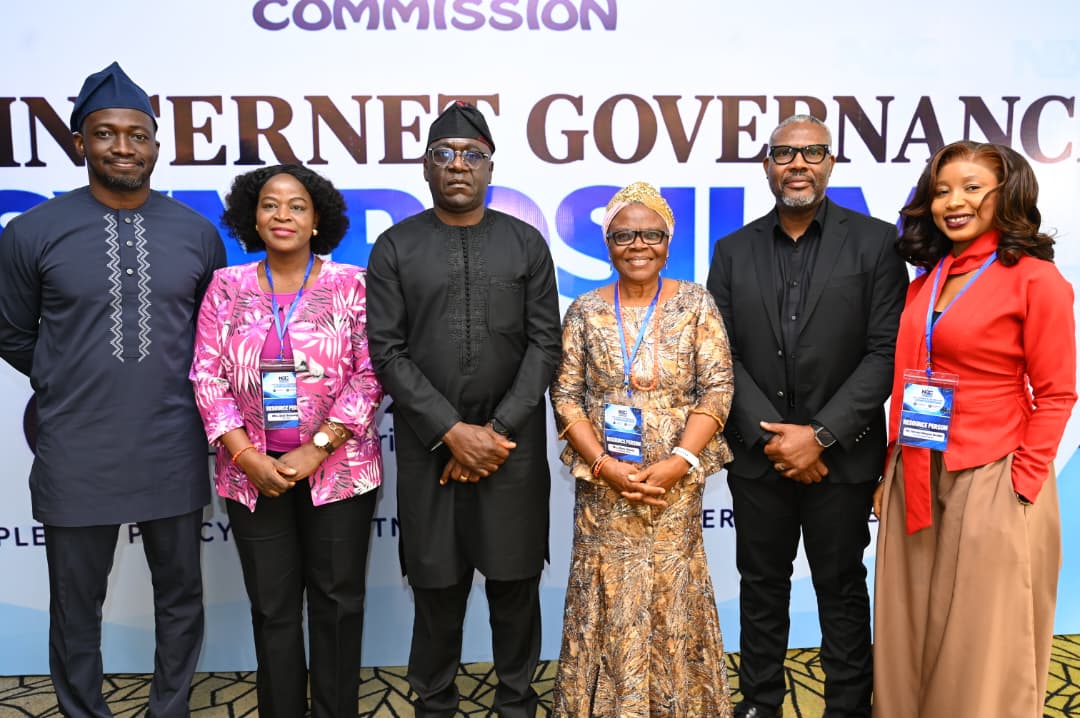
L- R: Mr. Dewole Ajao, Board Member, African Network Information Centre; Mrs. Seyi Onasanya, Chief Operating Officer, Nigeria Internet Registration Association (NIRA); Engr. Abraham Oshadami, Executive Commissioner, Technical Services, Nigerian Communications Commission, (NCC); Mrs. Mary Uduma, Coordinator, West Africa Internet Governance Forum; Mr. Tony Emoekpere, President Association of Telecom Companies of Nigeria (ATCON); Ms. Atinuke Ibrahim, Representating Association of Licensed Telecommunications Operators of Nigeria, (ALTON), during the NCC Internet Governance Symposium 2026, at Radisson Blu, Ikeja, Lagos.
From John Silas, Lagos
Nigerian Communications Commission (NCC) has launched the Internet Governance Working Group (IGWG) to strengthen stakeholder participation in Internet governance and promote a safer, more secure and responsible digital environment in Nigeria.
The initiative was unveiled on Thursday, at the Commission’s inaugural Internet Governance Symposium in Lagos.
Speaking at the event, the Executive Commissioner, Technical Services, NCC, Engr. Abraham Oshadami, who delivered the opening address on behalf of the Executive Vice Chairman of the NCC, Dr Aminu Maida, said the working group would provide a continuing platform for stakeholder engagement beyond the symposium.
He said the initiative was designed to strengthen collaboration among government, industry, the technical community, academia and civil society on issues shaping the future of the Internet.
According to him, decisions about the Internet go beyond telecommunications infrastructure, as they affect economic opportunities, public trust, security and the rights of users.
He stressed the need for Nigeria’s communications sector to contribute its practical experience to national, regional and global Internet governance discussions and translate the outcomes into meaningful action.
The Executive Commissioner noted that the growing influence of artificial intelligence (AI) had made collaboration among stakeholders increasingly important.
He explained that while AI was transforming how people learn, work, communicate and access services, it was also raising concerns about harmful content, fraud, privacy, accountability and the protection of children and other vulnerable users.
“These questions cannot be answered by one institution alone. They require informed dialogue and cooperation across the communications sector and beyond,” he said.
The commissioner added that the symposium provided an opportunity for stakeholders to examine emerging challenges and develop practical approaches to Internet governance, including responsible AI deployment and online safety.
He also highlighted the importance of the Internet Code of Practice (ICOP) 2026, which provides a framework for promoting a safer and more responsible online environment.
According to him, the successful implementation of the code will require clear expectations, meaningful engagement with affected stakeholders and consistent enforcement of applicable obligations.
He further drew attention to the Cyber Resilience Framework for the Nigeria Communication Sector (CRF-NCS), which seeks to strengthen the security and resilience of infrastructure supporting digital services.
He said both initiatives reflected the Commission’s commitment to ensuring that Nigerians could use the Internet with greater confidence.
The symposium, held under the theme “Strengthening sector participation in Internet Governance processes,” also examined Nigeria’s role in global Internet governance discussions, private sector participation and the security of critical Internet resources.
Other areas of focus included the .ng country-code domain, Domain Name System (DNS) security, domain name abuse and implementation requirements under ICOP 2026.
Participants were also expected to discuss developments following the 20-year review of the World Summit on the Information Society (WSIS+20) and developments at the Internet Governance Forum (IGF).
A presentation of stakeholder survey results on private sector participation formed part of the programme, with discussions focusing on barriers preventing organisations from participating consistently in Internet governance processes.
The symposium also featured expert presentations and panel discussions, with participants expected to adopt a joint communiqué outlining agreed priorities, resolutions and key actions.
The NCC said the working group would help sustain engagement among stakeholders, provide a channel for contributions and support follow-through on agreed priorities.
The initiative is expected to strengthen cooperation across the communications sector and ensure that Nigeria’s perspectives and priorities receive greater attention in discussions shaping the Internet’s future.