By Stella Odueme
Managing Partner of Sahel Capital, Mezuo Nwuneli, has praised the National Agricultural Development Fund (NADF) for its interventions aimed at tackling critical challenges in Nigeria’s agricultural sector.
Nwuneli described NADF as a strategic partner in promoting sustainable agricultural development, citing its interventions in ginger production, provision of farm inputs and promotion of irrigation as evidence of its commitment to improving agricultural productivity.
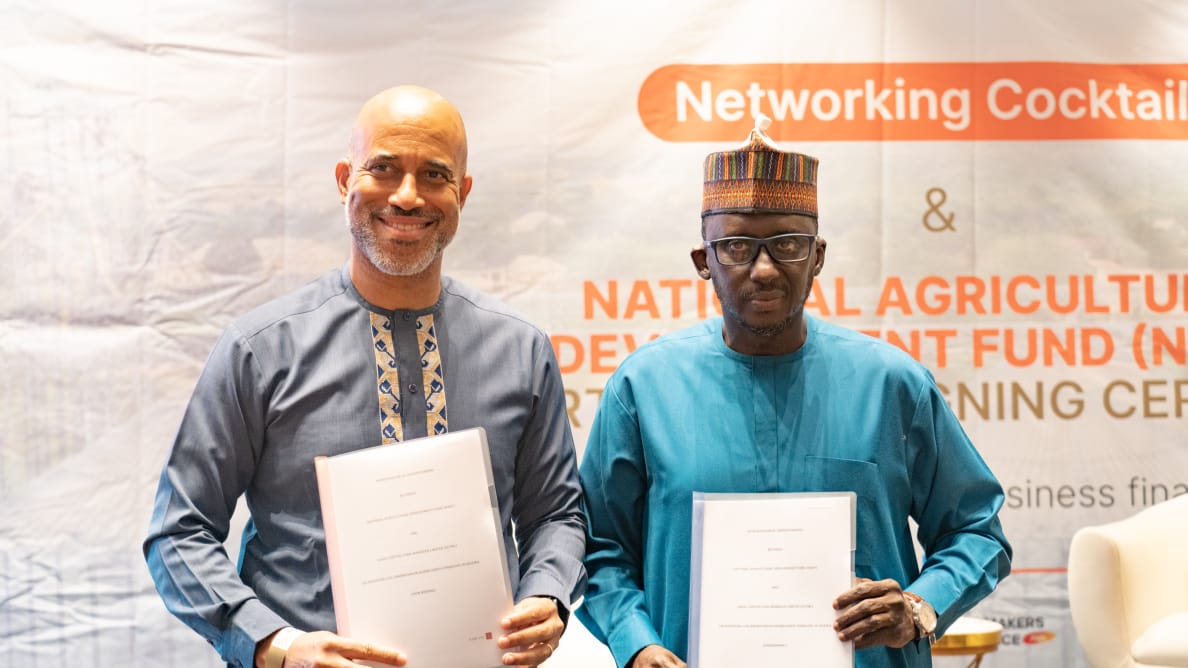
He spoke during the signing of a Memorandum of Understanding (MoU) between NADF and Sahel Capital Fund Manager Limited to explore opportunities for expanding financing to agribusinesses across the country.
According to a statement on Friday, he said Sahel Capital was encouraged by NADF’s deliberate efforts to address challenges within the agricultural ecosystem and its commitment to delivering measurable impact.
According to him, the partnership will concentrate on two key areas: reducing the cost of financing for agribusinesses and identifying critical challenges affecting agricultural productivity and value chains.
Nwuneli explained that many small and medium-sized agribusinesses currently access loans at interest rates of between 24 and 27 per cent, making it difficult for them to expand operations and invest in growth.
He said the collaboration would enable NADF to provide capital alongside Sahel Capital, thereby lowering the blended cost of financing for eligible businesses.
He noted that access to cheaper financing would improve the viability of agribusinesses and allow them to channel more resources towards expansion and development.
Nwuneli further disclosed that Sahel Capital had made 45 investments across eight African countries over the past 15 years, providing growth equity and private credit to businesses with annual revenues ranging from N500 million to N20 billion.
He said the firm would bring its investment experience and expertise in different agricultural value chains to support the development of Nigeria’s agricultural sector.
In his remarks, the Executive Secretary of NADF, Muhammed Ibrahim, said the partnership represented a shift from conventional agricultural lending towards building a sustainable investment ecosystem capable of attracting more capital into the sector.
Ibrahim observed that although agriculture was often regarded as a high-risk investment area, it offered enormous opportunities that could be unlocked through appropriate financing arrangements and strategic partnerships.
He said NADF would contribute its development mandate, catalytic financing capacity and knowledge of national agricultural priorities, while Sahel Capital would provide market intelligence, investment expertise and experience across agricultural value chains.
“The agricultural sector is often viewed through the lens of risk, but beyond those risks lie enormous opportunities. What we are doing with Sahel Capital is a deliberate shift from simply financing agriculture to building an investment ecosystem where capital can flow sustainably into the sector, attract more investors and support the growth of agribusinesses,” he said.
According to Ibrahim, combining public-sector and concessionary capital with private investment expertise would help establish a sustainable financing structure capable of attracting institutional investors.
The partnership is expected to explore blended financing arrangements, including concessional funding and risk-sharing mechanisms, to improve access to capital for eligible agricultural businesses.
Other areas of cooperation will include identifying bankable agribusiness projects, information sharing, technical assistance and capacity building.
Ibrahim expressed optimism that the collaboration would strengthen investment flows into Nigeria’s agricultural sector and create opportunities for the growth of agribusinesses.es.