By Felix Khanoba
Former Vice President Atiku Abubakar has identified the failure to adequately educate, employ and empower young Nigerians as the country’s most pressing national challenge, warning that the nation’s growing youth population could become a source of instability if not properly harnessed.
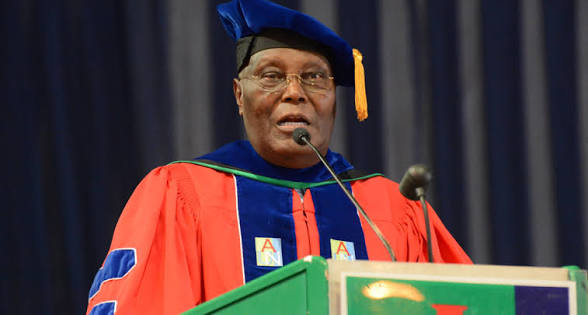
Atiku, founder of the American University of Nigeria (AUN), Yola, Adamawa State, made the observation during the institution’s 18th Founder’s Day celebration in Yola on Saturday.
Represented by his vice-presidential running mate, Rotimi Amaechi, the former Vice President urged the country to move away from short-term consumption-driven policies and prioritise sustainable investment in human capital development.
The celebration featured tributes to Atiku in recognition of his vision, leadership, generosity and contributions to education and national development. Members of the university community also prayed for the continued realisation of his aspirations for future generations.
In his address, Atiku described Nigeria’s expanding youth population as both an opportunity and a challenge that demands urgent and deliberate national action.
He noted that although the country is richly endowed with natural resources and cultural influence, its greatest strength lies in its young population, whose potential must be developed through quality education, skills acquisition and meaningful employment.
According to him, Nigeria must make a deliberate choice between transforming its youthful population into a productive and skilled workforce or allowing neglect to deepen poverty, insecurity and social discontent.
Atiku maintained that economic prosperity cannot be achieved through consumption alone, stressing that sustainable development depends on creating value through productive activities.
He also criticised the overemphasis on obtaining academic certificates without corresponding practical skills, arguing that educational qualifications must translate into demonstrable competence and the ability to solve real-life problems.
The former Vice President further highlighted the growing influence of emerging technologies, including Artificial Intelligence (AI), robotics, biotechnology and digital networks, urging African countries to develop the capacity to create technology rather than remain dependent on imported innovations.
“We need Nigerian solutions for Nigerian problems and challenges,” Atiku stated, advocating the deployment of digital technologies to improve agricultural production, rural education, public health information systems and access to locally generated clean energy.
He warned that unequal access to technology could further widen the gap between privileged and disadvantaged groups, while the absence of strong ethical and institutional safeguards could expose societies to misinformation, privacy violations and the manipulation of corporate and democratic institutions.
Addressing the students, Atiku urged them to approach their careers with an entrepreneurial mindset, describing each individual as an enterprise whose future should be built around problem-solving, integrity and the ability to address local needs rather than an obsession with prestigious brands or corporate indicators.
Earlier, the President of AUN, Prof. Dwayne Frazier, expressed the university’s appreciation to its founder for his years of commitment and investment in the institution.
Reflecting on the significance of the university’s establishment, Frazier said, “But what if the university wasn’t here? I think of our students as much as our own faculty. That is my founder’s dream.”
He disclosed that the institution allocates 30 per cent of its scholarships to students from the host community, explaining that its community engagement initiatives are guided by the needs and priorities of residents.
“Our work begins by asking our neighbors what they need and listening to what they tell us. Then we ask, what can we do together? This is how a university learns its place in the community relationship.”
Frazier also highlighted the university’s community development interventions, including its Feed and Read programme, designed to help reduce the number of out-of-school children in Adamawa State.
Other initiatives, he said, include free medical services and academic quiz competitions for secondary school students in Yola and other local government areas.
Delivering the Founder’s Day Lecture, the Founder and Chairman of United Nigeria Airlines, Prof. Obiora Okonkwo, commended Atiku for his contributions to education and national development, describing his university initiative as a lasting investment in the future.
Speaking on the theme, “Purposeful Education and the 21st-Century University: Leadership, Innovation and Social Responsibility,” Okonkwo said the AUN experience demonstrated that the vision behind establishing a university must extend beyond its formal inauguration.
He explained that such a vision must be sustained through relevant academic programmes, quality faculty recruitment, student welfare, effective governance, infrastructure development, research and meaningful engagement with surrounding communities.
Okonkwo, a Professor of Entrepreneurship at the University of Abuja, also identified entrepreneurship as a critical component of innovation, particularly in an economy where the formal employment sector may be unable to accommodate all university graduates.
“But entrepreneurial education should not be reduced to instructing every student to become a business owner. It should cultivate opportunity recognition, resourcefulness, financial literacy, design thinking, collaboration, resilience, and value creation,” he added.
The celebration also featured the presentation of gifts to Atiku, certificates to winners of the Science, Technology, Engineering and Mathematics (STEM) quiz competition, and awards recognising staff members for outstanding performance and long service to the university.