By Stella Odueme
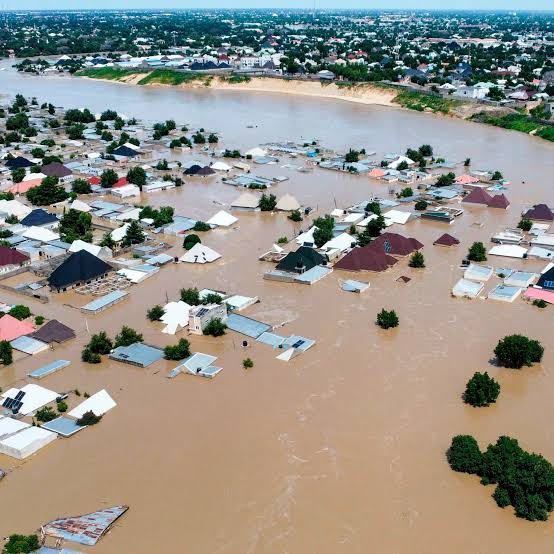
The Federal Government has raised alarm over heightened flood risks across Nigeria in 2026, revealing that over 14,000 communities in 33 states and the Federal Capital Territory (FCT) fall within high-risk flood zones.
This was disclosed on Wednesday during the presentation of the 2026 Annual Flood Outlook (AFO) by the Nigeria Hydrological Services Agency (NIHSA) at the State Banquet Hall, Aso Villa, Abuja.
President Bola Ahmed Tinubu, who was represented by the Minister of Environment, Balarabe Abbas Lawal described the event as a significant milestone in the administration’s efforts to strengthen national resilience against flooding and climate-related disasters.
The President noted that flood management remains a critical national challenge, and highlighted that his administration has implemented key policy frameworks and programmes, including nationwide flood control projects, with special focus on high-risk states such as Adamawa, Benue, Kogi, Bayelsa, Rivers, and Delta.
The Minister of Water Resources and Sanitation, Engr. Prof. Joseph Terlumun Utsev, described the Annual Flood Outlook as a critical planning tool for governments, farmers, disaster managers, and communities, noting that early warning information remains key to saving lives, protecting infrastructure, and reducing economic losses.
According to the report, 14,118 communities in 266 Local Government Areas (LGAs) across 33 states and the FCT are categorized as high flood risk areas.
Additionally, 15,597 communities in 405 LGAs across 35 states fall under moderate risk, while 923 communities in 77 LGAs in 24 states are projected to experience low flood risk.
The minister further highlighted seasonal variations, explaining that flood intensity is expected to increase significantly between July and September, with over 14,000 communities likely to be affected during that period alone.
He also warned of impending flash and urban flooding in major cities including Abuja, Lagos, Port Harcourt, Ibadan, Kano, Kaduna, and Makurdi, attributing the risks to heavy rainfall, poor drainage systems, and rapid urbanisation.
Coastal and riverine flooding is also expected in states such as Bayelsa, Delta, Lagos, Rivers, and Ondo due to rising sea levels and tidal surges, which could impact fishing, wildlife, and river navigation.
Utsev emphasized that Nigeria must begin to transition from an oil-dependent economy to a water-based economy, describing water as a vital resource for economic growth, food security, energy generation, and environmental sustainability.
“Nigeria is richly endowed with water resources. If properly managed, these can drive agriculture, hydropower, transportation, and industrial development,” he said.
To address the growing risks, the Federal Government is modernizing hydrological monitoring systems through the deployment of automated river gauge stations, improved data collection, and advanced forecasting technologies. The minister added that collaboration with the Nigerian Meteorological Agency (NiMet) is being strengthened to improve the accuracy of weather and flood predictions.
He noted that efforts are also underway to expand early warning systems and improve communication channels to ensure that flood alerts reach vulnerable communities promptly and in understandable formats.
The minister called on state governments, local authorities, and stakeholders to integrate flood risk considerations into urban planning and infrastructure development, stressing that preparedness remains the most effective strategy for mitigating disaster impacts.
“The Annual Flood Outlook is not just a scientific document; it is a call to action. We must work together to build a flood-resilient and water-secure Nigeria,” Utsev said.
He urged communities, farmers, and disaster management agencies to study the report carefully and take proactive measures ahead of the flood season.
The event brought together policymakers, development partners, and experts committed to strengthening Nigeria’s resilience against climate-induced disasters.