By Felix Khanoba
The National Open University of Nigeria (NOUN) has commenced work on an institutional policy framework for micro-credentials in partnership with the Commonwealth of Learning (COL), as part of efforts to equip learners with emerging skills and improve graduate employability.
The four-day workshop, which began on October 5 and ends October 8, 2026, is expected to provide the foundation for NOUN’s institutional micro-credential system and the eventual development of pilot courses.
The initiative is part of a wider Commonwealth project led by COL to help countries and institutions establish credible, flexible and quality-assured approaches to micro-credential education.
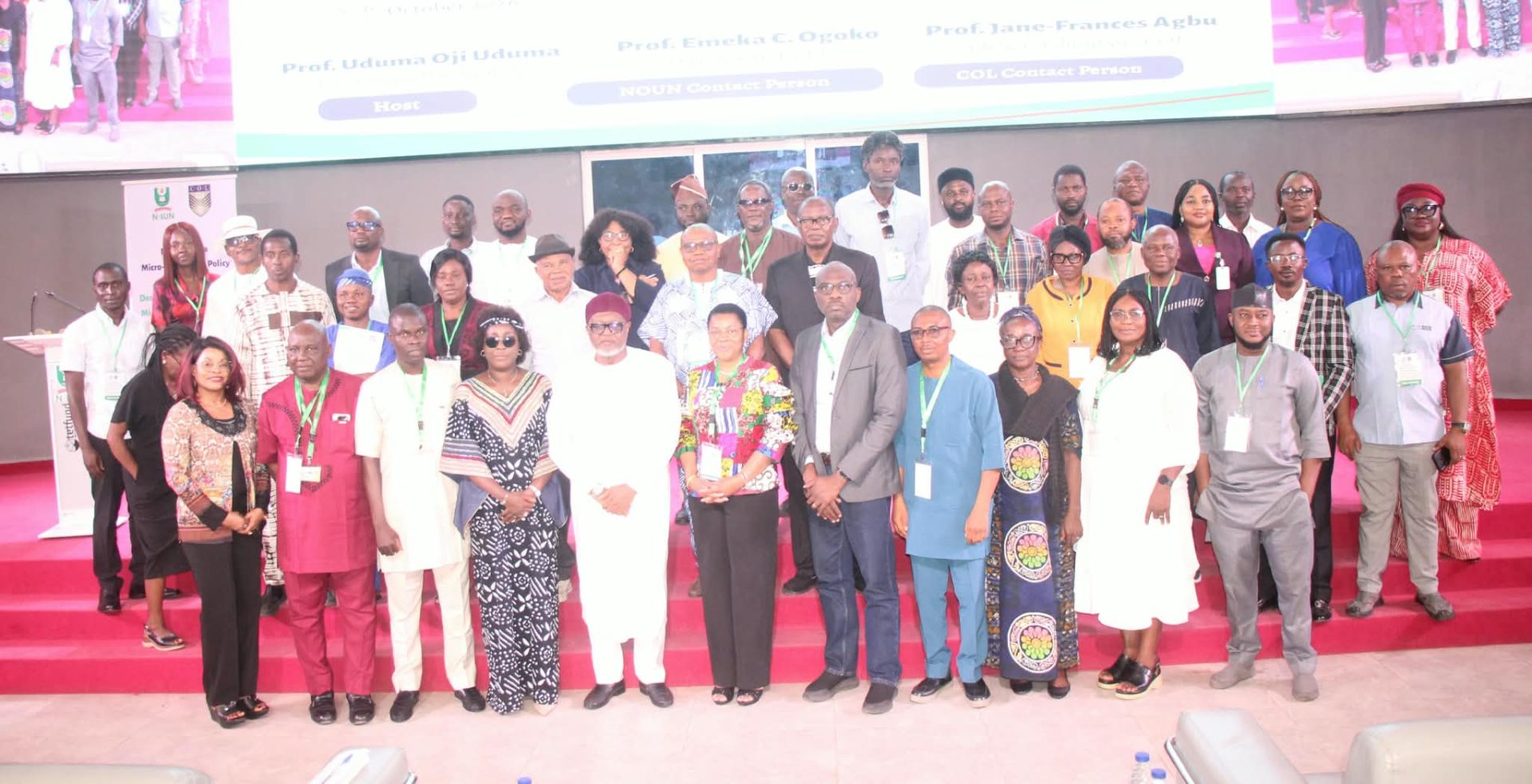
The workshop has drawn NOUN management, academic and professional staff, the National Universities Commission (NUC), COL representatives, resource persons and other stakeholders.
Speaking at the opening of the workshop, NOUN Vice-Chancellor, Professor Uduma Oji Uduma, who was represented by the Deputy Vice-Chancellor, Academic, Professor Chiedu Mafiana, described the initiative as a major step towards expanding flexible and technology-driven learning at the university.
“Today we’re not simply opening another workshop. We are taking an important step towards shaping the future of flexible lifelong and technology-enabled learning in the National Open University of Nigeria,” he said.
Uduma said micro-credentials would enable the university to widen access to learning, respond more quickly to emerging skills requirements, enhance employability and promote lifelong education.
He said NOUN’s objective should extend beyond providing short courses to creating a sustainable and credible micro-credential system based on quality, relevance, flexibility, scalability, recognition and sustainability.
Representing COL, Professor Jane-Frances Agbu, Adviser, Higher Education, said the workshop represented the first phase of the organisation’s engagement with NOUN, while a second phase would focus on developing micro-credential courses.
Agbu said the initiative formed part of COL’s broader Commonwealth programme, which involves regional consultations, national policy development and institutional pilot projects aimed at strengthening the connection between policy and implementation.
“The value of micro-credentials rests not simply on their short duration or flexibility. The credibility of micro-credentials depends on a well-articulated policy guideline.”
She said the growing importance of micro-credentials was being driven by rapid technological development, digital transformation, artificial intelligence and changing employment patterns.
According to her, the increasing need for people to continuously acquire new knowledge and skills has made upskilling, reskilling, professional development and lifelong learning critical components of modern education.
The National Universities Commission also pledged its support for the initiative.
Dr Fumilayo Morebise, who represented the NUC Executive Secretary, Professor Abdullahi Yusuf Ribadu, said the commission was collaborating with COL to advance Nigeria’s micro-credential agenda.
“The micro-credential has been a major burning issue. And NUC, as a responsive commission, we don’t want Nigeria to lag behind,” she said.
Morebise said the national framework and emerging guidelines would provide the basis for institutional implementation, with NOUN among the institutions selected to pilot the initiative.
She added that lessons from the pilot institutions would be used to strengthen the national guidelines ahead of their wider implementation.
The workshop is also reviewing the outcome of an institutional readiness assessment conducted at NOUN.
The assessment identified areas requiring attention, including policy and governance, quality assurance, staff capacity, digital credentialing, industry recognition, recognition of prior learning, credit transfer and stackability, assessment integrity, artificial intelligence and technical infrastructure.
The initiative is expected to lay the groundwork for a sustainable micro-credential ecosystem at NOUN, providing flexible learning opportunities for students and professionals while supporting employers and contributing to Nigeria’s human-capital development.
It will also feed into COL’s wider Commonwealth efforts to promote trusted, relevant and quality-assured micro-credential programmes.