By Felix Khanoba
Nigeria’s Minister of Education, Dr. Tunji Alausa, has highlighted what he described as major gains recorded in the country’s education sector under the administration of President Bola Tinubu, saying the reforms would have a long-term impact on future generations.
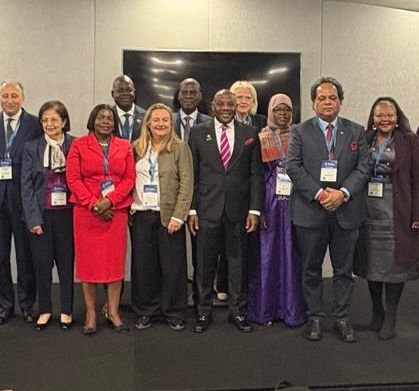
Alausa made the remarks on Monday during a special roundtable session at the Education World Forum in London, United Kingdom, where he joined education ministers and international stakeholders to discuss Nigeria’s reforms in foundational learning.
Addressing participants on the country’s Foundational Literacy and Numeracy (FLN) programmes, the minister said Nigeria had harmonised literacy delivery under a unified national framework covering both formal and non-formal education systems.
“We’re scaling RANA for Primary 1 to 3 and Teaching at the Right Level for Primary 4 to 6 across 15 states through UBEC. This uses structured lesson plans, weekly teacher coaching and regular assessments,” he said.
He explained that the Accelerated Basic Education Programme (ABEP), designed by the Nigerian Educational Research and Development Council, was helping out-of-school children and adolescents attain foundational literacy and numeracy skills within a three-year period.
“Both tracks now report into NEDI, so for the first time we can monitor formal and non-formal education coverage from one dashboard,” he added.
The minister also pointed to reforms introduced at state level, including EKOEXCEL, KwaraLEARN and BayelsaPRIME, describing them as effective examples of technology-driven and data-focused teaching models already yielding positive results.
“The impact is measurable. KwaraLEARN halved foundational learning deficiencies in less than two years, while BayelsaPRIME improved literacy by 20 percentage points in just 19 weeks. The model is working, and we are now scaling it nationally,” he said.
Speaking further, Alausa stated that foundational literacy and numeracy had become central pillars of President Tinubu’s Renewed Hope Agenda as well as the National Foundational Literacy and Numeracy Programme.
He disclosed that the Federal Government was in the final stages of developing a National Policy on Foundational Literacy and Numeracy aimed at establishing a lasting legal and institutional structure for reforms across federal, state and non-formal education systems.
“Through our Partnership Compact with GPE, 70 per cent of funding is tied to measurable outcomes in learning, teacher management and data utilisation,” he said.
The minister also announced plans by the Federal Government to raise the Universal Basic Education Commission’s allocation from the Consolidated Revenue Fund from two per cent to four per cent, a move expected to significantly boost funding for basic education nationwide.
On efforts to tackle the challenge of out-of-school children, Alausa said ABEP was creating an approved pathway for children outside the formal school system to move into Junior Secondary School.
“ABEP centres and formal schools now use the same coaching tools and learning materials, with SUBEB officers supervising both systems across 15 states. There are no parallel systems, lower costs and consistent quality,” he said.
Highlighting the role of accountability and data management in the reform process, the minister said the newly introduced National Education Data Initiative had revealed major shortcomings in donor funding efficiency.
Alausa stressed that the country was now prioritising measurable learning outcomes rather than educational inputs alone, expressing optimism that the reforms underway would help curb learning poverty across the country.
“With the National Policy on FLN nearly finalised and one standard across formal and non-formal systems, we are building a foundation that will outlast any single programme cycle. That is how we will end learning poverty at scale,” he added.