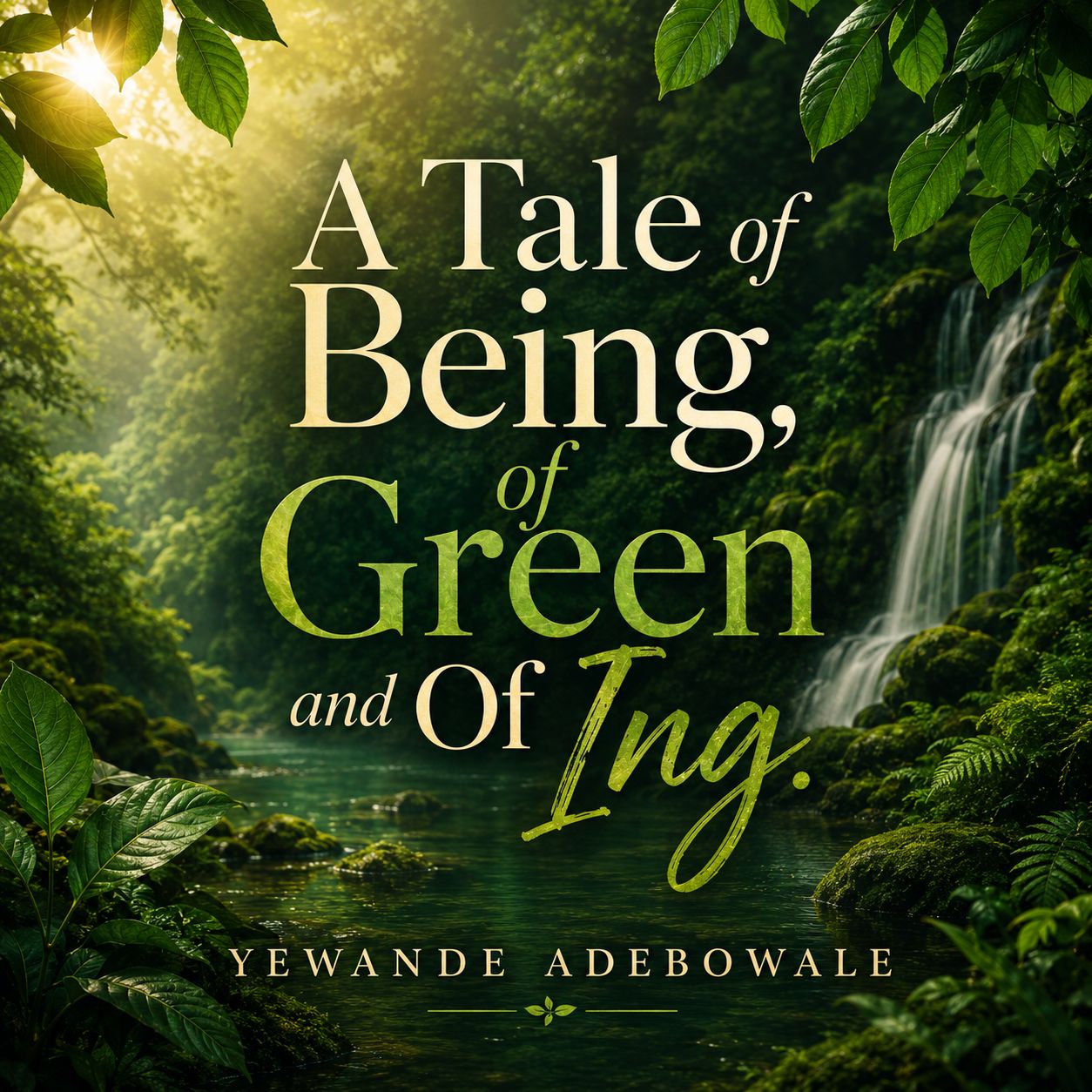
Yewande Adebowale’s A Tale of Being, of Green and Of Ing reads like a study of pressure. Not simply political pressure or economic strain, though those currents move forcefully through the collection. The deeper concern of the book is what happens to people, nations and landscapes when they are pushed repeatedly to their limits. Across its pages, Adebowale examines the conditions under which individuals bend, fracture, adapt or harden.
This is what gives the collection its unusual emotional texture. The poems are less interested in arrival than in strain itself. Cities tremble under instability. Families scatter under necessity. Citizens negotiate systems that appear permanently overheated. Even nature seems burdened. Rivers overflow or dry out. Forests are threatened. Heat hangs heavily across entire poems as though climate itself has become another participant in human struggle.
Adebowale approaches these realities with a sharp awareness of accumulation. The crises in the book are rarely isolated events. They layer upon one another until exhaustion becomes cultural atmosphere. In poems centered on conflict, insecurity and displacement, the poet captures how instability alters everyday psychology. People become alert, restless and emotionally weathered. Entire communities operate in survival mode for so long that tension begins to feel ordinary.
The collection’s recurring imagery of land and vegetation is central to this idea. Green appears constantly, though not as a simple emblem of vitality. Here, green functions more like contested terrain. It represents resources, identity, territory and emotional attachment. The struggle over land becomes inseparable from the struggle over dignity itself. Adebowale understands that environmental decline and political unrest often feed one another. When systems collapse, both people and landscapes absorb the damage.
What makes the poetry compelling is its refusal to romanticize suffering. The book does not treat hardship as noble or cleansing. Instead, pressure is portrayed as transformative in unpredictable ways. Some figures emerge disciplined and defiant. Others appear worn thin by repetition. This complexity gives the collection credibility. Adebowale recognizes that prolonged adversity changes people unevenly.
There is also an undercurrent of generational tension running throughout the work. Younger voices appear caught between inheritance and obligation, forced to navigate conditions they did not create. Several poems grapple with the burden of carrying history forward while attempting to construct stable futures. The result is a portrait of a society negotiating the cost of continuity.
Stylistically, the poet relies heavily on rhythmic repetition and escalating imagery. Her lines move with urgency, often building through layered phrases that resemble waves gathering force. This technique mirrors the thematic structure of the book itself. Problems intensify. Emotions compound. Systems tighten around ordinary lives. The repetition creates momentum while also conveying the relentless nature of social and personal strain.
Perhaps the collection’s greatest strength lies in its scope. Adebowale moves fluidly between the intimate and the national without losing emotional clarity. One moment she writes about a fractured homeland. The next, she narrows her focus to the inner fatigue carried by individuals living within that reality. The poems suggest that large crises are ultimately experienced through human bodies, relationships and routines.
Of Green and Of Ing succeeds because it understands that endurance is not abstract. It is physical, emotional and communal. It is found in the worker navigating instability, the family adapting to disruption and the citizen attempting to maintain dignity under pressure. Adebowale’s poetry captures the weight of modern existence with unsettling precision, offering a portrait of societies stretched taut yet still functioning against immense force.