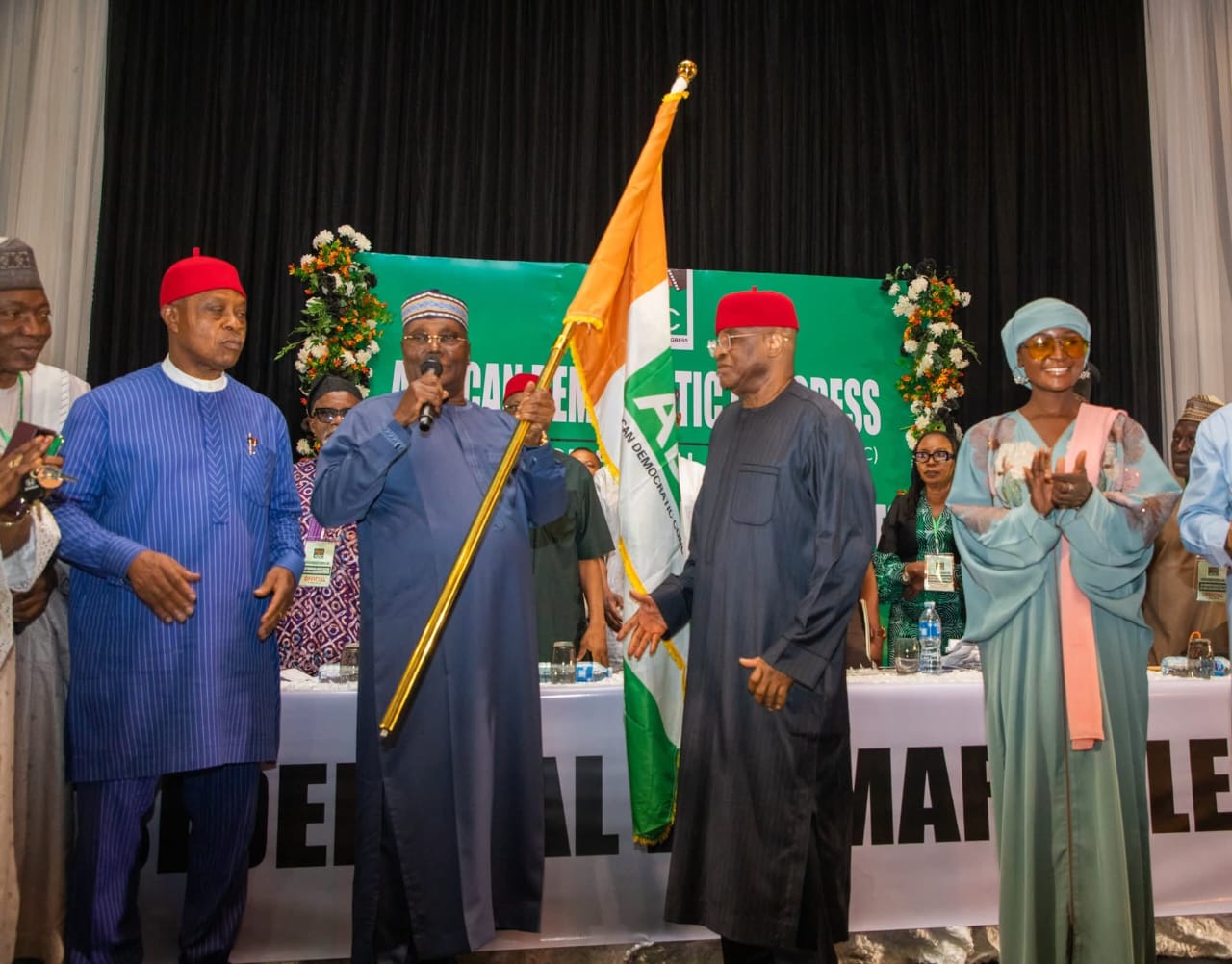
The African Democratic Congress (ADC) has arrived at its defining political moment.
The nationwide direct presidential primaries conducted across 8,809 wards on May 25, 2026, were not merely an internal democratic exercise; they were the first real stress test of whether the ADC can transform itself from an opposition platform into a credible governing alternative capable of unseating the ruling APC in 2027.
The contest featured formidable contenders: former Vice President Atiku Abubakar, former Rivers State Governor and ex-Minister of Transportation Rotimi Amaechi, and respected economist and businessman Mohammed Hayatu-Deen.
Expectedly, a contest of this magnitude would produce tensions. Keenly fought political battles rarely end without bruised egos, procedural complaints, and emotional reactions. That is the nature of politics.
But history will judge what follows next.
Will the ADC become another opposition coalition that collapsed under the weight of ambition, mistrust, and internal sabotage?
Or will it rise above personal disappointment to become the most formidable electoral coalition Nigeria has seen since 2015?
That is now the defining question.
Even before the primaries, it was evident that attempts to broker a consensus candidacy had failed. That alone showed the depth of ambition among the aspirants. Yet the decision to proceed with a direct primary was itself a democratic statement — one that placed power in the hands of grassroots party members rather than elite backroom negotiators.
Early endorsements across both northern and southern blocs suggested momentum in favour of Atiku Abubakar, whose political organization, name recognition, and national reach remain unmatched within the opposition ecosystem.
The direct primary model naturally rewarded broad-based mobilization, and in that terrain, Atiku’s political machinery demonstrated superior capacity.
That said, the reservations expressed by Rotimi Amaechi and Mohammed Hayatu-Deen cannot simply be dismissed with arrogance or triumphalism.
Allegations of irregularities deserve sober internal review—not because the outcome must be reversed, but because trust must be preserved.
A victorious party that ignores grievances plants the seeds of future implosion.
But it must also be said plainly: no serious political contender enters a democratic contest under the illusion that victory is guaranteed.
Elections produce winners and losers.
Disagreement is legitimate.
Self-destruction is not.
The bitter lesson of Nigeria’s opposition history is that fragmentation is often more lethal than defeat.
In 2023, opposition disunity handed strategic advantage to the ruling party.
Repeating that mistake in 2027 would amount to political self-harm.
And the APC knows it.
Indeed, nothing would delight the ruling establishment more than watching the ADC descend into legal warfare, factional crises, media mudslinging, and mutual suspicion.
A divided ADC is Tinubu’s easiest path to re-election.
A united ADC is his greatest political nightmare.
That is why this moment demands maturity from all actors.
Rotimi Amaechi brings undeniable political weight, strategic experience, executive governance credentials, and significant southern influence.
Mohammed Hayatu-Deen brings technocratic depth, credibility in economic management, elite business networks, and appeal among reform-minded stakeholders.
These are not disposable political assets.
They are strategic pillars.
To reduce this moment to winner-takes-all bitterness would be a monumental error.
The battle ahead is bigger than any single ambition.
It is about rescuing Nigeria from economic decline, deepening insecurity, democratic erosion, and a governance model many citizens increasingly regard as exclusionary and exhausted.
If ADC is serious about power, then reconciliation must begin immediately.
And that responsibility falls first on the presidential nominee.
Victory must be worn with humility.
Atiku Abubakar must resist even the slightest temptation toward triumphalism.
This is the hour for statesmanship, not celebration.
He should personally engage Amaechi and Hayatu-Deen—not through intermediaries, but directly.
He should acknowledge their strengths, respect their supporters, and invite them into the strategic architecture of the campaign.
Visible inclusion matters.
A post-primary grievance review mechanism should also be established to transparently examine concerns and reassure party stakeholders that fairness remains a core value.
The ADC must also move swiftly to project balance, inclusion, and strategic intelligence in its next decisions—especially regarding the vice-presidential selection.
A ticket that reflects national balance, competence, and coalition-building logic will strengthen confidence internally and expand electoral appeal nationally.
Public messaging from all camps must now shift from internal competition to collective mission.
This cannot be framed as Atiku’s victory alone.
It must be framed as the beginning of a national rescue coalition.
Because the truth is simple:
The ruling party is strongest when the opposition is fragmented.
But when serious political forces unite behind a coherent platform, incumbency suddenly becomes vulnerable.
The APC understands this arithmetic.
That is why every crack in ADC will be watched, amplified, and potentially exploited.
The antidote is unity.
Not cosmetic unity.
Not forced photo opportunities.
Real strategic unity built on respect, inclusion, discipline, and shared purpose.
If the ADC gets this right, what happened in these primaries will not be remembered as the beginning of division.
It will be remembered as the birth of the coalition that made the ruling party genuinely fear 2027.
*Babajide Balogun, writes from Ibadan