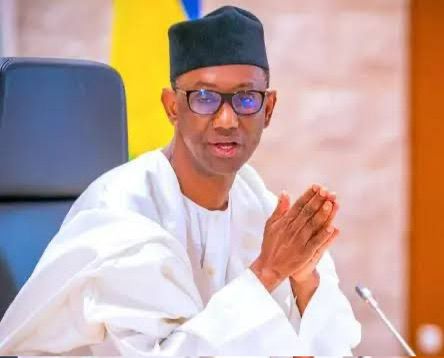
June 26, 2026, marked the third anniversary of the appointment of Mallam Nuhu Ribadu as National Security Adviser (NSA) by President Bola Ahmed Tinubu. In the three years since that pivotal decision, Nigeria has witnessed a profound shift in its approach to combating terrorism, insurgency, and banditry, one defined by intelligence-driven precision, inter-agency harmony, financial disruption of criminal networks, and a pragmatic restoration of international partnerships.
The results speak for themselves: thousands of terrorists and bandit elements neutralised, high-value leaders eliminated or captured across multiple states, the near-decimation of crude oil theft in the Niger Delta, and a reinvigorated Nigeria–United States security partnership that has already delivered historic blows against global terror networks.
President Tinubu broke the longstanding convention when he appointed Mallam Nuhu Ribadu, a distinguished former police intelligence officer and pioneer Chairman of the Economic and Financial Crimes Commission (EFCC) to head the Office of the National Security Adviser (ONSA). For decades, the position had been reserved almost exclusively for retired senior military officers.
This was not mere symbolism. It reflected a deliberate strategic vision: to inject fresh thinking, intelligence expertise, and economic-crime-fighting acumen into the apex of Nigeria’s security architecture. Ribadu’s background in policing, intelligence gathering, and dismantling sophisticated financial crime syndicates positioned him uniquely to tackle the evolving threat landscape, one where terrorists and bandits relied increasingly on illicit funding, logistics networks, and cross-border alliances.
Under Ribadu’s leadership, operations have become markedly more intelligence-led and surgically precise. The results have been felt across the Northeast, Northwest, and other theatres. Security forces have recorded numerous high-impact successes, eliminating or capturing notorious figures who once instilled fear in communities.
Among the most significant was the neutralisation of Abu-Bilal al-Minuki (also known as Abu-Mainok), described as the global second-in-command and director of operations for ISIS, in a precision joint operation in Northeastern Nigeria’s Lake Chad Basin in May 2026. This strike, conducted in coordination with the United States Africa Command, represented a watershed moment.
In the Northwest, bandit kingpins who terrorised Zamfara, Katsina, Sokoto, and Kaduna States have been systematically degraded. Notable among those neutralised are:
- Kachalla Halilu Sububu (also referred to as Halilu Buzu), a prominent Zamfara-based bandit warlord eliminated in a targeted operation in September 2024.
- Alti, the infamous “TikTok bandit commander” whose activities fuelled kidnappings and violence along key routes in the Northwest, killed in early 2026 operations.
- Dan Karami, another dreaded bandit leader taken out in a joint military operation in April 2025.
- Multiple other Kachalla warlords and lieutenants in Shinkafi, Isa, and surrounding areas of Zamfara whose camps were dismantled in coordinated raids.
In the Northeast, beyond the ISIS leadership strike, security forces under the renewed coordination have continued to degrade ISWAP and residual Boko Haram networks, with senior commanders and hundreds of fighters neutralised in Borno and Yobe States. Overall, public reports indicate that well over 13,000 terrorists, insurgents, and associated criminal elements have been neutralised since the new security strategy took firm root.
Perhaps Ribadu’s most transformative contribution has been the deliberate fostering of synergy across Nigeria’s security and intelligence agencies. For years, inter-agency rivalry and siloed operations had led to duplicated efforts, intelligence hoarding, and, in some tragic cases, botched missions that allowed high-value targets to escape.
Today, that dynamic has been fundamentally altered. Under ONSA’s coordination, the Armed Forces, Nigeria Police Force, Department of State Services, National Intelligence Agency, and other stakeholders now operate with a level of seamlessness previously unseen. Joint planning cells, shared intelligence platforms, and unified command structures have replaced fragmentation. The result: operations that are faster, better informed, and far more decisive.
Ribadu’s tenure at the EFCC and his deep experience as a police intelligence officer have proven invaluable. Terrorist and bandit groups sustain themselves through extortion, kidnapping-for-ransom, illegal mining, arms trafficking, and other illicit economies. By applying forensic financial investigation techniques and strengthening collaboration with financial regulators and international partners, the security apparatus has significantly disrupted these funding streams and logistical supply chains.
Camps have been denied resupply. Weapons procurement has been complicated. The economic incentive structures that once sustained prolonged insurgencies are being systematically eroded.
One of Ribadu’s quiet but most consequential achievements has been in the diplomatic domain. Early in the administration, there were concerns about potential strains in Nigeria–United States relations. Through strategic, low-key, and professional engagement with American officials, Ribadu helped forestall deterioration and instead rebuilt trust.
This renewed partnership has already yielded concrete operational dividends. The May 2026 elimination of ISIS’s global second-in-command in the Lake Chad region stands as a powerful testament to what coordinated Nigeria–U.S. action can achieve. What began as careful diplomatic repair has matured into a results-oriented partnership focused on shared threats.
Beyond the traditional theatres of insurgency and banditry, Ribadu’s coordination role extended decisively to the Niger Delta. Working with the military, specialised security contractors (including Tantita Security Services), and relevant government agencies, his leadership helped drive an aggressive campaign against crude oil theft and illegal refining.
The results have been remarkable. Crude oil theft, which once exceeded 100,000 barrels per day and crippled national revenue, has been drastically reduced, in some periods to as low as 5,000–9,600 barrels per day. This near-obliteration of large-scale oil theft has contributed directly to the significant rebound in Nigeria’s crude oil production, which climbed above 1.7 million barrels per day in recent periods, the highest levels recorded in years.
The Niger Delta, long synonymous with militancy and economic sabotage, has experienced a sustained period of relative peace, enabling communities, legitimate businesses, and the nation at large to benefit from increased hydrocarbon output and fresh investment interest.
President Tinubu deserves commendation for having the courage and foresight to entrust Nigeria’s security coordination to Mallam Nuhu Ribadu. It was a decision rooted in results-oriented thinking rather than tradition and it is delivering.
Ribadu himself merits equal recognition for his unflinching commitment, professional humility, and tireless work ethic. He has not sought the spotlight; he has delivered outcomes. His leadership style, combining intelligence expertise, financial acumen, diplomatic skill, and an insistence on inter-agency unity, has redefined what is possible in Nigeria’s fight against asymmetric threats.
The gains of the past three years are substantial and worthy of celebration. Yet the admonition must be clear: these victories must not breed complacency. The remnants of terrorist networks, surviving bandit groups, and emerging threats require sustained pressure. Every geopolitical zone, from the Northeast to the Northwest, the North-Central, South-west to the South-South and Southeast must ultimately enjoy the same measure of security and normalcy that hard-won progress has begun to restore in key areas.
Mallam Nuhu Ribadu must continue to build on these foundations, deepening intelligence capabilities, further strengthening inter-agency fusion, expanding regional and international cooperation, and ensuring that no part of Nigeria remains a sanctuary for terror or criminality.
Three years on, the trajectory is positive. With continued focus, unity of purpose, and the support of all Nigerians, the vision of a Nigeria where every citizen can live, work, and travel in safety is increasingly within reach. The war is far from over but under this leadership, it is being fought with renewed clarity, coordination, and conviction.
Dr. Ukuemene Sylvester Obos is a Houston based security Analyst and Researcher