China’s gross domestic product (GDP) grew 4.7% year on year in the first half of 2026, reaching 69.57 trillion yuan ($10.28 trillion), data from the National Bureau of Statistics showed on Wednesday.
The country’s key economic indicators have shown solid performance, with new growth drivers expanding quickly, signaling sustained resilience of the economy.
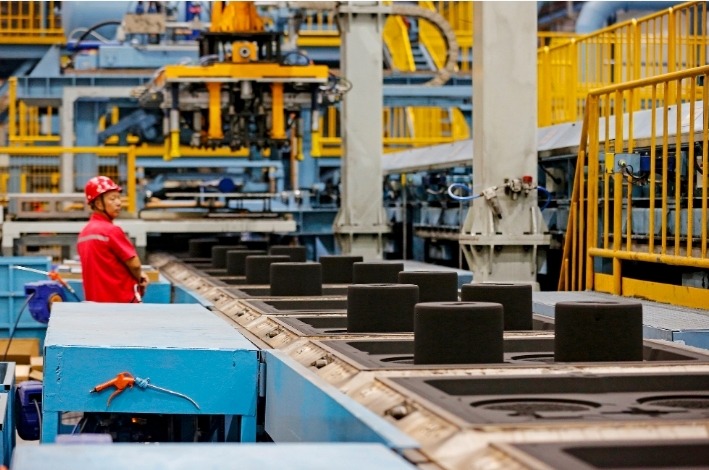
In the first six months of 2026, the value-added industrial output of China’s industrial enterprises above designated size, enterprises with annual revenue of at least 20 million yuan, grew by 5.4%. Notably, the value-added industrial output of equipment manufacturing and high-tech manufacturing climbed 9.3% and 13.3%, respectively.
Retail sales of goods and services, a key gauge of the country’s consumption strength, expanded 2.7% year on year. Total retail sales of consumer goods came in at 24.87 trillion yuan during the January-June period. Meanwhile, the service sector also expanded, with output increasing 5.2%.
China’s foreign trade saw robust growth during this period, with imports and exports totaling 25.47 trillion yuan, a 16.9% year-on-year growth.
Fixed-asset investment, excluding rural households, went down 5.7% year on year to reach 22.64 trillion yuan.
Overall, China’s economic performance remained within a reasonable range in the first half of this year, with new quality productive forces continuing to gain momentum, according to Mao Shengyong, deputy head of the NBS. However, with growing external uncertainties and imbalances between domestic supply and demand, the foundation for sustained economic recovery still needs to be consolidated, Mao added.
The main strengths of China’s economy in the first half of the year were the recovery in consumption, rising rural incomes and the resilience of high-tech manufacturing. On the downside, investment continued to weaken, capacity utilization declined, and consumer spending remained subdued, according to Bruce Pang, adjunct associate professor at CUHK Business School.
The economy is expected to maintain a moderate recovery in the second half of the year, said Pang, adding that policy efforts will need to focus on stabilizing investment, boosting domestic demand and supporting industrial upgrading.