By Jane Okeke
The Federal Government has reaffirmed its commitment to deploying electricity as a catalyst for economic growth rather than merely expanding power access, calling for stronger policy alignment and investment to accelerate the use of energy-efficient agricultural equipment across rural Nigeria.
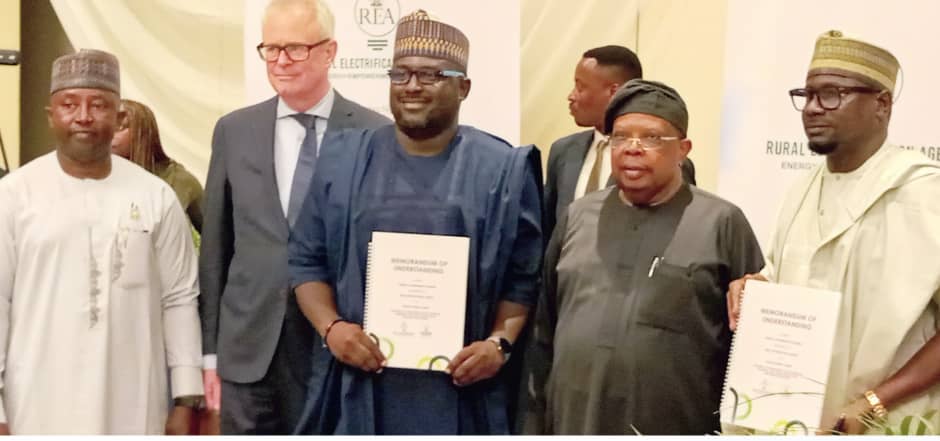
Speaking at the National Stakeholders’ Engagement Workshop on Productive Use of Energy (PUE) in Abuja on Thursday, the Minister of Power, Chief Joseph Olasunkanmi Tegbe, said the administration of President Bola Ahmed Tinubu is repositioning rural electrification to stimulate enterprise, increase agricultural productivity and create jobs.
The workshop, organised by the Rural Electrification Agency (REA) in collaboration with the ECOWAS Commission under the Regional Off-Grid Electricity Access Project (ROGEAP), focused on policy alignment, market readiness and deployment of energy-efficient productive-use equipment for agriculture.
Tegbe said rural electrification must move beyond connecting communities to the national grid, stressing that electricity should power businesses, improve livelihoods and strengthen rural economies.
According to him, the true measure of success in the power sector is not the number of megawatts generated or kilometres of transmission lines constructed, but the extent to which electricity enables farmers, processors and entrepreneurs to become more productive.
He noted that access to reliable electricity would enable farmers to irrigate larger farmlands, processors to add value to agricultural produce, cold rooms to preserve perishable commodities and rural entrepreneurs to establish viable agro-processing businesses.
The minister identified inadequate cold storage, limited processing capacity, high production costs and poor access to energy-efficient equipment as major factors responsible for post-harvest losses and reduced competitiveness in Nigeria’s agricultural sector.
He explained that the Productive Use of Energy initiative addresses these challenges by lowering operating costs, increasing productivity, boosting farmers’ incomes and creating new opportunities for manufacturers, technology providers and financial institutions.
Tegbe urged policymakers, regulators, financiers, manufacturers, farmers and development partners attending the workshop to produce practical, evidence-based recommendations capable of unlocking investments and accelerating deployment of productive-use technologies nationwide.
He commended the Rural Electrification Agency for convening the dialogue and acknowledged the support of the ECOWAS Commission, ROGEAP, development partners, financial institutions and private sector stakeholders in advancing Nigeria’s clean energy agenda.
The minister expressed confidence that the outcomes of the engagement would shape national policies, stimulate innovation and position Nigeria as Africa’s leading market for productive use of renewable energy in agriculture.
Earlier, the ECOWAS Commission called on stakeholders to establish a coordinated national framework that would encourage private sector investment in off-grid renewable energy technologies for agriculture.
Speaking on behalf of the President of the ECOWAS Commission, Dr. Omar Alieu Touray, the Senior Adviser to the Commissioner for Infrastructure, Energy and Digitalization and Coordinator of ROGEAP, Mr. El Hadji Sylla, said access to sustainable energy remains central to economic development and poverty reduction across West Africa.
Sylla observed that despite the region’s enormous solar energy potential, inadequate electricity supply continues to constrain socio-economic development and regional integration.
He said ECOWAS, through ROGEAP, is supporting member states in creating an enabling environment for a harmonised off-grid solar market capable of powering productive economic activities rather than providing only household lighting.
According to him, energy must become an engine for wealth creation, local processing and enterprise development in rural communities.
He challenged participants to develop a National Productive Use of Energy Deployment Framework capable of harmonising financing mechanisms, integrating off-grid energy infrastructure with productive-use technology providers and creating predictable market conditions that would attract long-term private investment.
Sylla disclosed that ROGEAP, funded by the World Bank with co-financing from the Clean Technology Fund and the Government of the Netherlands, supports ECOWAS member states as well as Chad, Cameroon, the Central African Republic and Mauritania in expanding access to solar-powered electricity.
He explained that the project seeks to improve electricity access for households, businesses, health facilities and educational institutions while promoting regional market integration and strengthening access to finance for stand-alone solar energy enterprises.
The ECOWAS official commended the Federal Ministry of Power and the Rural Electrification Agency for providing leadership in promoting renewable energy solutions and urged stakeholders to adopt concrete commitments that would serve as a model for productive energy deployment across West Africa.
Power Minister Seeks Policy Alignment to Drive Rural Prosperity Through Renewable Energy