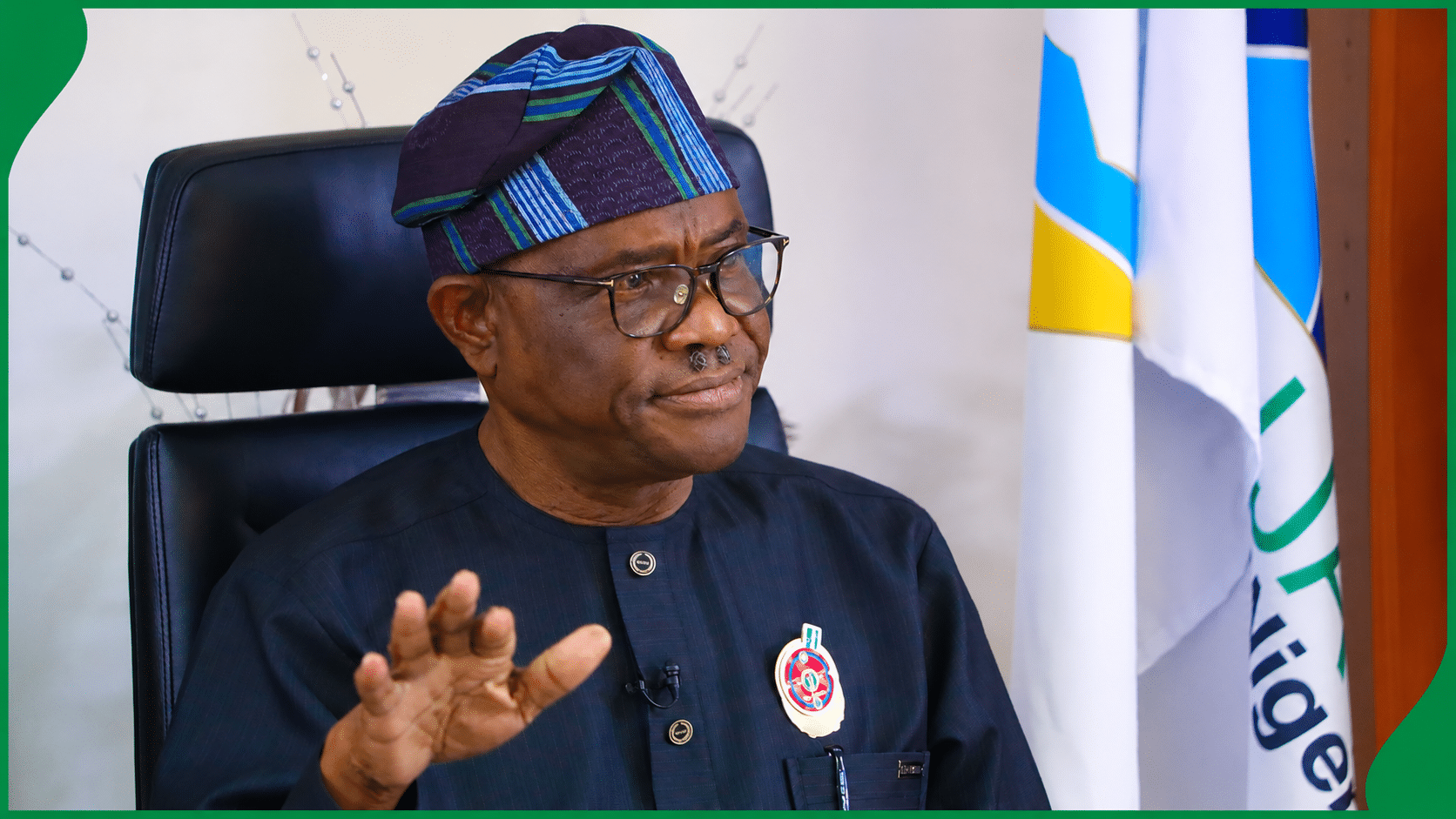
By Daniel Tyokua
The Minister of the Federal Capital Territory (FCT), Nyesom Wike, has urged Nigerians to reject politicians who exploit ethnic sentiments and grievances over marginalisation to pursue personal ambitions.
Wike warned that ethnic loyalty should not override competence, accountability and service delivery, insisting that the quest for political power must not be driven by sectional interests at the expense of national development.
The minister spoke on Thursday, in Abuja at the inaugural Idoma hall of fame induction ceremony, organised in collaboration with Och’Idoma as part of the Idoma Centenary Plus celebration.
In his lecture titled “People, Politics and Power Play in Nigeria: The Agitation for Equity and Fairness,” Wike cautioned against politicians who use the agitation for equity as a tool to secure public office without a genuine commitment to the welfare of citizens.
He urged Nigerians to examine the records and intentions of political leaders rather than allow ethnic affiliation and political calculations to determine their choices.
Wike questioned the sincerity of politicians who, according to him, ignored the downtrodden while holding public office but had begun celebrating their birthdays in Internally Displaced Persons (IDP) camps in pursuit of presidential ambitions.
He described such political manoeuvres as deceptive, urging Nigerians to distinguish between genuine public service and actions calculated to gain political advantage.
Wike also challenged Nigerians to demonstrate consistency in their demand for justice, warning against opposing marginalisation only when it affects their own communities.
He maintained that genuine fairness required Nigerians to defend justice regardless of whether the outcome favoured their ethnic groups or political interests.
On the federal character principle enshrined in the 1999 Constitution, as amended, Wike said the provision was designed to promote national unity and prevent the domination of public institutions by a few states or sectional groups.
However, he stressed that equitable representation should not undermine competence, insisting that appointments must balance inclusion with merit.
The minister argued that Nigeria’s struggle for fairness would remain unresolved if political groups focused solely on which ethnic group or region controlled power without addressing how such power was exercised.
“If one group replaces another at the table while the benefits remain fundamentally exclusionary, the occupants have changed, but the injustice has not,” he said.
“A Nigerian should not be excluded from public office because of where he or she comes from; neither should competence become irrelevant once a candidate’s identity satisfies a representational expectation.
“If we complain about marginalisation only when our own people are excluded, but become silent when others are marginalised after our people gain power, we are not opposing injustice; we are seeking access to its privileges.
“One of the enduring difficulties of our political life is the tendency to convert public power into private possession,” he said.