From Maurice Okafor, Enugu
The United Nations Children’s Fund, UNICEF, has harped on adequate breastfeeding and food nutrients that can be generated locally as very important diet for every child in the first 1000 days of his/her birth for effective development of their brains and other organs.
UNICEF said the first 1000 days starts from the first day of conception and throughout the gestation period of 270 days(nine months) in addition to the first two years(730 days) in the life of every child.
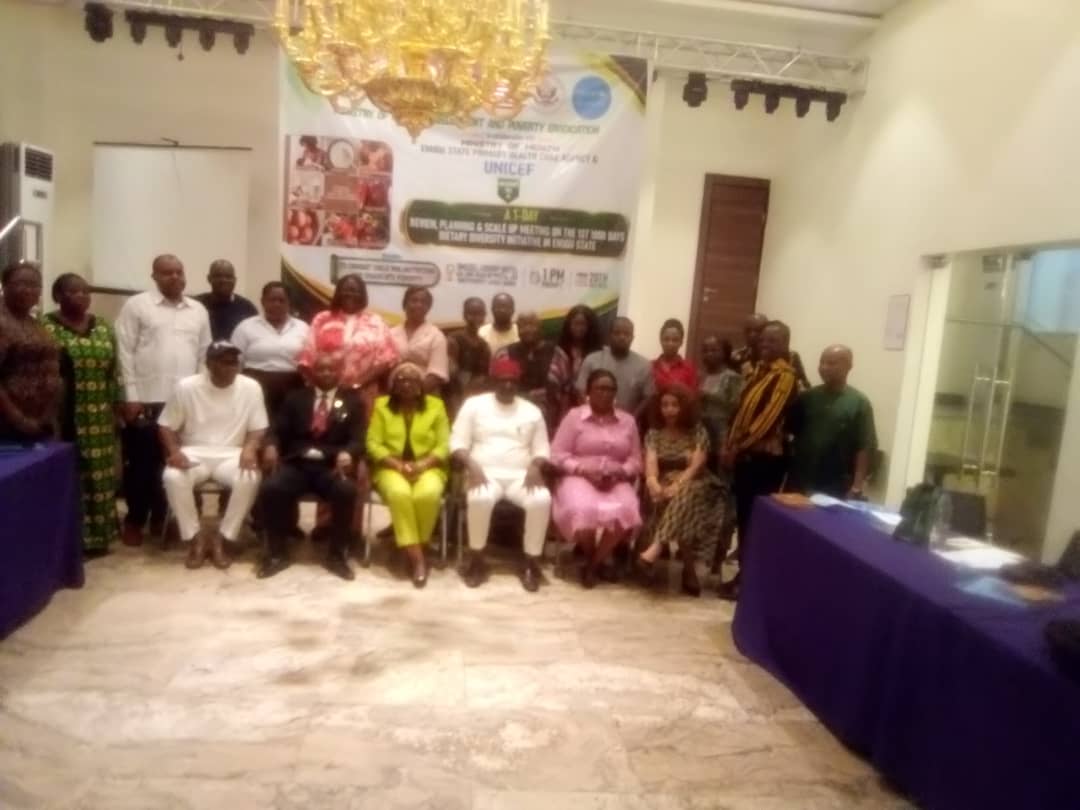
UNICEF Nutrition Specialist, UNICEF, Enugu Field Office, Dr. Ngozi Onuora gave the explanations during a one-day Review, Planning and Scale-up on the First 1000 days Dietary Diversity Initiative with a theme: “Combat Child Malnutrition and Enhance Healthy Growth”,held in Enugu on Monday,July 20th.
She recommended adequate exclusive breast feeding for the first six months after birth as very good for the survival of every child, in addition diets sourced locally from vegetables, crops like maize, water melon, local beans, yams,plaintain can beef of the health and development of the brain and other sense organs of every child.
UNICEF lamented that about 15% of children in Enugu State have stunted growth, an indication that they could not receive the recommended dietary allowance for a child per day.
The UNIICEF Nutrition Specialist, Dr Ngozi Onuora,said it is disheartening that Enugu State that is known for its agrarian nature, children are still suffering stunting and malnutrition, adding that to curb the menace, Enugu is a focal state that is benefiting from of the United State’s grant on preventing malnutrition in the first 1000 days.
She disclosed that UNICEF devised the programmes to counter child malnutrition in Enugu state and six other states in Nigeria.
She stated, “UNICEF started a programme, model project in the state on dietary diversity in the first year. It is to ensure that after six months of exclusive breast feeding, mothers give their children diverse foods,” she pointed out, lamenting however that stunting is still a menace in the state.
“Unfortunately, Enugu is supposed to be an agrarian community, but we still have pockets of malnutrition. We have about 15% level of stunting, for children who are shorter than their expected height of their age. Which means that out every one in four children , are shorter than their expected height of their age.
“And in terms of feeding the children after exclusive breast feeding for six months, what do they eat? So, the least of minimum dietary diversity for children from six months to twenty-three months in Enugu is 28%. Which means that about one out of every four children do not receive the recommended dietary allowance for the child per day.
“So, what is it means is that UNICEF has supported the state to implement this programme and we are benefiting. We have selected Igbo-Etiti local government area, Udi and Nkanu West to implement and we are having success stories because women who were trained on caring practices about exclusive breastfeeding dietary diversity like income generating activities such as goat farming, vegetable gardening and production of complementary foods are giving testimonies of how it has been helping their children to grow effectively,” she pointed out.
Earlier in his address, the Enugu State Commissioner for Human Development and Poverty Eradication, Prof. Bernadette Okoli who convened the scaling up and review meeting, noted that the first 1000 days was important in the life and growth of the children hence, the need to scale-up dietary diversity initiative.
“The first 1,000 days of life—from conception to a child’s second birthday—represent a critical period for ensuring proper growth, brain development and lifelong health.
“Adequate and diverse nutrition during this period can significantly improve a child’s chances of survival, healthy development and future productivity.
“As the Ministry responsible for Human Development and Poverty Reduction, we recognise that malnutrition is not merely a health challenge; it is also both a cause and a consequence of poverty.
“Families experiencing poverty often face difficulties in accessing nutritious food, quality healthcare and other essential services required for healthy child development.
“Today’s meeting therefore provides an opportunity to review our progress, strengthen collaboration, identify gaps and agree on practical strategies for expanding the initiative across Enugu State,” she disclosed.
One of the participants and the deputy chairman of Aninri local government area of Enugu State, Hon. Mary Oluchi Nwani stressed the importance of nutrition in the early life of the child and said that as a local government, “We scale-up the importance of nutrition in farming, livestock farming and also formulating feeds and our locally grown crops and grains.”
UNICEF stressed that having used Nkanu West,Udi and Igbo Etiti local government areas as Pilot projects and achieved success, they will extend the advocacy and means of achieving adequate diet for the first 1000 days for every new born child in Enugu state to other Council areas in Enugu state.
The meeting which was co sponsored by CNF(Child Nutrition Fund) and USA,was also attended by Comrade Aka Eze Aka, the Chairman of Udenu local government area, while his Colleagues from Enugu East Council area and Isi Uzo local government area were represented by the deputies.
The Oji River local government chairman was represented by his media aide, Mr Fabian Kenechukwu.