By Felix Khanoba
The Federal Government has equipped 38 federal and state technical colleges across Nigeria with modern facilities to expand access to free vocational training, offering beneficiaries monthly stipends and business starter packs to promote self-employment and tackle youth unemployment.
The initiative, supported by the World Bank, is designed to equip young Nigerians with practical, market-driven skills and provide them with the necessary resources to establish businesses after completing their training.
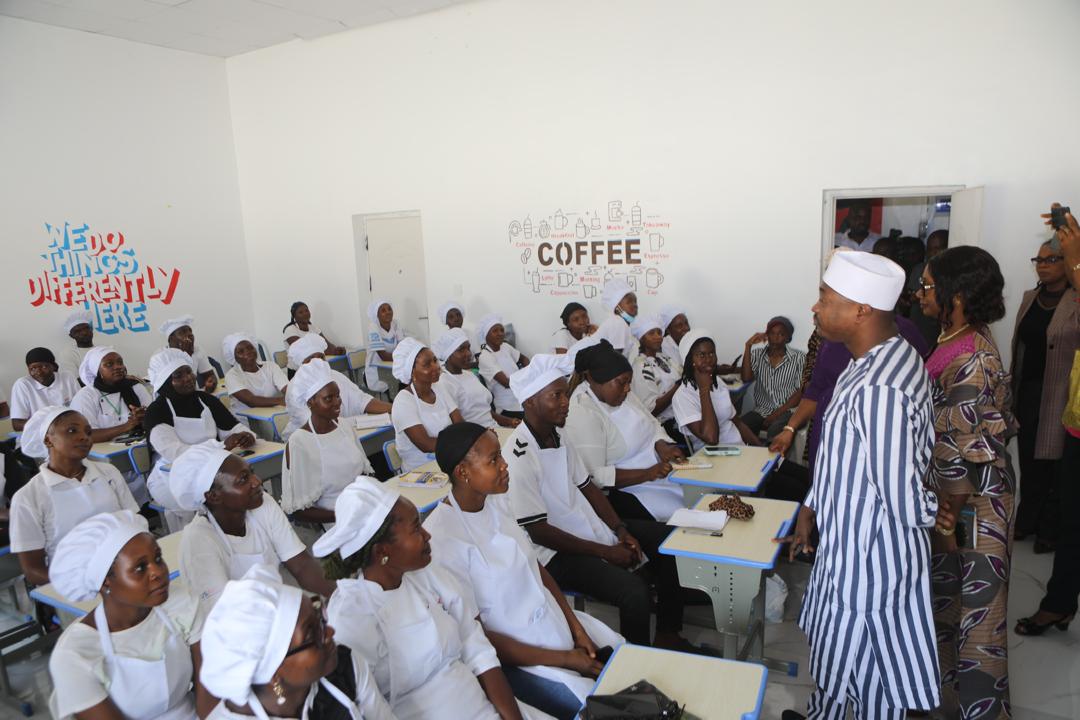
National Project Coordinator of the Innovation Development for Effective Acquisition of Skills (IDEAS) Project, Mrs Blessing Ehi Ogwu, disclosed this during an inspection of the IDEAS Project Centre at the Federal Science and Technical College (FSTC), Orozo, Abuja.
Ogwu said the intervention had covered 20 federal and 18 state technical colleges, with investments in infrastructure, workshops and equipment to strengthen technical and vocational education and training (TVET) across the country.
She explained that the initiative was part of the Federal Government’s strategy to reduce unemployment by giving young people practical competencies that could translate into sustainable livelihoods.
“The Federal Government is interested in TVET education. That is why we have about 38 technical colleges that the Federal Government has funded and equipped like this, all to enhance skills,” she said.
According to her, the participating institutions provide opportunities for formal and informal skills acquisition, while FSTC Orozo serves as the designated federal technical college for the Federal Capital Territory.
She expressed optimism that the programme would be sustained under the present administration, urging Nigerians to support efforts to expand access to vocational education.
Also speaking, the National Project Monitoring Officer in the Minister’s Office at the Federal Ministry of Education, Mr Olatunji Odewunmi, said Nigeria had more than 1,000 TVET centres, including approximately 140 skills training centres in the FCT.
He described the IDEAS Project and the Federal Government’s broader TVET initiative as complementary efforts aimed at making practical skills education more accessible to Nigerians.
Odewunmi stressed that participation in the programme was entirely free, explaining that the government covered tuition, training fees, instructional materials and other essential requirements, including accommodation for beneficiaries in boarding facilities.
He added that participants received monthly stipends to support them during training and would be given starter packs to enable them to commence business activities upon completing their programmes.
“Every one of them will get a starter pack even before the end of the training. By the day they graduate, they can go home with it,” he said.
On efforts to ensure discipline and commitment among trainees, Odewunmi said biometric attendance monitoring had been introduced to track participation.
He explained that beneficiaries who failed to meet the prescribed attendance requirements risked losing their stipends and entitlement to starter packs.
He added that monitoring officers regularly visited the centres to assess training activities and ensure that public resources were being properly utilised.
The Principal of FSTC Orozo, Dr Stella Uhuegbu, said the institution had aligned its training structure with the Federal Government’s revised TVET curriculum, which prescribes a 70 per cent practical and 30 per cent theoretical learning ratio.
She said the college had provided the necessary equipment, instructional materials and technical personnel to ensure that trainees acquired relevant hands-on experience.
According to her, the institution has more than 1,000 regular students, while its six-month vocational training programme accommodates over 1,000 participants across various trades.
The available courses include information and communication technology, automobile mechanics, auto-electrical repairs, catering, garment making and GSM repairs.
Uhuegbu described the IDEAS Project as a major boost to the college’s capacity to deliver effective vocational training, noting that the newly constructed and equipped workshops had improved the quality of practical instruction.
“All the workshops you are seeing here were newly built and well equipped. The essence is to ensure that the skills training aspect of the TVET initiative is achieved because, without the workshops and equipment, we cannot effectively impact skills on the trainees,” she said.
She added that participants would receive certificates at the end of their programmes, alongside government-provided starter packs to help them establish businesses in their chosen fields.
Beyond the government’s investment in facilities and training, some beneficiaries said they had begun translating the knowledge acquired into income-generating opportunities, even before completing their programmes.
One of the trainees, Modupe Osundeyi, who is undergoing catering training, said she had acquired practical skills in baking and food production, including the preparation of buns, egg rolls, doughnuts and other confectioneries.
She disclosed that she had already approached prospective customers and secured an opportunity to supply baked products to a school close to her residence.
“The programme has equipped me with practical knowledge and enabled me to earn an income. I went to a school close to my house, explained the skills I had acquired and asked if they could give me a contract. They agreed, and I will be making buns and doughnuts for them,” she said.
A female trainee in the automobile training programme said she had gained knowledge of different engine types, their components, maintenance procedures and basic repair techniques.
She, however, called on the government to provide additional equipment and extend the programme to rural communities to enable more young people to benefit.
The trainee also encouraged more women to venture into technical occupations traditionally dominated by men, insisting that gender should not prevent them from pursuing their career interests.
“I am in a class dominated by boys, and there are only two girls. However, that has given me more courage. I am not intimidated by the number of boys in my class,” she said.
Another beneficiary at the Zenou TVET Centre, Orozo, Joy Genesis, said she had started earning money from baking barely four months after enrolling in the programme.
Genesis said the practical training had equipped her to produce different types of cakes, pastries, bread and confectioneries, adding that she had begun receiving orders for wedding and birthday cakes.
She listed some of the products she had learnt to make to include meat pies, bread rolls, fruit bread, honey bread, coconut bread, coconut candy, buns, egg rolls, Scotch eggs and shawarma.
“We’ve learnt a lot. We’ve learnt pastries, how to make cakes and cover cakes. We’ve learnt meat pie, all forms of bread. They’ve taught us how to make bread rolls, fruit bread, honey bread and coconut bread,” she said.
She attributed her progress to the centre’s practical teaching approach, which allows participants to handle production themselves and practise the skills outside the training environment.
“Our work here is hands-on. We did the practicals by ourselves. We did it by ourselves, and we go home and practise,” she said.
Genesis said the training had already opened up business opportunities for her, disclosing that she had received orders for wedding and birthday cakes, including one for a birthday celebration in the preceding weekend.
“Yes, like me, since I started, I’ve had wedding cakes and birthday cakes. I even had a birthday cake this weekend that just passed,” she added.
The experiences of the beneficiaries underscore the potential of vocational education to create employment opportunities, particularly when practical training is complemented by equipment, financial support and start-up resources.