By Cyriacus Nnaji
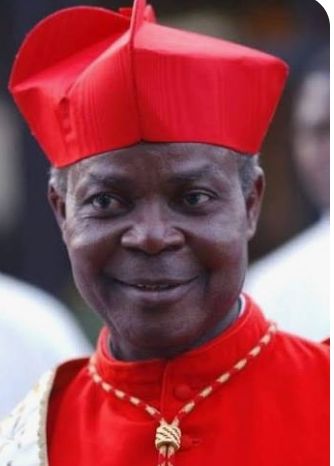
Remarkably remembered for his combination of episcopal gown and human right activism, His Eminence, the emeritus Archbishop of the Metropolitan See of Lagos, Anthony Cardinal Olubunmi Okogie, is a living icon, a legend by every conceivable adjective to qualify a man whose impactful leadership in Christendom has continued to reverberate across the globe. Just as amazing, indescribable and awesome, he became a bishop five years after ordination as a priest, that is unusually and amazingly unheard of, but that is just a glimpse into the life and time of the legendary quality of this astronomical homo sapiens.
What kind of gift is perfect for an icon of indescribable magnitude? So the Catholic Archdiocese of Lagos decided to celebrate Anthony Cardinal Olubunmi Okogie when he is still alive, to make him happy and show him how massively he is loved by his people, to appreciate him, even relatives, friends and well wishes were all around in their great numbers to say Daddy, we all love you.
Never in the history of the nation, has 48 Bishops attended the birthday of one man, it is like a fairy tale but it is true.
The Holy Cross Cathedral of the Catholic Church in the Island of Lagos was filled to the brim, as men and women, de creme de la creme of the society took turns to pour encomium and kudos to a man who held firm to the right of men even in the face of the booth and gun of the khaki men in the 80s and 90s.
Anthony Cardinal Olubunmi Okogie remains one of the most influential ecclesiastical figures in modern Nigerian history — a revered Prince of the Roman Catholic Church whose life and ministry have profoundly shaped the religious, moral, and socio-political landscape of Nigeria. Renowned for his fearless defense of justice, unwavering commitment to Catholic orthodoxy, and courageous interventions in national affairs, Cardinal Okogie’s legacy transcends the sanctuary and extends into the broader conscience of the Nigerian nation.
For almost six decades in active ministry, he stood at the intersection of faith, public morality, and national leadership, becoming a symbol of integrity, discipline, courage, and prophetic witness. Whether confronting military dictatorship, defending the oppressed, promoting Catholic education, or preserving doctrinal fidelity within the Church, Cardinal Okogie distinguished himself as both a spiritual shepherd and a moral statesman.
In 1971, at just 34 years old, Fr. Okogie was appointed Titular Bishop of Mascula and Auxiliary to Pope Paul VI. He was consecrated on August 29, 1971, at St. Benedict’s Cathedral, Osogbo, Oyo State. Following the death of Archbishop John Kwao Amuzu Aggey, he succeeded to Lagos as Auxiliary Bishop to Bishop Anthony Saliu Sanusi. Bishop Okogie received the Apostolic Delegate of Pope St. Paul VI appointing him as Metropolitan Archbishop of Lagos from the Apostolic Delegate on June 17, 1973, just one day after his thirty-seventh birthday. Anthony Olubunmi Okogie was enthroned as the youngest serving Catholic archbishop in Nigeria at the time.
His enthronement marked the beginning of a transformative era of ecclesiastical leadership and institutional transformation. When Archbishop Okogie assumed leadership, the Archdiocese of Lagos consisted of approximately fifteen parishes. By the time of his retirement in 2012, the Archdiocese had grown to over one hundred parishes, reflecting extraordinary expansion in pastoral outreach, evangelisation, and institutional development.
Under his leadership, the Archdiocese witnessed massive growth in Catholic schools, healthcare facilities, seminaries, and faith formation centres, reinforcing the Church’s role as a key contributor to moral and intellectual formation. Numerous schools, colleges, healthcare centres, and pastoral institutions were established or strengthened. Notable institutions founded and expanded under his leadership were Augustine University, St. Augustine’s College of Education, St. Raphael Divine Mercy Specialist Hospital, and several healthcare outreach centres serving vulnerable communities. These initiatives underscored his commitment to education, healthcare, and social assistance programmes for disadvantaged populations.
Beyond institutional expansion, Archbishop Okogie became widely respected for strengthening clerical discipline, promoting Catholic orthodoxy, and defending the Church during a period of increasing secularisation and rapid Pentecostal expansion across Nigeria. He remained unwavering in his defense of Catholic teachings on the sanctity of life, marriage, family, and ecclesial authority. His bold pastoral leadership earned him admiration among many Catholics who regarded him as a courageous guardian of apostolic tradition. At the same time, critics occasionally viewed his positions as rigid or excessively conservative. Nevertheless, his consistency and fidelity to Church teaching remained unmistakable throughout his ministry.
In October 2003, Pope John Paul II elevated Archbishop Okogie to the College of Cardinals, assigning him the titular church of Beata Vergine Maria del Monte Carmelo Mostacciano in Rome. His elevation represented not only personal recognition but also acknowledgment of the growing influence of the Nigerian Church within global Catholicism. As a cardinal, he participated in the papal conclaves that elected Pope Benedict XVI in 2005 and Pope Francis in 2013. Despite the prestige attached to the cardinalate, he remained notably humble and often employed his platform to challenge corruption, abuse of power, and social injustice. Cardinal Okogie became one of Nigeria’s most fearless socio-political voices, especially during the era of military dictatorship. As president of the Catholic Bishops Conference of Nigeria from 1988 to 1994 and President of the Christian Association of Nigeria from 1994 to 2000, he transformed religious leadership into a platform for moral resistance and national advocacy.
During the regime of General Sani Abacha and other military administrations, Cardinal Okogie openly condemned authoritarianism, corruption, human rights abuses, arbitrary arrests, and electoral injustice. At a time when many public figures feared speaking against oppressive government policies, Cardinal Okogie used sermons, pastoral letters, and public statements to demand justice, accountability, and democratic governance.
His fearless interventions earned him enormous respect among civil society groups, religious communities, and ordinary Nigerians who regarded him as a moral compass during periods of national uncertainty.
Cardinal Okogie also became known for his strong defense of human dignity across religious and ethnic boundaries. One of the most internationally publicised moments of his advocacy was his intervention in cases involving women sentenced to death by stoning under Sharia law.
Demonstrating extraordinary compassion and courage, he appealed publicly for mercy and justice, reinforcing his reputation as a defender of the oppressed regardless of religious affiliation.
The theological foundation of his activism was deeply rooted in Catholic social teaching, particularly the principles of human dignity, the common good, justice, and moral accountability. Unlike ideological revolutionaries, Cardinal Okogie’s activism remained fundamentally pastoral and non-partisan. He believed that silence in the face of injustice constituted moral complicity and that the Church had a responsibility to function as the conscience of society. His communication style further amplified his public influence. He was known for being direct, fearless, morally uncompromising, and intellectually articulate. He spoke truth to power without diplomatic ambiguity, earning admiration from both clergy and ordinary citizens.
Following his retirement as Archbishop of Lagos in 2012, Cardinal Okogie remained active in public discourse. He continued mentoring younger clergy, granting interviews, writing commentaries, and speaking on national issues affecting both the Church and society.
Today, Cardinal Anthony Olubunmi Okogie stands as one of the most respected Christian leaders in Nigerian history — a man whose life embodies fidelity to the Gospel, courage in public service, compassion for the oppressed, and unwavering commitment to truth and justice.
From the seminary halls of Ibadan and Rome to the warfronts of civil conflict, from Oyo to leadership in Lagos, from parish ministry to the College of Cardinals, his journey reflects the spiritual, moral, and political evolution of modern Nigeria itself. His enduring legacy remains that of a Catholic colossus, a fearless shepherd, and one of Nigeria’s most enduring voices of conscience.
As you celebrate these rare and extraordinary milestones of 90 years of life, 60 years of priesthood and 55 years of Episcopal Ordination, the words of Saint Paul “I have fought the good fight, I have finished the race, I have kept the faith” (2 Timothy 4:7) resonate profoundly in our hearts.
Holy Mother Church rejoices greatly and together with you; I wish to give thanks to God for the goodness and generosity of your heart throughout these years of faithful ministry.
The Church of God grows through witness and sacrifice, and your life stands as a clear testimony to this truth. All the goodness that you have shown over the years remains a valuable contribution to the growth of the Church in Nigeria and the Universal Church.
On behalf of His Holiness Pope Leo XIV and on my own behalf, I wish you many more years of authentic, peaceful and blessed life in the Lord. I gladly impart to you my personal blessings, while assuring you of my prayers and fraternal closeness.”
The Catholic Conference of Nigeria, in their congratulatory message as conveyed by Most Rev. Matthew Man-Oso Ndagoso
Archbishop of Kaduna read, “Your Eminence, on this unprecedented triple jubilee: ninety years of life, sixty years of priestly ministry and fifty-five years of episcopal service. These are not merely anniversaries; they are a monument to God’s fidelity and a testament to your own unwavering yes to the divine call. In you we see the living fulfillment of the Lord’s promise: “Even to your old age I am He, and to grey hairs I will carry you” (Isaiah 46:4). As we give thanks to God for his faithfulness in your life, we recall with profound admiration how your tenure as erstwhile President of the Catholic Bishops’ Conference of Nigeria (CBCN) remains a golden reference point. You led the college of bishops with courage, wisdom, and that characteristic blend of fatherly firmness and pastoral tenderness. Under your leadership, the Church in Nigeria did not merely speak truth to power; she became the conscience of the nation. Even now, advanced in age, you remain for all of us a living icon of what it means to serve and not to be served.
“As you celebrate these three jubilees, we do not wish you only joy; we wish you the unshakable peace of Christ which the world cannot give and which circumstances cannot steal. As we thank God for you on this day, it is our earnest prayer that the Lord, who has kept you for these remarkable years, will now surround you with consolation and strength. May Our Lady, Mother of Priests and Queen of Apostles, continue to intercede for you.”
Then from Peter Ebere Cardinal Okpaleke, Bishop of the Catholic Diocese of Ekwulobia, “I received with joy the invitation to the triple celebration of the 60th anniversary of your priestly ordination, the 55th anniversary of your episcopal ordination and the 90th anniversary of your birth. We continue to thank God for the witness of your life and ministry. The military were in power then. They have a rule of engagement different from that in a democracy. This, notwithstanding, you exercised your prophetic role, served as conscience of the nation, contributed to national discourse and the shaping of the trajectory for our nation while shepherding the flock in the Archdiocese.
I have already celebrated the Eucharist in thanksgiving for God’s blessings on your life.”
These were just a few among other dignitaries that sent their warm felicitations and goodwill.