
By Felix Khanoba
The Federal Government has reaffirmed its commitment to ensuring that all completed Smart Schools, Bilingual Schools and Alternative Schools across the country are fully operational before the end of the year as part of efforts to improve access to quality basic education.
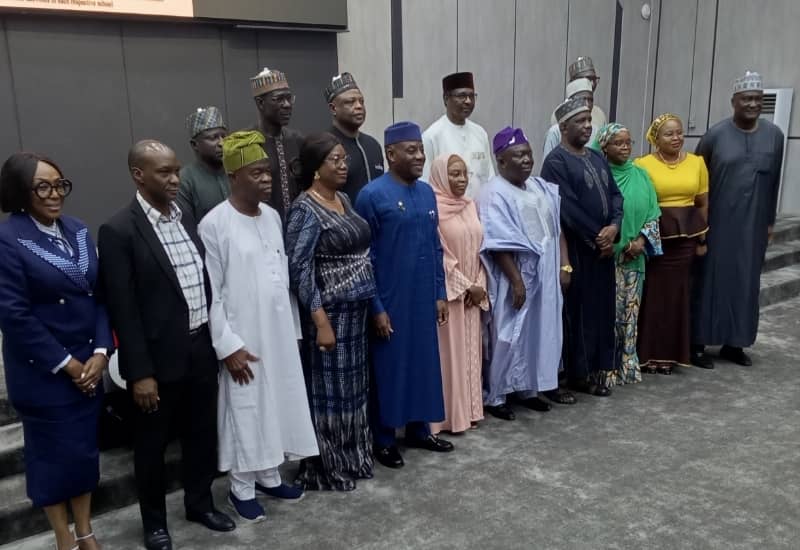
Minister of Education, Dr. Maruf Tunji Alausa, stated this on Tuesday in Abuja during the inauguration of the Universal Basic Education Commission (UBEC) Ministerial Implementation and Monitoring Committee for Smart Schools, Bilingual Schools and Alternative Schools.
The minister expressed concern that several completed education projects have remained unused for various reasons despite significant public investment.
“Our aim is to get the bilingual, smart , alternative schools operational before end of the year , 2026,” the minister said.
Alausa explained that under the Renewed Hope Agenda, education has become a key driver of national development rather than being viewed solely as a social service.
“It is the foundation upon which we shall build a productive economy, create opportunities for our young people, strengthen national cohesion and secure Nigeria’s future competitiveness.
“Our responsibility, therefore, extends beyond building classrooms. Our responsibility is to ensure that every educational investment made by government translates into meaningful learning opportunities for Nigerian children,” he said.
The minister stressed that government would no longer tolerate situations where projects are certified as completed without becoming accessible to the intended beneficiaries, even as he criticised the failure to hand over some completed schools to state governments for use.
“More concerning is the fact that several completed schools have not been fully handed over to the state government…
“This situation cannot be allowed to continue. Every day, the completed school remains locked representing lost opportunities for thousands of Nigerian children. Every abandoned school project represents resources that are not giving their intended educational value,” he said.
Alausa also expressed concern over the poor transition from primary to junior secondary school, saying the separation between JSS and the senior secondary school level will be addressed in next national council of education meeting.
He said: “We have 20 million dropouts from primary school to JSS. Where are those students? What we also noticed is that we have 80,000 public primary schools, while we have only about 15,000 junior secondary schools—a ratio of one to eight.
“And if you look at the completion rate, it shows that we, as government, have not done what we need to do. Previous governments might have failed in this regard, but this government will not fail. We’re fixing this, so we need to create many more opportunities for students to attend junior secondary schools by expanding the infrastructure…
“This disarticulation policy has also contributed to this. We’re seeing data from states such as Kaduna and other northern states. Because you have one principal for junior secondary school and another principal for senior secondary school, we now have overflowing JSSs and underutilised senior secondary schools.
“So, I can objectively report today that this disarticulation policy has failed. We will phase it out,” he said.
On the inaugurated committee, the minister said team has been mandated to verify the status of Smart, Bilingual and Alternative School projects nationwide, facilitate the completion of outstanding infrastructure and ensure completed schools are formally handed over to state ministries of education.
Other responsibilities include overseeing the installation of equipment and furniture, ensuring adequate staffing and instructional resources, monitoring project implementation, engaging communities to promote ownership and security, and submitting quarterly progress reports to the Minister of Education, the Minister of State for Education and the Executive Secretary of UBEC.
Earlier, UBEC Executive Secretary, Dr. Aisha Garba, disclosed that 37 Smart Schools had been established across the country, with 24 already in operation while the remaining schools were at different stages of completion and preparation for academic activities.
She added that 30 bilingual schools had been established in nine participating states under the UBEC-IsDB programme. According to her, three of the schools have been completed and commissioned, while four others are substantially completed and awaiting commissioning.
Garba said the Alternative Schools Programme was also expanding access to education for out-of-school children and other vulnerable learners through flexible and inclusive learning models.
“Our collective objective is to ensure that every Smart School, Bilingual School and Alternative School becomes a fully functional centre of excellence, delivering quality, inclusive and technology-driven education to Nigerian children,” she said.
She described the newly inaugurated committee as a strategic intervention aimed at accelerating project delivery, strengthening collaboration among stakeholders and ensuring that government investments produce fully functional schools.
Speaking on behalf of the committee, its chairman and former Deputy Executive Secretary of UBEC, Emeritus Professor Rashid Aderinoye, assured the minister that members would carry out their assignment with transparency while working closely with relevant stakeholders to improve the fortunes of basic education in the country.
