By Stella Odueme
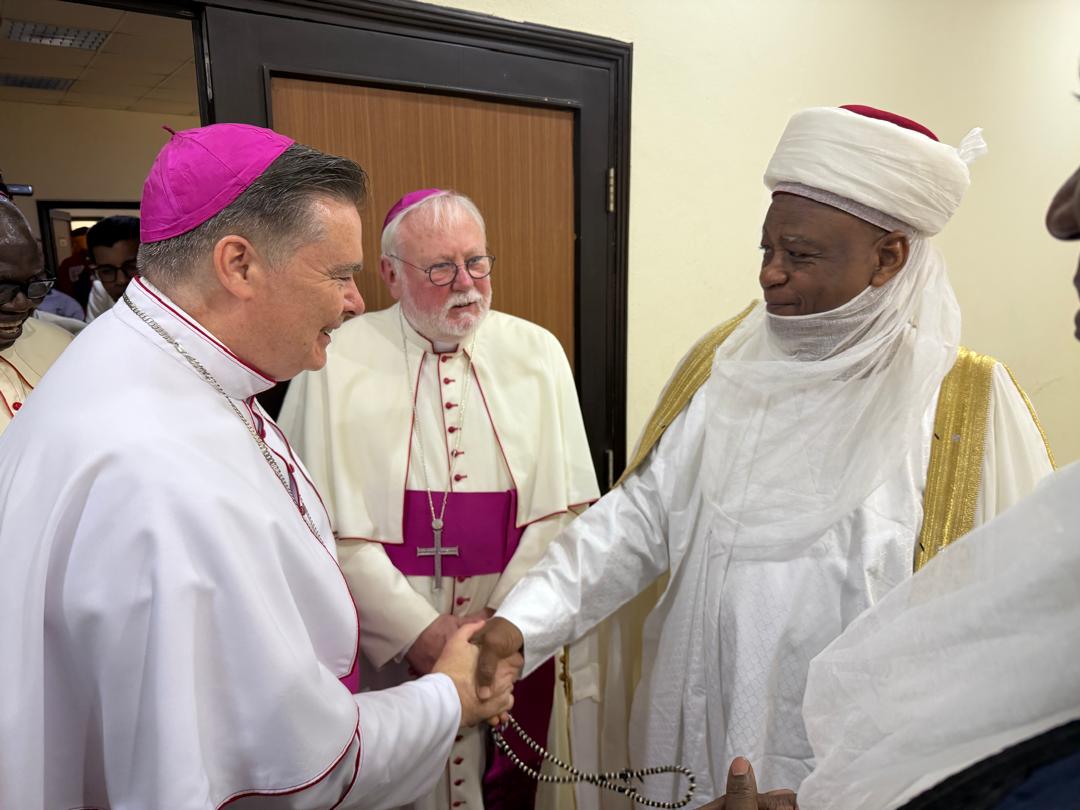
The Sultan of Sokoto and President-General of the Nigerian Supreme Council for Islamic Affairs, Muhammad Sa’ad Abubakar, has reaffirmed the commitment of Nigeria’s Muslim community to strengthening interfaith relations and promoting peaceful coexistence during a meeting with the Vatican’s Secretary for Relations with States and International Organisations, Archbishop Paul R. Gallagher.
The high-level meeting on Monday, brought together a delegation from the Holy See, including Vatican officials and leaders of the Catholic Church in Nigeria, to discuss ways of deepening collaboration between the Muslim and Christian communities in advancing peace, security and mutual understanding.
Speaking on behalf of the Sultan after the meeting, the Deputy Secretary-General of the NSCIA, Professor Salisu Shehu, said the visit underscored the shared commitment of both faith communities to fostering harmony and addressing common societal challenges.
According to him, the discussions centred on strengthening cooperation among religious leaders to promote peaceful coexistence, improve security and encourage greater understanding across faith communities, not only in Nigeria but around the world.
“His Eminence warmly welcomed the Archbishop and commended the Catholic community, particularly in Nigeria, for its cooperation and commitment to peaceful coexistence,” Professor Shehu said.
“He acknowledged the willingness of the Catholic Church to continue working with the Muslim community through various interfaith platforms and activities to promote peace, unity and security in Nigeria.”
Professor Shehu disclosed that one of the major concerns raised during the meeting was the growing menace of hate speech, which both leaders described as a serious threat to national unity and religious harmony.
“Hate speech has been one of the greatest obstacles to peaceful coexistence in our country. It has created perceptual and relational crises among different faith communities,” he said.
He noted that both sides called on religious organisations, community leaders and citizens to work together in combating hate speech, particularly the increasing trend of insulting respected religious leaders and personalities.
“There was a strong appeal for people to refrain from insulting religious leaders who are highly revered within their faith communities, as well as ordinary citizens who equally deserve respect and dignity.”
The NSCIA official also said the meeting highlighted the dangers posed by the spread of fake news, describing misinformation as a major factor fueling tension and instability.
“Fake news has become another dangerous tool for creating conflict and misunderstanding in society. It is something that all stakeholders must collectively confront,” he said.
The discussions also focused on what the participants described as the growing moral decline across the world.
Professor Shehu said both the Sultan and Archbishop Gallagher stressed the responsibility of religious leaders to provide moral guidance and address what they termed “moral degeneration and moral perversion” affecting societies globally.
“Religious leaders and faith workers have a responsibility to confront these moral challenges and help build societies founded on sound values,” he said.
Another issue raised was the increasing rejection of religion among young people.
Professor Shehu said both leaders expressed concern over the growing trend of atheism and urged religious institutions to strengthen efforts to engage young people and reinforce faith-based values.
“There is a growing rejection of God among young people in both the Muslim and Christian communities. This is a challenge that requires renewed commitment from religious leaders to engage and guide the younger generation.”
On his part, Gallagher acknowledged that; “the visit has been very, very good. I was delighted to be invited by His Eminence, the Sultan.
“We had a very frank and illuminating conversation—”illuminating” is the word he used—and it was good to hear that many of our positions regarding the role of religious leaders, both on the Catholic side and the Muslim side, coincide.
“For me, this is a reason for optimism regarding the religious cohesion of the country and our shared commitment to working for the good of all Nigerians.
“The observation is that there is a common view and a common conviction that Christians and Muslims, particularly their leaders, must work together for the common good of all Nigerians.”
The meeting concluded with a renewed commitment by both the NSCIA and the Holy See to deepen interfaith dialogue and strengthen cooperation in promoting peace, mutual respect and social cohesion in Nigeria and beyond.