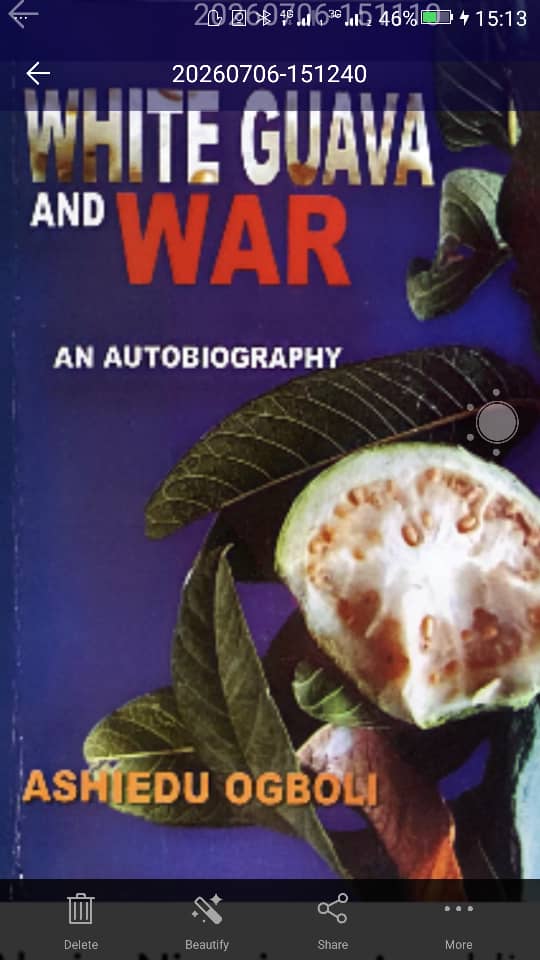
Book Title: White Guava and War
Author: Ashiedu Peter Ogboli
Publisher: Ahmadu Bello University Press Ltd
Year of Publication: 2026
Reviewer: Joseph Ollor Obari, Esq
Way back in my days as Maiduguri correspondent of The Guardian, I had written a pre-publication review of a collection of short stories, Balaraba V-Boot by Ashiedu Ogboli. It was an interesting read that got a positive review in The Guardian.
When I got Ogboli’s 132-page White Guava and War, I read it with some Balaraba nostalgia. The new book was published early this year alongside the author’s more academic work, Readings in Art Design Culture.
On the pages of this racy writing, we journey with the author from the innocence of his Isele Ukwu birthplace through early school days to when he had to confront challenges of adulthood; his crucible. He takes us to the crossroads of his life and leaves us there wondering if he made it or not.
It is a simple story told in a uniquely powerful way in the rich flow of words that evoke imageries. The author thrusts us into a cascade of memories; we see rolls and rolls of events that shaped the early days of the author pass before us.
As these images assail us, Ashiedu in twelve chapters, leads us into serious contemplation of the challenges that a young mind has to grapple with in a war zone and other themes. And it is this juxtaposition of childhood experiences and the seriousness of life that marks out this work’s uniqueness.
In the New World chapter, the author narrates how his father’s career impacted the entire family and how it contributed to shaping his life into what it is today. His father, an educationist, had been seconded to the government of then North Central State just after a bitter Civil War, so they embarked on a road journey from the present-day Delta State, surmounted challenges and arrived safely in Kaduna. Kaduna was a culture shock for the family, but they gradually eased into life there. This and many new experiences opened the author’s eyes to the complex social mix that is Nigeria. He ponders how a posting that was meant as uniting gesture by the Mid-West government, could elicit subtle hostilities that stemmed from distrust.
Despite this, we also see a different Nigeria. One that attracted foreign nationals and was still innocent enough to hesitantly explore interethnic experimentation. This chapter also revealed to us the root of the author’s life path as he tells us about the foundation of his artistic career:
My parents seemed to have notice that I had an inclination for fanciful artistic things, that I constructed imaginary situations, families, beings and cities. I conducted conversations between all the characters all by myself. It seems that I was in tune with the Muse.
The chapter A Young Man Emerges dwells essentially on his transition into adulthood, his university education and fundamentally the broadening of his artistic foundation at the then University of Ife (now Obafemi Awolowo University, Ile Ife) and later, Ahmadu Bello University, Zaria along with some mischievous exploits.
The rest of the book covered the author’s experiences after graduation: the National Youth Service, a trip to London, contemplations on the way forward, his employment by the University of Maiduguri, the end of his first ‘missionary journey’ at the university, his entrepreneurial frustration and the return back home to his parents.
For anyone that knows Ogboli, this is an incomplete account, because the book ends at a point of his life when he faces internal battle; at a point when he saw himself as an infantry man who must summon inner strength and climb back to victory.
To the uninitiated, White Guava and War reads like the first part of a serial with the part two missing, since the author returned to the University of Maiduguri and climbed to the pinnacle of his career as a Professor of Industrial Design that he is today.
The literary success of this book lies in its use of poetic prose and the author’s skilful play with allusions, metaphors, humour and emotive symbolism in the simple rendition of complex themes.
On page 86, the author relives the emptiness of Nigeria’s national unity rhetoric as exemplified by his father’s experience in North Central Nigeria and wonders aloud, “What did my father’s experience teach me about National Unity of Nigeria?”
And long before the japa phenomenon, Ash as a young person had faced the reality of emigration. The lesson he took away from his trip to London forms the piece of advice on page 83, which is even more relevant today than it was at the time.
Ogboli debates the role of art and culture in society. His stubborn approach to interpreting life through his own lenses is portrayed in his narration of the shock that greeted his exhibitions on campus. And he argues:
Out of complacency, perhaps, many viewers of paintings and art quickly conclude that “beauty” is the reason for the creation of Art. I do not think that this should be so. I wanted to say so openly. This was probably a polemical stance. It challenges many of the materials that art teachers in Nigerian Art Departments preach. That mantra tends, to my mind, to tie up art in narrow commercialism, and “enslaves” the artist in a noble savage Prospero and Caliban relationship that ultimately and erroneously tend to be as touted as artistic achievement.
In the chapters Travails of the Royal Palm and Hard Knocks the author reveals his struggles in the Nigerian enterprise world and the challenges that still plague publishing till date.
As the industrial atmosphere in Nigerian universities became toxic, he took a leap of fate to dive into the world of commerce, and he then faces full-blast how capricious it is. From managing factory workers to music production, Ogboli finds himself like fish out of water and had to abandon ship.
White Guava and War can be said to be a reflective autobiographical work that masterfully weaves personal experiences around serious themes. It is sometimes humorous, at other times provocatively descriptive and intellectually engaging.
This book is not just a story of Professor Ashiedu Ogboli. It is also a social commentary on the events that happened around him; the Civil War, spirituality, death, ethnic identity, military adventurism, major political developments of his times, and cultural dynamism. The author weaves between the past and present reinterpreting major national issues and addressing pertinent questions that agitate the average Nigerian.
It is an ideal read for art teachers, students and book lovers.
Joseph Ollor Obari, Esq is a lawyer, media trainer, and a public relations consultant.