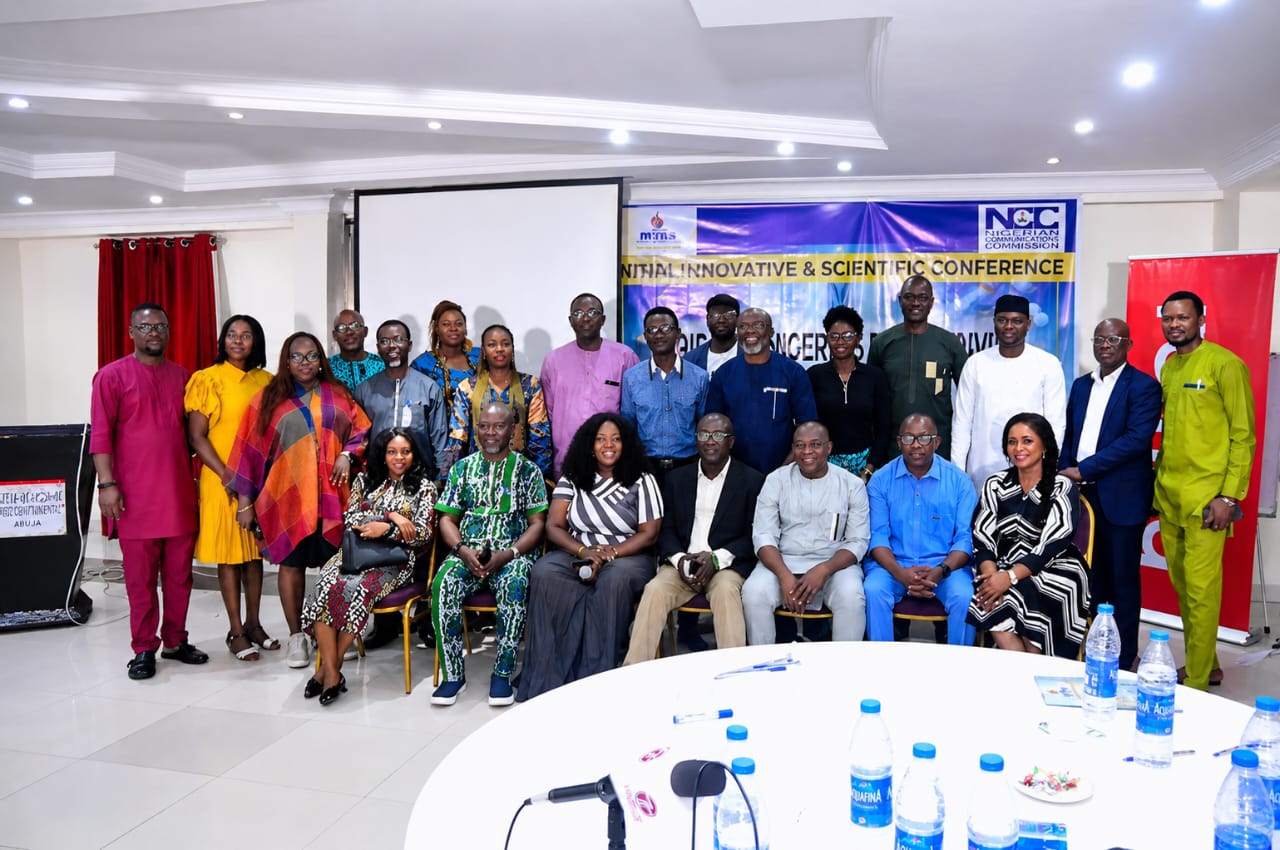
From Cyriacus Nnaji, Lagos
The Nigeria Information Technology Reporters Association (NITRA) has held its Innovative and Scientific Conference on Thursday, July 23rd, 2026, at Citi Height Hotel, Ikeja, Lagos, bringing together government agencies, industry leaders, and policymakers to explore strategies for bridging Nigeria’s digital divide through scientific innovation.
Themed “Bridging Nigeria’s Digital Divide With Scientific Innovation,” the conference featured a panel discussion titled “The Place of Policy and Infrastructure in Nigeria’s Quest for Global Competitiveness through Scientific Innovation: Roles of Different Stakeholders in Grassroots Mobilisation.”
Industry leaders identified multiple taxation, prohibitive right-of-way costs, and inconsistent state-level policies as major obstacles slowing infrastructure rollout. One panelist noted that transporting bandwidth from Lagos to Canada is cheaper than delivering services to other parts of Nigeria due to transport access limitations. He explained: “When we talk about right of way limitation, it plays on cost of providing services to some subnationals. Some states say right of way is free, but when they give you free right of way, they add other elements—development charge, education levy, infrastructure fee—and all of that makes a mess of the free right of way.” He called for harmonised policies to ensure affordable internet access across the country.
Another panelist, representing telecoms operators, stressed that policies must not favour only dominant players. “Policy should not get higher; it’s just for the food. That’s why the policy is not for instance, cyber security will not work,” he said, adding that regulatory engagement with the industry had seen some improvement.
A representative of a private sector innovation fund shared insights from supporting young innovators through essay competitions and grants. “We believe that by helping people think—helping the educational system, people in secondary school, primary school—from that young age, they think wide and broadly about what innovation looks like. By opening up those eyes at that young age, the older they become, they can fall into these opportunities.” He stressed that innovators exist everywhere, including rural villages, and need exposure to thrive.
On cybersecurity capacity building, a panelist emphasised grassroots talent development. “Part of what we are known for is the development of local talent. We don’t just import talent or rely on experts from overseas. We bring in interns from schools, and they go through the element of understanding what cybersecurity is.” He suggested rehabilitation over incarceration for young cyber offenders: “We need to find a way to retain them. Not necessarily put them in jail, but ensure we have programs to harness their talents.”
A representative from the computer society sector outlined a roadmap starting from primary education. “If Nigeria is going to be globally competitive, we start from primary school level. At that level, we need to teach them early—bring coaching, robotics to them. Our schools should not just be examination centers; we should make our schools innovation clubs,” he said, citing the recent launch of an AI university portal in Lagos that builds a digital talent pipeline from primary school to university.
On the role of regulation, a media analyst cautioned against over-regulation. “Regulation must come with discussion. In the first phase, regulators should be looking at how to build things so they don’t stifle innovation. If you bring so much regulation, that stifles innovation,” he said, noting that Nigeria is currently considering AI regulation and must strike the right balance.
On infrastructure protection, a panelist stressed the need for community awareness. “When infrastructure is not protected, who will feel the brunt of it? The regulator will feel it, the operator will feel it. When locals need money, they go and vandalise sites. We need to do a lot more public awareness. People need to own their behaviour—even on social media, they need to have the conscience that they own their behaviour.”
Addressing affordability, one speaker called for government subsidies similar to the petroleum sector. “Telecommunications companies are businesses, not charity organisations. What government can initiate is a subsidisation policy. Just like they did in the petroleum sector, if they can do that, it will drag down the price of devices,” he said, while another noted that “the child that has access to electricity 24 hours—we cannot compare the global competitiveness of that child with a child in Nigeria that has not seen light for six months. For Nigeria to be globally competitive, the Nigerian child should be provided electricity 24 hours, internet connection 24 hours, and opportunity for skill acquisition.”
NITRA Chairman, Chike Onwuegbuchi, had earlier noted that the conference was designed to provide a platform for stakeholders to discuss policies that would strengthen scientific innovation and promote grassroots technological development. The Federal Government, he said, has demonstrated growing commitment to building an innovation-driven economy through strategic programmes.
Founded in 2013, NITRA is the umbrella body for journalists covering Nigeria’s information and communications technology sector.