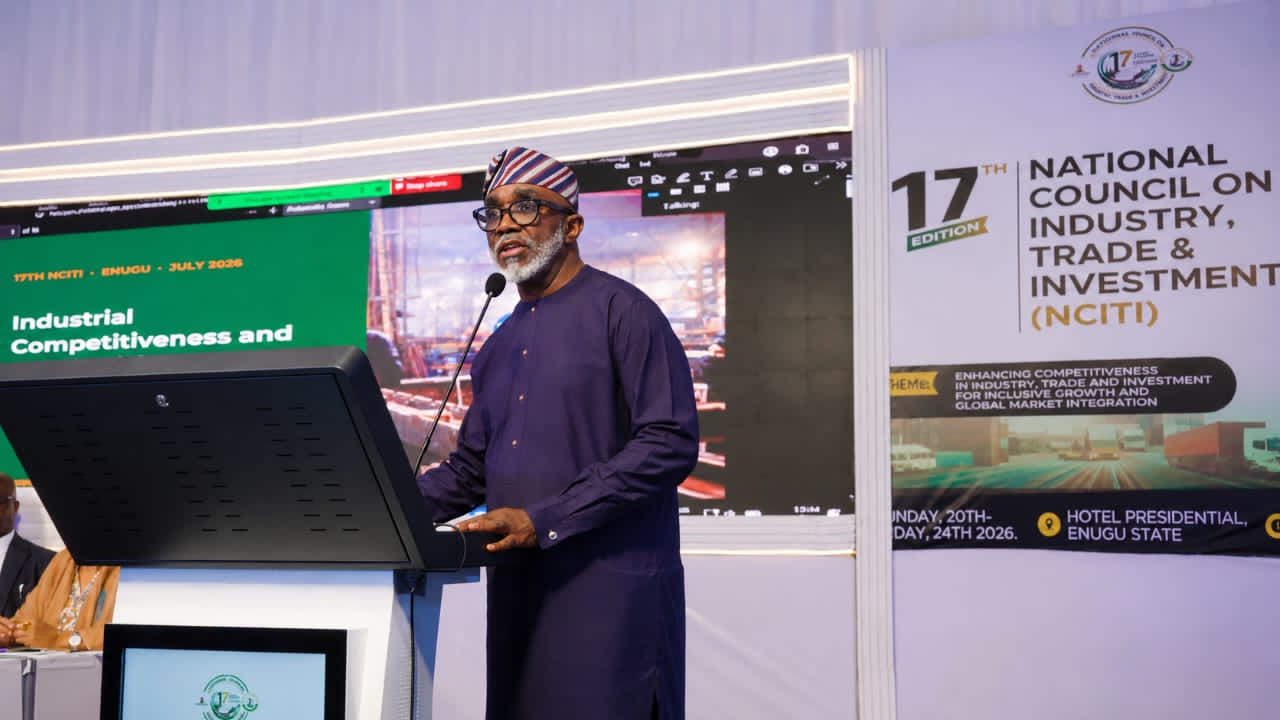
The Executive Secretary of the National Sugar Development Council (NSDC), Mr. Kamar Bakrin, speaking on Industrial Competitiveness and Productivity Enhancement during the 17th meeting of the National Council on Industry, Trade and Investment (NCITI) held in Enugu.
By Felix Khanoba
Executive Secretary of the National Sugar Development Council (NSDC), Mr Kamar Bakrin, has called for a decisive steps to reduce the high cost of production, warning that Nigeria risks losing the African market if manufacturers remain burdened by expensive power, financing and logistics.
Speaking during the technical session of the 17th National Council on Industry, Trade and Investment (NCITI) in Enugu, Bakrin presented a four-point strategy aimed at making Nigerian industries more competitive and positioning the country to take full advantage of opportunities under the African Continental Free Trade Area (AfCFTA).
According to him, manufacturers in Nigeria spend between two and ten times more than their counterparts in countries such as Vietnam and China on critical production inputs, making locally produced goods less competitive despite the country’s vast market potential.
Illustrating the challenge, Bakrin compared two factory managers operating identical production lines in Aba, Nigeria, and Ho Chi Minh City, Vietnam, noting that while both employ capable workers and target similar markets, the Nigerian manufacturer bears significantly higher costs for electricity, financing and transportation.
He disclosed that industrial electricity costs around eight US cents per kilowatt-hour in Vietnam and about 10 cents in China, while manufacturers in Nigeria pay approximately 15 cents on the national grid, with costs climbing to nearly 30 cents whenever diesel-powered generators are used.
Bakrin revealed that Nigerian manufacturers spent an estimated ₦1.34 trillion generating their own electricity last year.
“Every factory in Nigeria is running a second, unwanted business as a private power station,” he said.
He also noted that manufacturers pay between 27 and 35 per cent interest on working capital loans, compared to about nine per cent in Vietnam and three per cent in China.
In addition, he said Nigeria ranks 88th out of 139 countries on the World Bank’s Logistics Performance Index, trailing Vietnam, which ranks 43rd, and China, which occupies the 19th position.
These challenges, he said, have contributed to manufacturing accounting for only about eight per cent of Nigeria’s Gross Domestic Product, while factory capacity utilisation has fallen to 57.7 per cent despite the country’s population of about 230 million people and access to a duty-free African market of 1.4 billion consumers.
“None of this is a demand problem. Nobody on this continent needs persuading to buy what Nigeria makes,” he said. “It is a cost-of-production problem — and that distinction matters, because costs, unlike demand, are within our power to fix.”
Bakrin argued that current economic conditions provide a unique opportunity for industrial growth, noting that recent macroeconomic reforms have improved stability, reduced inflation from its peak and raised Nigeria’s foreign reserves to about $51 billion, the highest level recorded since 2009.
He said the changing nature of global supply chains also presents opportunities for Nigeria to attract manufacturers looking to diversify production bases.
“A factory anchored in another country this decade will not move twice,” he said.
On the opportunities under AfCFTA, Bakrin stressed that Nigeria must either emerge as a leading exporter or become a destination for products manufactured elsewhere on the continent.
“Either our goods are crossing borders going out, or everyone else’s goods are crossing ours coming in. We are either going to compete, or we are going to concede the market.”
To demonstrate that industrial transformation is achievable, Bakrin cited the remarkable growth of Nigeria’s urea industry, which expanded production capacity from about 500,000 tonnes in 2005 to 6.5 million tonnes, making the country one of the world’s top ten exporters of nitrogen fertiliser.
He attributed the success to a deliberate policy of treating natural gas as a strategic industrial input rather than merely a source of government revenue.
“The whole lesson is in one sentence,” he said. “When a country prices inputs as if it wants industry to live, industry lives,” the NSDC boss said.
Drawing comparisons with Vietnam and Bangladesh, he added:”Neither of them struck oil. They struck discipline — and held it for twenty years.”
Bakrin outlined measurable targets that he believes are essential to improving Nigeria’s competitiveness, which include reducing electricity costs for industrial clusters to between eight and 10 US cents per kilowatt-hour, providing single-digit interest loans for manufacturers, reducing port clearance time from the current 18 to 21 days to less than seven days, and doubling workers’ productivity by 2030.
“These are not aspirations to admire,” he said. “They are the line at which a made-in-Nigeria product stops apologising.”
To achieve these objectives, he proposed four key resolutions for adoption by the Council.
The first called on every state government to establish at least one industrial cluster with a dedicated power arrangement within the next 12 months.
The second recommends a federal-state partnership to harmonise taxes and eliminate informal checkpoints along industrial corridors.
The third seeks the creation of an annual State Industrial Competitiveness Index to publicly rank states based on power supply, land administration, taxation and logistics performance.
The fourth advocates strict enforcement of Nigeria First procurement policies at both federal and state levels through quarterly compliance reports.
“Every resolution needs a named owner, a date and a way to measure it. Otherwise it becomes another document that gets filed, framed and forgotten,” he said.
Bakrin further maintained that government incentives should remain performance-driven.
“Nothing should be handed out as an entitlement — because once it is, it can never be taken back,” he added.
He urged state governments to leverage the Electricity Act 2023 to develop functional electricity markets, simplify land acquisition for industries, harmonise multiple taxes and align technical education with the manpower needs of targeted industries.
On the proposed competitiveness ranking, he remarked: “We rank our football clubs every weekend. We can manage to rank our investment climates once a year.”
Beyond economic indicators, Bakrin said improving industrial competitiveness would create employment opportunities for the estimated four million young Nigerians entering the labour market annually, reduce prices through increased local production, strengthen the naira by replacing imports with locally manufactured goods and expanding exports, and stimulate balanced economic growth across the country’s six geopolitical zones.
He also described industrialisation as the most effective response to the growing trend of youth emigration.
He therefore urged the Council to make future meetings more result-oriented by assessing progress against measurable targets, including raising manufacturing’s contribution to GDP to 15 per cent, lowering industrial electricity costs to about 10 US cents per kilowatt-hour, reducing lending rates for manufacturers to below 10 per cent, cutting port clearance to under seven days, expanding exports across Africa and creating productive jobs for four million new entrants into the workforce each year.
“The reform half of Nigeria’s story has been written,” he said. “The industrial half will be written in kilowatt-hours, lending rates and port days. The window is open. No window stays open forever.”