By Jane Okeke
The Federal Government has unveiled a comprehensive 10-year National Agri-Food Systems Strategy and Action Plan aimed at transforming Nigeria’s agricultural sector, strengthening food security, reducing poverty and creating millions of jobs.
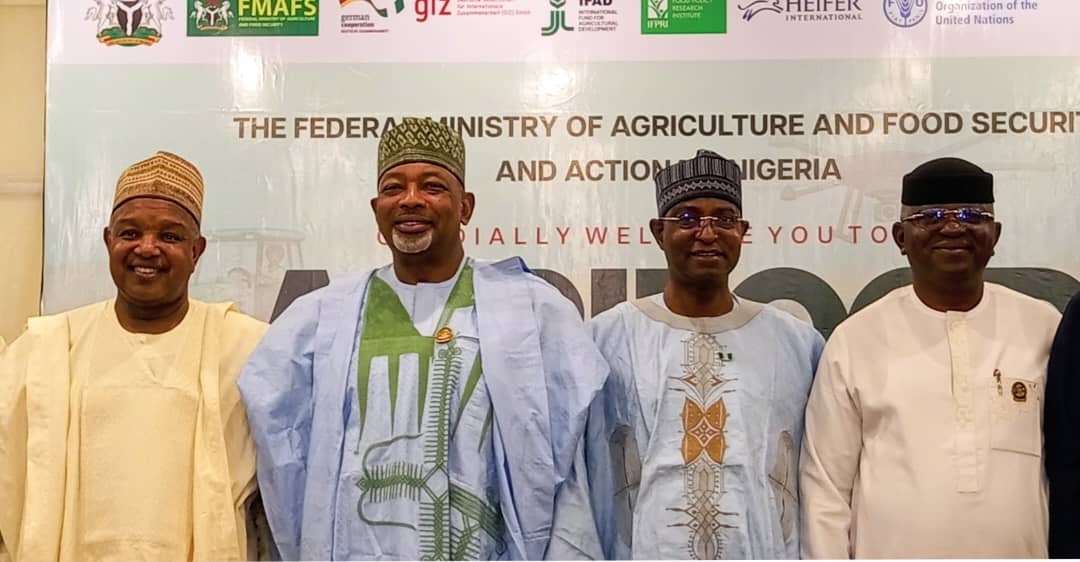
Speaking at the second Biannual Agri-Food Systems Working Group meeting in Abuja, the Minister of Agriculture and Food Security, Senator Abubakar Kyari, said the strategy was developed in line with the African Union’s Kampala Declaration (2026–2035) and President Bola Tinubu’s Renewed Hope Agenda.
Kyari said the plan would be presented for adoption by stakeholders before its submission to the Federal Executive Council (FEC) for approval, giving it legal backing across all Ministries, Departments and Agencies (MDAs).
He described food security as a national security priority, stressing that President Tinubu had directed the ministry to develop a bankable, implementable roadmap capable of transforming Nigeria’s agri-food system over the next decade.
According to him, extensive consultations were held across the six geopolitical zones to ensure national ownership of the strategy.
”The President has charged us to move beyond fragmented interventions and deliver a coherent, implementable plan that will fundamentally transform Nigeria’s agri-food system,” Kyari said.
He noted that the strategy aligns Nigeria with the Kampala Declaration, which seeks to increase agri-food output, expand intra-African agricultural trade, reduce post-harvest losses, improve nutrition and attract increased investment into agriculture.
Highlighting achievements under the Tinubu administration, the minister disclosed that 500,000 farmers had been financed through the Smallholder Financing and Value Chain Fund implemented by the Bank of Agriculture in partnership with 21 farmer aggregation companies.
He added that over two million bags of fertiliser and 34,000 metric tonnes of improved seeds had been distributed, while the government’s target is to support two million farmers during the current wet and dry farming seasons.
Kyari also said the National Agricultural Development Fund (NADF) had distributed more than 500,000 bags of free fertiliser to over 120,000 farmers across 25 states and the Federal Capital Territory, while disbursing more than ₦16 billion in agricultural loans across key value chains.
He further disclosed that the Renewed Hope Agricultural Mechanisation Programme had deployed 2,000 tractors and other farm equipment nationwide, while one million improved hybrid cocoa seedlings had been distributed to boost cocoa production.
According to the minister, these interventions have contributed to a gradual reduction in food prices across the country.
Also speaking, the Minister of Budget and Economic Planning, Senator Abubakar Atiku Bagudu, said achieving food security requires collaboration among the federal, state and local governments as well as the private sector.
Bagudu said President Tinubu had challenged his ministers to lift Nigerians out of poverty by 2030 through inclusive economic policies.
He noted that Nigeria’s agricultural sector is supported by over 42 million farming households, making agriculture central to poverty reduction and national development.
”Our agriculture is largely driven by the private sector. Government’s responsibility is to create an enabling environment that makes farming profitable and sustainable,” he said.
The minister added that reforms such as the creation of the Ministry of Livestock Development and the transfer of fisheries to the Ministry of Marine and Blue Economy demonstrate government’s commitment to repositioning agriculture.
Bagudu acknowledged that rising global energy prices, climate change and trade distortions continue to impact food production but maintained that Nigeria was making progress in addressing insecurity affecting farming communities.
He cited the resumption of farming activities in Damasak, Borno State, after years of insurgency as evidence of improving security.
Meanwhile, ActionAid Nigeria called on governments at all levels to increase agricultural spending to meet continental commitments.
Presenting findings from budget performance tracking, ActionAid’s Food Systems Specialist, Azubike Nwokoye, said only 10 states recorded high capital expenditure on agriculture in 2025, while many states allocated less than the recommended benchmark.
He said Nigeria currently spends only about 4.58 per cent of its budget on agriculture, far below the 10 per cent target under the Maputo and Malabo Declarations.
According to him, meeting the target could generate about 3.5 million direct jobs across the country.
The Economic Community of West African States (ECOWAS) also commended Nigeria for becoming the first country in West Africa to domesticate the Kampala Declaration through a national agri-food strategy.
Delivering a goodwill message on behalf of the ECOWAS Commission, officials described the initiative as a model for other countries in the region and pledged continued support for Nigeria’s agricultural transformation agenda.
Similarly, the German Development Agency (GIZ) pledged support for the implementation of the strategy, describing stakeholder collaboration as critical to strengthening food and nutrition security across Nigeria.
Nigeria Unveils 10-Year Agri-Food Strategy to Boost Food Security, Create Millions of Jobs