By Felix Khanoba
The Federal Government has announced a renewed drive to tackle illiteracy in Nigeria through expanded adult and non-formal education programmes, the activation of community learning centres and increased investment in infrastructure.
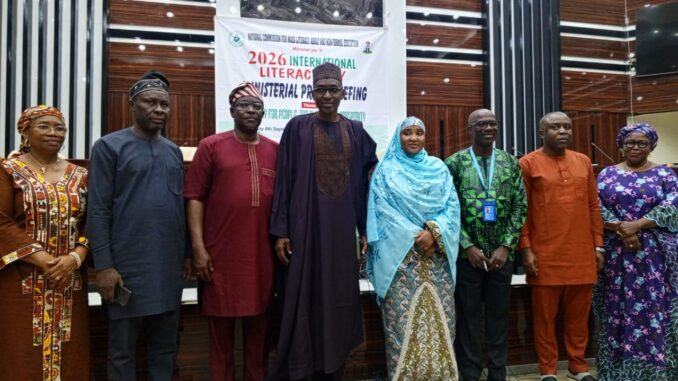
The Minister of State for Education, Prof. Suwaiba Ahmad, disclosed this on Friday in Abuja while addressing journalists to mark the 2026 International Literacy Day, themed, “Literacy for people, the planet and prosperity.”
Ahmad said the government was expanding infrastructure for adult and non-formal education across the country, including plans to establish a new National Centre for Adult Education and provide a permanent headquarters for the National Commission for Mass Literacy, Adult and Non-Formal Education.
She added that community learning centres were being activated, with staff of the commission expected to serve as instructors, particularly in communities where access to conventional education remained limited.
According to the minister, the initiative would create flexible learning opportunities for young people and adults who could not access or complete formal education.
She also called for stronger participation by stakeholders outside government, stressing that the scale of youth and adult illiteracy required a collective response.
On Nigeria’s progress towards Sustainable Development Goal 4, which promotes quality and inclusive education, Ahmad expressed optimism that the country was making significant progress.
“A major milestone in this effort is the full restoration of academic autonomy, a critical step for a healthy plan for education. For too long, the Commission has operated under significant constraints. We are now addressing these challenges head-on.
“This innovative approach addresses the perennial challenge of sustaining participatory students while expanding access to literacy opportunities. The centres will provide flexible, accessible pathways for young people and adults who miss out on formal education.
“I can assure you that we have gone very far in terms of achieving SDG 4. SDG 4 is not just about adult literacy, but about education generally. I can assure you we are very well on track,” she said.
The minister further assured that rural communities would be carried along in government programmes involving digital technology and artificial intelligence in teacher training.
“We are very conscious of that. We are ensuring that both rural and urban teachers, because of your location, are not at a disadvantage,” she said.
Ahmad charged the new leadership of the commission to adopt a more proactive and inclusive approach in implementing its mandate.
“You need to do more. You need to be more proactive. Ensure that whatever you do, you carry along every sector. Our mission is clear, to eradicate illiteracy and provide inclusive, lifelong, non-formal, and continuing education for sustainable development,” she said.
Meanwhile, the newly appointed Executive Secretary of NMEC, Prof. Dahiru Muhammad Shuni, raised concerns over the lack of current data on Nigeria’s literacy situation.
Shuni disclosed that the available literacy data dated back to 2010, describing the situation as unacceptable.
He said the commission had commenced efforts to obtain accurate and up-to-date figures on the number of Nigerians affected by illiteracy.
“When I came in, the first thing I asked was to obtain the data. I was informed that the data available was obtained since 2010. That’s why I mandated my staff to get accurate data. Right now, our people are on the field getting the data,” he said.
Also speaking, the Head of Education Sector at the UNESCO Abuja office, Mr. Oladeji Adeyemi, said global literacy had improved considerably over the past decade but noted that millions of people remained affected by illiteracy.
Adeyemi said more than 88 per cent of the world’s population could now read and write, compared with about 65 per cent a decade ago.
He reaffirmed UNESCO’s commitment to partnering with Nigeria and other member states to promote literacy and education as tools for sustainable development.
Citing Kano State as an example, Adeyemi said UNESCO-supported programmes had helped expand mass education beyond basic reading, writing and numeracy to include health and well-being education under family-life initiatives.
“Kano State is doing very well with regards to mass literacy, especially due to support from UNESCO. We’re on the right course and supporting the government for the education of Nigerians,” he said.