By Felix Khanoba
The Small Scale Women Farmers Organisation in Nigeria (SWOFON) has called for greater accountability in agricultural spending, saying the increased participation of women farmers in budget processes has yet to consistently translate into identifiable budget provisions, timely releases and tangible projects.
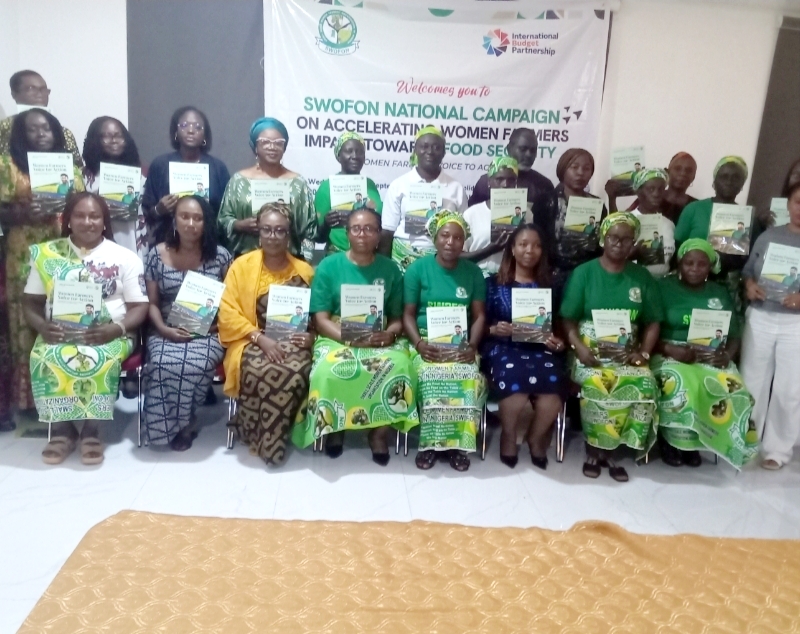
The organisation made the call on Wednesday in Abuja at its National Campaign, Policy Brief Launch and Press Briefing on the challenges confronting smallholder women farmers in Nigeria.
The campaign, tagged “Women Farmers’ Voice to Action,” brought together smallholder women farmers, government officials, civil society organisations, development partners, journalists and other stakeholders to deliberate on women farmers’ priorities and their inclusion in agricultural policy, budgeting and implementation.
In a joint presentation of text of press briefing by SWOFON National Secretary, Chinasa Asonye, and National Treasurer, Petuniya Kefas, the organisation said women farmers had made progress in gaining access to government platforms but that such participation had not been matched by corresponding fiscal commitments.
“Smallholder women farmers remain central to Nigeria’s food production, rural livelihoods and household welfare. Yet many continue to face persistent barriers to land, finance, agricultural inputs, mechanisation, extension services, markets and meaningful participation in decisions that affect their livelihoods.
“Through the ‘Women Farmers’ Voice to Action’ campaign, SWOFON is calling for stronger links between the realities experienced by smallholder women farmers, evidence-based advocacy, government commitments and measurable action,” the organisation said.
SWOFON said its assessment of its 2019–2025 in partnership with the International Budget Partnership (IBP) under the SPARK project showed that organised women farmers had secured greater recognition and participation in state budget processes in Nasarawa, Niger, Anambra, Oyo and Jigawa states.
According to SWOFON, all five state chapters submitted Charters of Demands to relevant government institutions during the period under review, with the submissions acknowledged.
However, it said the assessment revealed a gap between participation and actual budget responsiveness.
“The available evidence does not consistently demonstrate that women farmers demands were translated into identifiable state budget lines, timely releases, expenditure and verifiable delivery,” the group said.
SWOFON also raised concerns over the gap between Nigeria’s agricultural budget and the country’s advocacy benchmark under the Maputo/Malabo commitment.
It said Federal Government allocations to agriculture rose from ₦228.4 billion in 2023, representing about 1.05 per cent of the federal budget, to ₦362.94 billion in 2024, or 1.32 per cent, and ₦826.5 billion in 2025, representing 1.7 per cent.
Despite the increase, the organisation said agriculture’s share of the national budget remained substantially below the 10 per cent Maputo/Malabo benchmark.
SWOFON said the reported 2025 federal budget of about ₦49.7 trillion would translate to approximately ₦4.97 trillion if 10 per cent were allocated to agriculture, compared with the reported ₦826.5 billion allocation, indicating a gap of about ₦4.14 trillion.
“The increase in nominal allocations is therefore important but should be considered alongside the scale of Nigeria’s agricultural financing needs and the extent to which approved resources are actually released, spent and converted into services and productive assets,” the organisation said.
It added that its advocacy was not limited to increasing agricultural allocations but also ensuring that a meaningful proportion of public resources addressed the specific needs of smallholder women farmers.
The group listed access to land, affordable finance, improved inputs, mechanisation, extension services, irrigation, storage, markets and climate-resilient agricultural technologies among the key areas requiring attention.
“These findings reinforce the need to move beyond budget approval to tracking the full public finance cycle from allocation and release to expenditure, implementation and actual delivery to farmers,” they said.
The organisation further called for its Charter of Demands to become a practical tool for securing identifiable and costed government commitments.
It said priority demands should be converted into budget lines with clearly identified beneficiaries, locations, responsible agencies, timelines and measurable delivery indicators.
SWOFON also urged governments to involve women farmers in agricultural planning and budget processes at the local government level, arguing that local authorities are closest to farming communities.
“Local governments are closest to communities and play important roles in areas affecting farmers’ everyday lives. Creating formal opportunities for women farmers to contribute to local agricultural priority setting would strengthen the connection between community needs, public budgets and service delivery,” they said.
The organisation called on the Federal and state governments, local government councils, the National and State Houses of Assembly, development partners, civil society organisations, private-sector players and the media to work with women farmers to build a more inclusive and accountable agricultural system.
“SWOFON therefore calls on the Federal Government, State Governments, Local Government Councils, National and State Houses of Assembly, development partners, civil society organisations, private sector actors and the media to work with women farmers to build a more inclusive, accountable and responsive agricultural system.
“This is the time to move women farmers voice to action.
“Smallholder women farmers are not only beneficiaries of agricultural development. They are producers, economic actors and critical stakeholders in Nigeria’s food security. Their voices must be reflected in the policies, plans and budgets that shape the agricultural sector,” the organisation added.
Earlier, SWOFON Acting National President, Ojo Florence, said the campaign would help accelerate the economic impact of women farmers and contribute to food security.
She said, “Our voice to action is to promote a better agricultural policy, adequate and budgetary provision, which we have advocated before.
“When we invest in woman farmer, we invest in a strong family and community and a better future for our nation.”
Florence urged policymakers, particularly government officials, to involve women farmers in the preparation and implementation of agricultural budgets.
“So we want also, call us, put us in your budgeting, and when we want to make a decision-making, let our woman farmer to be on the table policy,” she said.
In a goodwill message, the Chairman of the House of Representatives Committee on Agricultural Production and Services, Hon. Bello Kaoje, represented by Aggreh Oluwabunmi Agbeke, expressed lawmakers’ commitment to policies aimed at empowering farmers, particularly women.
While commending SWOFON for its activities, the lawmaker said the future of Nigerian agriculture rests on smallholder farmers.
The event, which was organised with the support of IBP, also featured a panel session during which concerns were raised over the quality of agricultural inputs supplied to farmers.
One of the panellists said some government-provided farm inputs, including rice seedlings and fertiliser, were totally bad and called for the supply of better inputs to farmers.
The event also featured the presentation of key findings and recommendations from SWOFON’s policy brief.
Representatives of the Federal Capital Territory Administration, Ministry of Women Affairs, Ministry of Agriculture, International Budget Partnership and ActionAid, among others, attended the event.