By Chuks Oyema-Aziken
The Federal Government has been urged to grant three-to-five-year tax holidays to solar manufacturers, impose 10 to 20 per cent tariffs on imported finished panels, and enforce 30 to 50 per cent local content quotas in government-funded electrification projects.
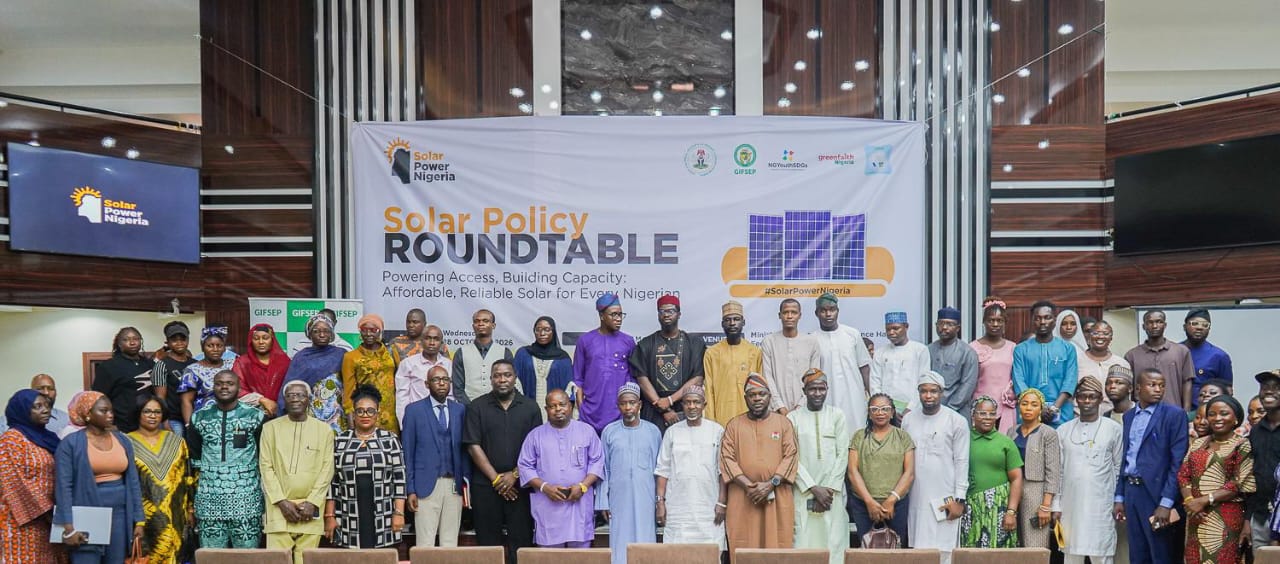
The recommendations were contained in a policy brief presented at the Abuja Solar Policy Roundtable on Wednesday, which advocated a phased, three-to-five-year localisation strategy to boost domestic production without making solar energy unaffordable.
The roundtable, organised by the Global Initiative for Food Security and Ecosystem Preservation (GIFSEP) and the Solar Power Nigeria Campaign, also proposed zero duties on essential manufacturing inputs, concessional loans and stronger quality controls.
GIFSEP Executive Director and campaign co-convener, Dr Michael T. David, said Nigeria must convert growing solar demand into jobs, technical expertise, investment and industrial development.
David said Nigeria imported approximately 2.9 million solar panels worth ₦435.52 billion in 2025, citing National Bureau of Statistics foreign trade data. He added that Nigeria ranked as Africa’s second-largest solar panel importer, according to the Global Solar Council.
He commended the Minister of Innovation, Science and Technology, Dr Kingsley Tochukwu Udeh, for opposing an import ban before local manufacturers develop sufficient production capacity, warning that premature restrictions could increase prices and limit access.
The policy brief noted that local solar assembly and battery manufacturing were growing but remained insufficient to meet national demand, urging the government to link import restrictions to verified production capacity, quality and affordability.
The Special Assistant to the President on Climate Change Matters, Comrade Yussuf Olatunji Kelani, said affordable and reliable energy was essential to Nigeria’s climate goals, economic development and national resilience.
Kelani said solar energy could create jobs, attract investment and improve electricity access but warned that localisation policies must not increase costs for households and underserved communities.
He identified the Electricity Act 2023, National Renewable Energy and Energy Efficiency Policy, Energy Transition Plan and Nigeria’s Nationally Determined Contribution 3.0 as frameworks for advancing renewable energy.
The policy brief recommended enforcing international solar panel standards, conducting factory audits and establishing testing laboratories to curb counterfeit and substandard products.
It also called for national certification of solar technicians, expanded practical training and retraining of generator technicians to meet growing renewable energy demand.
The roundtable urged the government to prioritise certified locally manufactured solar equipment in public electrification projects, including Solar Power Naija and the Nigeria Electrification Project, where capacity and competitiveness permit.
To lower production costs, it recommended dedicated power supplies for manufacturing zones, faster land allocation, and affordable long-term loans and credit guarantees for local manufacturers.
The brief further proposed university-industry research partnerships to develop local technologies, improve recycling of solar panels and batteries, and strengthen technical skills.
It concluded that Nigeria should pursue local solar manufacturing without an immediate import ban, measuring success through affordable electricity, quality products, job creation and improved energy access.