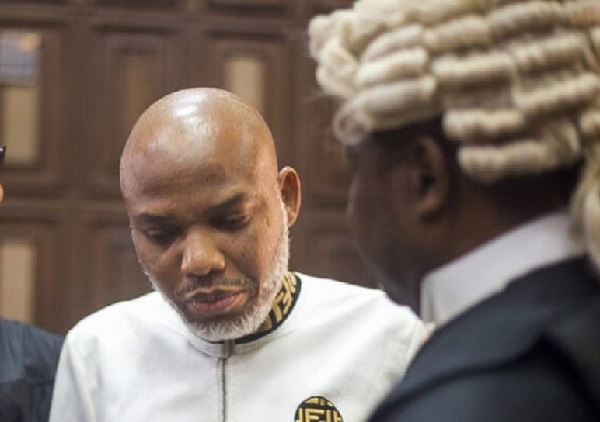
The Indigenous People of Biafra (IPOB) has faulted the United Igbo Political Congress (UIPC) over its position on the conviction of its leader, Nnamdi Kanu, insisting that the six terrorism counts against him were based on a repealed law.
Reacting on Wednesday to UIPC’s statement, IPOB through its media officer, Rev. Chimezie Ochụlọ, said the Terrorism Prevention (Amendment) Act 2013, under which it alleged the counts were brought, had been repealed by the Terrorism (Prevention and Prohibition) Act 2022.
The group was reacting to a statement issued by the UIPC on October 27 and signed by High Chief Major (Dr.) C.O.C. Uzor (Rtd.).
IPOB disagreed with the UIPC’s position that the question of whether Justice James Omotosho breached Section 36(12) of the Constitution in convicting Kanu should be determined by a competent court, particularly the Court of Appeal.
According to IPOB, the judgment delivered on November 20, 2025, showed that the repealed 2013 legislation was relied upon in convicting Kanu on the six terrorism counts.
“The Nigerian Constitution says plain and clear: You cannot jail someone using a law that no longer exists,” the group said.
IPOB argued that the repeal of the legislation raised questions about the legal basis of the conviction. It maintained that the issue should not be dismissed as one that could only be examined through appellate proceedings.
IPOB also raised concerns about the progress of Kanu’s appeal, alleging that he filed the appeal on February 4, 2026, and served the government with the relevant documents on June 5.
It claimed that the government had yet to file a response and that the court had not fixed a date for the hearing.
The group further said lawyers and members of Kanu’s family wrote letters on August 18 to the Chief Justice of Nigeria, the head of the Court of Appeal and the Chief Registrar, seeking intervention over the delay.
According to IPOB, the letters had not received responses as of the date of its statement.
The group questioned the pace of the proceedings, comparing the alleged delay in scheduling Kanu’s current appeal with earlier court proceedings involving his release.
It accused the UIPC of failing to address these concerns in its statement, arguing that discussions about due process should also consider the progress of the appeal.
IPOB also criticised the UIPC’s disclaimer that its statement did not constitute a legal opinion on pending court cases.
The group said it disagreed with the UIPC’s approach to the controversy surrounding the conviction and urged its supporters to reject the organisation’s position.
Kanu was convicted in November 2025 and sentenced to life imprisonment in a terrorism-related case.