By Stella Odueme
Nigeria’s Minister of Agriculture and Food Security, Senator Abubakar Kyari, has declared that the country is undergoing a major transformation in agricultural research, driven by science, innovation, institutional reforms and strategic investments aimed at guaranteeing national food security and positioning Nigeria as a regional leader in agricultural innovation.
Speaking on Nigeria Day at the 9th Africa Agricultural Science Week on Wednesday in Abuja, Kyari said the administration of President Bola Ahmed Tinubu has placed research and innovation at the centre of its agricultural transformation agenda, insisting that “the change is not merely coming; indeed, the change is here.”
Delivering a keynote address titled “Progress on Agricultural Research in Nigeria: The Change is Here – Harnessing Science, Innovation and Strategic Investment for National Food Security,” the minister stressed that no nation has attained lasting agricultural prosperity without sustained investment in science and research.
“Throughout history, no nation has achieved lasting agricultural prosperity without first investing in science. Countries such as Japan, the Republic of Korea, Brazil, India and China transformed their agriculture through sustained investment in research, innovation and strong institutions.
“The lesson is clear: prosperous agriculture is built on research, strategic investment, effective institutions and continuous innovation. For Nigeria, this lesson has never been more relevant.”
Kyari noted that as Africa’s largest economy and one of the continent’s leading agricultural producers, Nigeria recognizes that future food security depends not only on expanding farmland but also on expanding scientific knowledge.
He explained that under President Tinubu’s Renewed Hope Agenda, agricultural research has been elevated from a supporting function to a strategic national investment capable of driving productivity, resilience, competitiveness and long-term economic growth.
“The Renewed Hope Agenda places agriculture at the heart of Nigeria’s economic transformation because food security is fundamental to national security, economic growth and human development,” he said.
According to the minister, the Federal Government is simultaneously strengthening agricultural production, research, financing, mechanization, extension services, value addition and market development through an integrated approach rooted in evidence-based policymaking.
Kyari highlighted the critical role of the Agricultural Research Council of Nigeria (ARCN), describing it as the institution coordinating Nigeria’s extensive agricultural research system by aligning research priorities with national development goals while strengthening collaboration among research institutes, universities, extension services and the private sector.
He said government is repositioning research institutions to focus not only on scientific publications but also on developing technologies that increase productivity, create jobs, attract investments and improve farmers’ livelihoods.
“Our focus is no longer simply on generating scientific publications, but on developing technologies that increase productivity, create jobs, attract investment and improve farmers’ livelihoods,” he stated.
The minister disclosed that the government is investing heavily in modern laboratories, scientific equipment, digital technologies, research infrastructure and advanced training while encouraging stronger partnerships with development partners, universities, state governments and private investors.
A major milestone, according to Kyari, is the operationalization of the National Agricultural Development Fund (NADF), which he described as a game changer in agricultural financing.
He said the fund provides a sustainable financing mechanism for research, technology development, enterprise creation, value chain modernization and commercialization of innovations.
“The Fund marks a strategic shift in agricultural financing by providing a more sustainable mechanism to support research, technology development, enterprise creation, value-chain modernization and private-sector participation.
“More importantly, it bridges the gap between scientific discovery and commercial application, enabling innovations to move from laboratories to farms and markets.”
Kyari also announced that Nigeria is embracing digital agriculture through the deployment of artificial intelligence, remote sensing, geographic information systems, data analytics and climate-smart technologies to improve research, extension services and agricultural planning.
He added that government is strengthening agricultural extension through digital advisory platforms, value chain-based extension services and stronger collaboration between researchers and agribusinesses to ensure innovations reach farmers more rapidly.
According to him, commercialization of research outputs remains a major priority, with government promoting technology licensing, innovation incubation, agritech enterprises and public-private partnerships capable of transforming research into businesses and employment opportunities.
The minister said Nigeria’s agricultural innovation strategy now integrates research, financing, mechanization, digital transformation, climate resilience, extension and commercialization into a coordinated framework designed to boost food security, reduce poverty and stimulate economic growth.
“What distinguishes our approach is that these interventions are no longer implemented as isolated programmes. They form part of a coordinated national innovation strategy,” he said.
Looking ahead, Kyari said Nigeria is preparing for the future by investing in emerging technologies including biotechnology, robotics, genomics and artificial intelligence, warning that countries making such investments today will shape tomorrow’s global food systems.
“Our vision is to build an agricultural research and innovation system that is globally competitive, digitally enabled, climate-smart and commercially driven,” he said.
To achieve this, he outlined five strategic priorities: strengthening scientific excellence, accelerating digital transformation, promoting commercialization and private-sector participation, investing in human capital and expanding national, regional and international partnerships.
Kyari further revealed Nigeria’s ambition to become a regional centre of excellence in agricultural research and innovation by developing technologies that will contribute to agricultural transformation across Africa.
He urged African governments to increase investment in homegrown research, innovation and scientific institutions, stressing that sustainable agricultural transformation must increasingly be driven by African leadership and financing.
“Africa must invest more boldly in its own scientists, research institutions and innovation systems. While global partnerships remain important, sustainable agricultural transformation must increasingly be driven by African knowledge, African leadership and African investment,” he said.
Calling for stronger continental collaboration, the minister reaffirmed Nigeria’s commitment to working with the Forum for Agricultural Research in Africa (FARA), the African Union, AUDA-NEPAD, CGIAR Centres and regional economic communities to build a resilient and competitive African agrifood system.
“As we deliberate throughout this Science Week, let us move beyond dialogue to decisive action by investing in science, empowering our researchers and young innovators, and accelerating the commercialization of African technologies.
“Change is here; let us sustain it, let us accelerate it, and let us build it together,” Kyari concluded.
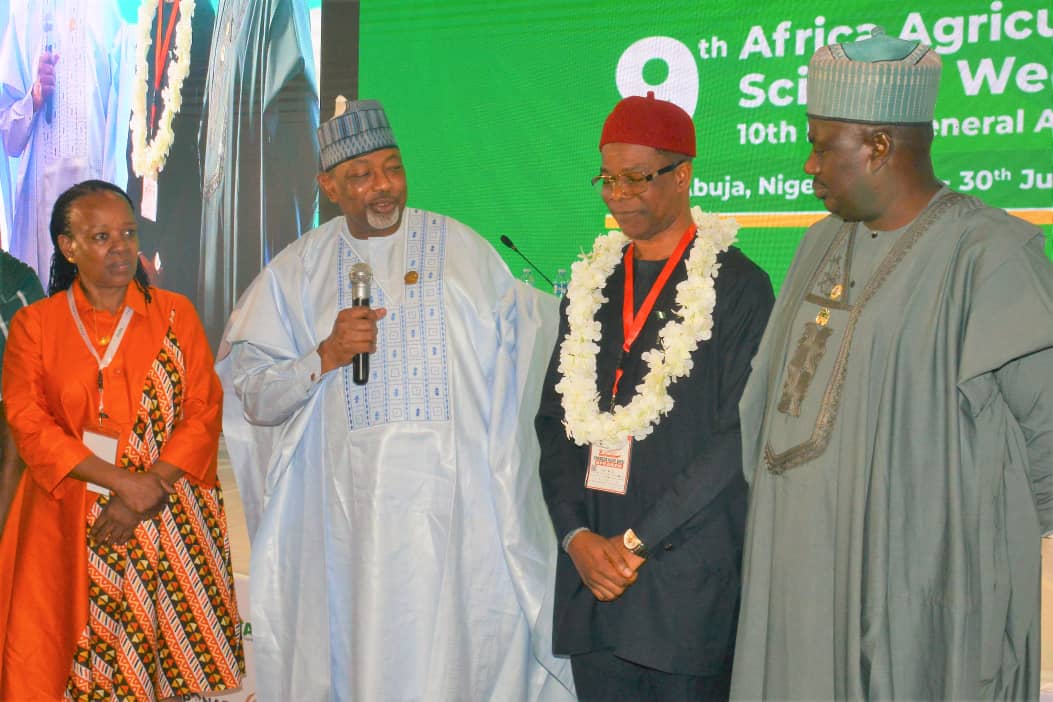
Delivering the welcome address, the Minister of State for Agriculture and Food Security, Senator Dr. Aliyu Sabi Abdullahi, said Nigeria Day provided a platform to present the country’s agricultural progress while strengthening continental collaboration to build resilient and sustainable agrifood systems.
He welcomed delegates from across Africa and beyond, describing their participation as evidence of a shared commitment to achieving food security, climate resilience and agricultural prosperity through collective action.
According to the minister, no African nation can achieve sustainable agricultural development in isolation, stressing that the future of the sector depends on partnerships, knowledge sharing and innovation.
Abdullahi said Nigeria was proud to host the continental gathering, noting that as one of Africa’s largest agricultural producers, the country has a responsibility to contribute to the continent’s food security and economic development.
He highlighted Nigeria’s extensive National Agricultural Research System, comprising 16 National Agricultural Research Institutes and 18 Federal Colleges of Agriculture, working alongside universities, development partners, the private sector and farming communities to generate technologies, build human capacity and improve agricultural productivity.
“Our progress must contribute to Africa’s progress,” he said, adding that innovations, partnerships and policies developed in Nigeria should strengthen the continent’s capacity to feed its growing population, create jobs for young people and compete in the global agricultural economy.
The minister noted that the theme of this year’s Africa Agriculture Science Week, “Innovation and Partnerships for Resilient and Sustainable Agrifood Systems in Africa,” reflects the urgent need to leverage science and technology to address challenges facing African agriculture.
He said discussions throughout the week had focused on emerging technologies, climate-smart agriculture, nutrition, healthy food systems and financing mechanisms required to scale agricultural innovations across the continent.
Abdullahi explained that Nigeria’s programme for the event featured technology exhibitions, keynote presentations, case studies, a Commissioners’ Fireside Chat and a Youth Innovation Challenge to showcase scientific breakthroughs, agricultural technologies, livestock transformation, blue economy initiatives and value-chain development.