By Mercy Aikoye
The House of Representatives on Tuesday moved to bridge widening differences among petroleum marketers and refiners over the future of fuel imports, opening consultations aimed at shaping legislative reforms for Nigeria’s downstream petroleum sector.
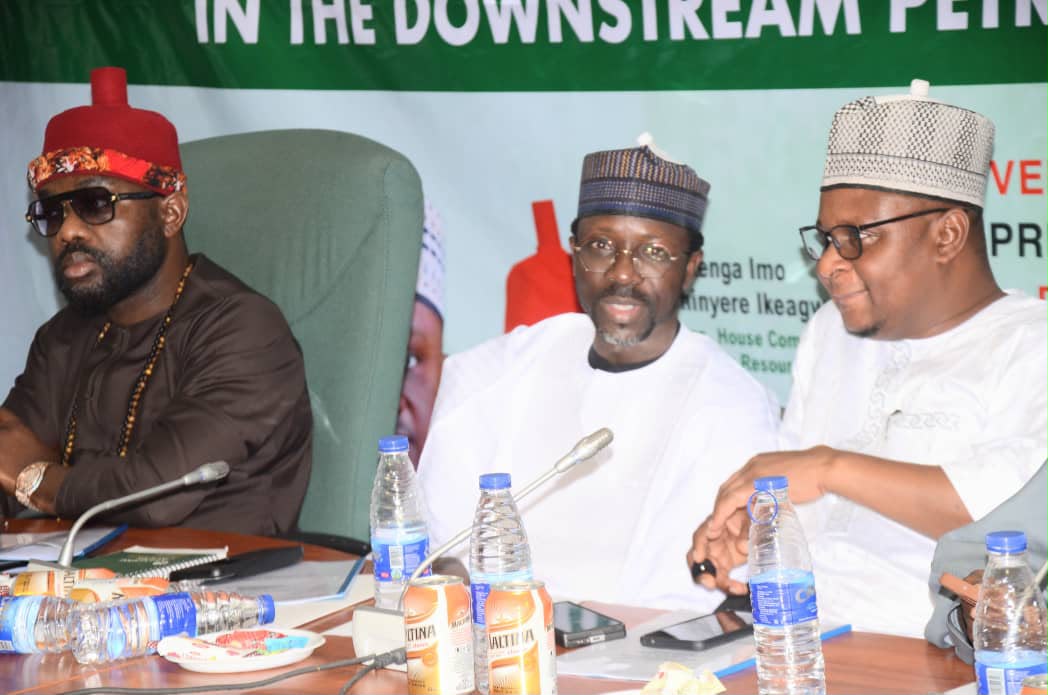
The House Committee on Petroleum Resources (Downstream), Hon. Ikenga Imo Ugochinyere, convened an interactive session with the Depot and Petroleum Products Marketers Association of Nigeria (DAPPMAN), the Independent Petroleum Marketers Association of Nigeria (IPMAN), led by its National President, Abubakar Maigandi Shettima, and the Major Energies Marketers Association of Nigeria (MEMAN) to gather industry input on policies affecting fuel supply, domestic refining and energy security.
The engagement comes amid growing debate over how to support Nigeria’s expanding local refining capacity while maintaining adequate fuel supply through imports where necessary.
Addressing stakeholders, Ugochinyere said the committee would adopt a consultative approach in driving reforms, assuring operators that no policy affecting the downstream sector would be introduced without broad engagement with industry players.
“We are here not to interrogate, not to accuse and not to put anyone on trial. We are here to listen. We are here to talk to one another as partners who share one common destiny, a Nigeria where energy is affordable, supply is stable and no citizen suffers because petroleum products are out of reach,” he said.
He described marketers and depot owners as the critical link between government policy and consumers, noting that stable prices and uninterrupted fuel supply depend largely on the strength of the country’s distribution network.
The committee chairman said submissions from stakeholders would guide legislative measures aimed at strengthening domestic refining, encouraging investment, promoting healthy competition and ensuring affordable petroleum products nationwide.
While supporting local refining, stakeholders differed on the role fuel imports should continue to play in Nigeria’s evolving petroleum market.
DAPPMAN urged the Nigerian Midstream and Downstream Petroleum Regulatory Authority (NMDPRA) to develop clear operating-stock guidelines under Section 182 of the Petroleum Industry Act (PIA), covering stock measurement, reporting, quality assurance and emergency accessibility.
The association also proposed a joint market-monitoring framework involving the NMDPRA and the Federal Competition and Consumer Protection Commission (FCCPC) to track product availability, market concentration, transparent allocation and early warning signs of supply disruptions.
It further called for increased government investment in transport infrastructure, including roads, railways, pipelines, inland waterways and petroleum depots, as well as the establishment of a permanent government-industry consultative platform to review supply conditions and emerging sector risks.
Presenting IPMAN’s position, National President Abubakar Maigandi Shettima said Nigeria’s downstream petroleum industry remains central to the country’s economic growth and national development, but identified high financing costs, multiple taxation, foreign exchange volatility, poor infrastructure, pipeline vandalism, limited access to refinery products and delayed payment of bridging claims as major obstacles to growth.
The association urged lawmakers to support reforms that would improve logistics, lower distribution costs, deepen market competition and encourage greater investment across the sector.
MEMAN, however, cautioned against imposing blanket restrictions on petroleum imports despite Nigeria’s increasing domestic refining capacity.
Its Executive Secretary, Clement Isong, argued that government should retain the flexibility to approve fuel imports whenever local production falls short, warning that such imports remain essential to protecting consumers against supply shortages and price spikes.
He recommended the establishment of a strategic petroleum reserve capable of sustaining at least 60 days of national fuel consumption to shield the country from global supply disruptions and price volatility.
Isong cited the Liquefied Petroleum Gas (LPG) market as evidence that timely imports can stabilise supply and moderate prices, while reiterating MEMAN’s support for the Federal Government’s domestic refining agenda.
The meeting ended with a shared call for policy consistency, improved infrastructure, stronger regulatory coordination and sustained engagement between government and industry players as Nigeria seeks to build a more competitive, resilient and energy-secure downstream petroleum sector.