By Stella Odueme
The Federal Government has trained 1,884 agricultural extension agents and food security specialists under a new digital initiative aimed at improving farmers’ access to modern agricultural knowledge, increasing productivity and strengthening food security.
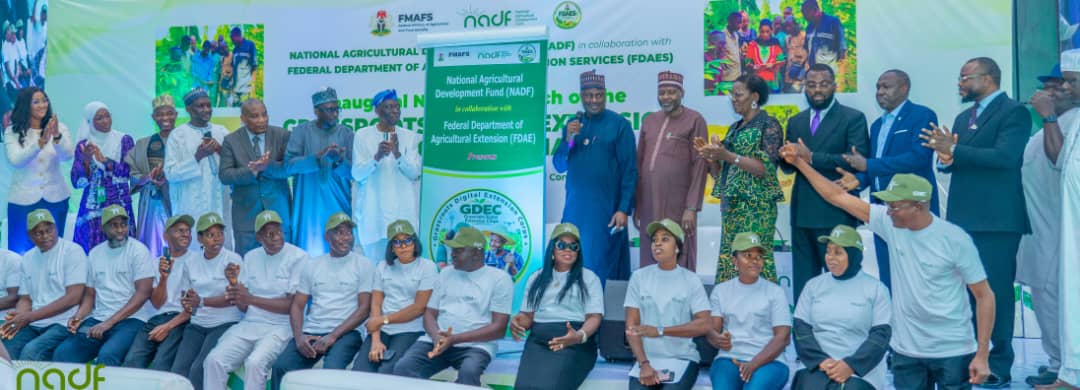
The initiative, known as the Grassroots Digital Extension Corps (GDEC), was launched by the National Agricultural Development Fund (NADF) in collaboration with relevant agricultural institutions and stakeholders.
The trained personnel comprise 1,110 agricultural extension agents and 774 food security specialists drawn from the 36 states and the Federal Capital Territory.
Speaking at the national launch in Abuja on Wednesday, the Minister of State for Agriculture and Food Security, Senator Aliyu Sabi Abdullahi, described the programme as a strategic intervention to address Nigeria’s low agricultural productivity and harness the sector’s estimated $300 billion economic potential.
He said agriculture currently contributes about 26 per cent to Nigeria’s Gross Domestic Product and provides employment for more than 70 per cent of the population across various segments of the value chain.
However, he expressed concern that the sector generates only about $1 billion in foreign exchange earnings despite its enormous potential for increased revenue through improved production, processing and exports.
According to him, agriculture could account for about 30 per cent of President Bola Tinubu’s $1 trillion economy target, representing approximately $300 billion.
Abdullahi stressed that achieving this ambition would depend largely on building a knowledge-driven agricultural system supported by competent personnel and effective extension services.
He noted that Nigeria’s crop yields remained significantly below those of some African countries, with average yields for several crops ranging between 1.3 and 1.5 tonnes per hectare, compared with about 11 tonnes per hectare recorded in Egypt under irrigation.
The minister cited cassava production as an example, noting that although Nigeria remained the world’s largest producer, with an estimated annual output of 63 million metric tonnes, its average yield of six to seven tonnes per hectare was still below its potential.
He said stronger extension services would enable farmers to adopt improved production methods, reduce costs and take advantage of industrial opportunities, particularly in the production of high-quality cassava flour and other value-added products.
He also emphasised the need to make agricultural extension services market-oriented, arguing that farmers must receive information that connects their production activities with the needs of industries and consumers.
Abdullahi further called for the integration of GDEC with the ministry’s existing National Electronic Extension Platform (NEEP) to prevent duplication and ensure consistency in agricultural information delivery.
He proposed the establishment of a ministerial committee to harmonise existing extension programmes into a unified national system and urged the National Assembly to reconsider the proposed Agricultural Extension Bill.
Earlier, the Executive Secretary of NADF, Mohammed Ibrahim, said GDEC was designed in partnership with the Federal Department of Agricultural Extension and other stakeholders to bridge the gap between agricultural research and its practical application at the farm level.
He explained that the programme was structured around three major components: people, tools and data, noting that it would also provide field-level information to support evidence-based government policies and interventions.
Ibrahim maintained that the effectiveness of the initiative would be determined by the number of farmers reached, the adoption of improved agricultural practices and measurable increases in productivity, rather than simply the number of personnel trained or digital devices distributed.
Similarly, the Director of the Federal Department of Agricultural Extension, Engr. Dr Taiye Tehinse, said digital platforms such as FarmEasy would complement conventional extension methods by strengthening communication, data gathering and agricultural decision-making.
He stressed that the trained personnel must combine digital competencies with practical agricultural knowledge to deliver effective advisory services.
Tehinse also advocated the inclusion of women, youths and persons with disabilities in digital agricultural programmes to ensure wider participation and access.
Also speaking, NADF Head of Policy and Advocacy, Yejide Olarinde, identified the shortage of agricultural extension personnel as a major challenge to the country’s agricultural development.
She disclosed that Nigeria currently had an estimated extension agent-to-farmer ratio of one to 10,000, far below the Food and Agriculture Organisation’s recommended ratio of one extension agent to 1,000 farmers.
According to her, the shortage has limited farmers’ access to timely information on improved farming techniques, climate-smart agriculture, soil management, appropriate use of inputs, pest and disease control and market opportunities.
Olarinde described extension agents as farmers’ closest partners, saying they play a critical role in translating research findings and agricultural innovations into practical solutions that improve productivity and livelihoods.
She expressed optimism that the GDEC initiative would strengthen grassroots knowledge delivery and ensure that agricultural innovations produce tangible improvements in farmers’ output and incomes.