By Jane Okeke
The Independent Corrupt Practices and Other Related Offences Commission (ICPC) has called for sustained institutional reforms in Nigeria’s health and education sectors, insisting that corruption prevention remains the most effective strategy for improving public service delivery.
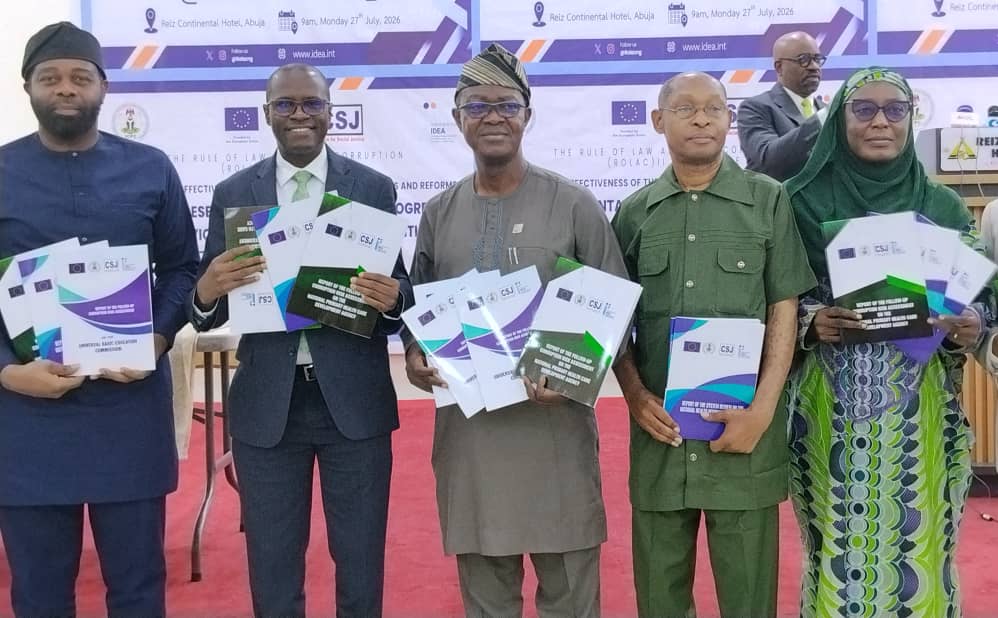
The Commission made the call on Monday in Abuja during the public presentation of the Follow-up System Review Report on the National Health Insurance Authority (NHIA), the Follow-up Corruption Risk Assessment Report on the National Primary Health Care Development Agency (NPHCDA), and the Follow-up Corruption Risk Assessment Report on the Universal Basic Education Commission (UBEC) and selected State Universal Basic Education Boards (SUBEBs).
Speaking at the event, ICPC Chairman, Dr. Musa Adamu Aliyu (SAN), said the reviews assessed the level of implementation of recommendations from previous system studies and corruption risk assessments, identified areas of progress and highlighted gaps requiring further reforms.
Aliyu said the Commission’s preventive mandate is aimed at strengthening systems and procedures in public institutions before they become vulnerable to corrupt practices. According to him, resilient institutions built on transparency, accountability, effective oversight and sound internal controls are critical to protecting public resources.
He stressed that the exercise was not intended to apportion blame but to encourage continuous improvement, noting that the reports recorded encouraging progress by the affected agencies while identifying outstanding recommendations that require sustained commitment.
The ICPC Chairman described the NHIA, NPHCDA and UBEC as strategic institutions responsible for delivering healthcare and education services to millions of Nigerians, adding that strengthening governance in the agencies would improve service delivery and restore public confidence in government.
Also speaking, Director of the Centre for Social Justice (CSJ), Dr. Eze Onyekpere, said the follow-up reviews were undertaken in collaboration with the ICPC under the European Union-supported Rule of Law and Anti-Corruption (RoLAC II) Programme.
Onyekpere identified persistent corruption risks, including leakages in health insurance payments, diversion of medical supplies, procurement irregularities, abandoned school projects and weak oversight mechanisms. He recommended stronger inter-agency collaboration, improved monitoring of reforms, institutionalised peer reviews and greater deployment of digital technology to strengthen transparency and accountability.
Chairman of the Federal Civil Service Commission, Prof. Tunji Olaopa, commended the ICPC’s preventive approach to fighting corruption, describing system reviews as a practical strategy for strengthening governance. He urged public institutions to embrace digital transformation, ethical leadership and transparent administrative processes to reduce corruption risks.
The event brought together senior government officials, development partners, civil society organisations and representatives of the health and education sectors, who reaffirmed their commitment to implementing the recommendations contained in the reports as part of broader efforts to strengthen institutional integrity and improve public service delivery across the country.