By Mercy Aikoye
Rotary leaders have raised concern over the growing burden of hepatitis in Nigeria, calling for increased public awareness, affordable vaccination and expanded screening services to curb what they described as one of the country’s most neglected public health threats.
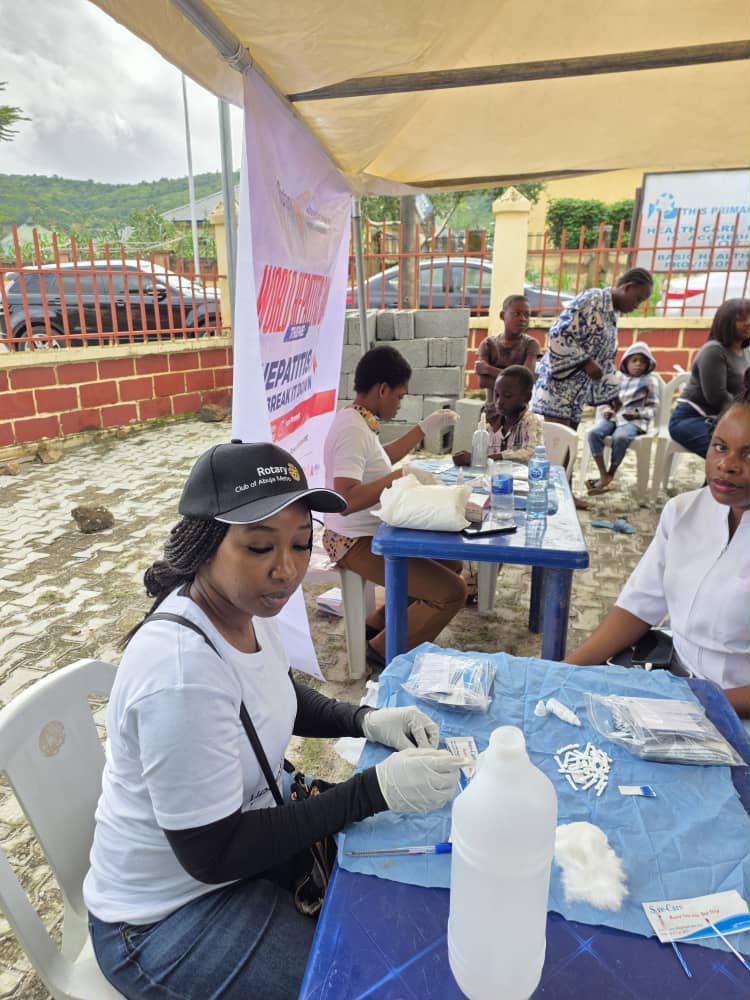
The appeal came during a joint maternal and child health outreach organised by the Rotary Club of Abuja Apo Resettlement and the Rotary Club of Abuja Metro at the Apo Resettlement Primary Health Care Centre recently to commemorate the 2026 World Hepatitis Day.
The outreach featured free hepatitis B and C screening, vaccination, counselling, and the distribution of birth kits to pregnant women and nursing mothers.
Director of Community Service, Rotary Club of Abuja Metro, Rotarian Hauwa Abbas, said hepatitis now requires the same level of public attention previously devoted to HIV, stressing that inadequate awareness and the rising cost of vaccination are limiting efforts to control the disease.
According to her, many Nigerians remain unaware of the different forms of hepatitis and the dangers of delayed diagnosis.
She noted that while government and development partners had invested heavily in HIV awareness over the years, hepatitis has received far less attention despite its increasing prevalence.
Abbas lamented the sharp increase in the cost of hepatitis vaccines, saying a dose that previously cost between N1,000 and N2,000 in public hospitals now sells for between N5,000 and N8,000, making it difficult for many families to complete the recommended three-dose schedule.
She urged governments, corporate organisations and development partners to subsidise vaccines through public-private partnerships and corporate social responsibility initiatives to make them more accessible.
“The first thing is awareness because without awareness there can be no understanding of hepatitis. The second is ensuring vaccines are subsidised so that ordinary Nigerians can afford them,” she said.
President of the Rotary Club of Abuja Apo Resettlement, Rotarian Christian Njoku, disclosed that more than 100 residents had turned out for the exercise, with beneficiaries receiving free hepatitis vaccination and maternal health support.
He said the intervention formed part of Rotary’s commitment to preventive healthcare and community development.
Njoku explained that beneficiaries would receive the complete three-dose vaccination over three months and urged government to intensify awareness campaigns, particularly in rural communities where knowledge of the disease remains low.
Past Rotary International District Governor, Rotarian Ayoola Oyedokun, described hepatitis as one of Africa’s “silent killers”, warning that many infected persons are unaware of their status because the disease often remains without symptoms until severe liver damage has occurred.
According to him, regular testing remains one of the most effective strategies for preventing transmission and ensuring early medical intervention.
He said Rotary has incorporated hepatitis screening into its medical outreaches but noted that funding continues to limit the scale of its interventions.
“We want people to know their status early because once you know your status, you can take steps to prevent transmission or begin appropriate medical management,” he said.
General Secretary of the Rotarian Action Group for Hepatitis Eradication, Rotarian Oye Oyewo, said this year’s World Hepatitis Day theme, “Hepatitis Can’t Wait,” reflects the urgency of expanding testing and vaccination.
He explained that hepatitis B can be prevented through vaccination but has no cure, while hepatitis C is curable but currently has no vaccine.
Oyewo said hepatitis contributes significantly to liver cirrhosis and liver cancer, warning that its long asymptomatic period allows many infected persons to unknowingly spread the virus.
He urged greater investment in hepatitis prevention, describing it as a critical public health issue with far-reaching implications for national productivity and healthcare costs.
The outreach formed part of Rotary’s annual World Hepatitis Day activities aimed at improving access to screening, vaccination and health education in underserved communities.