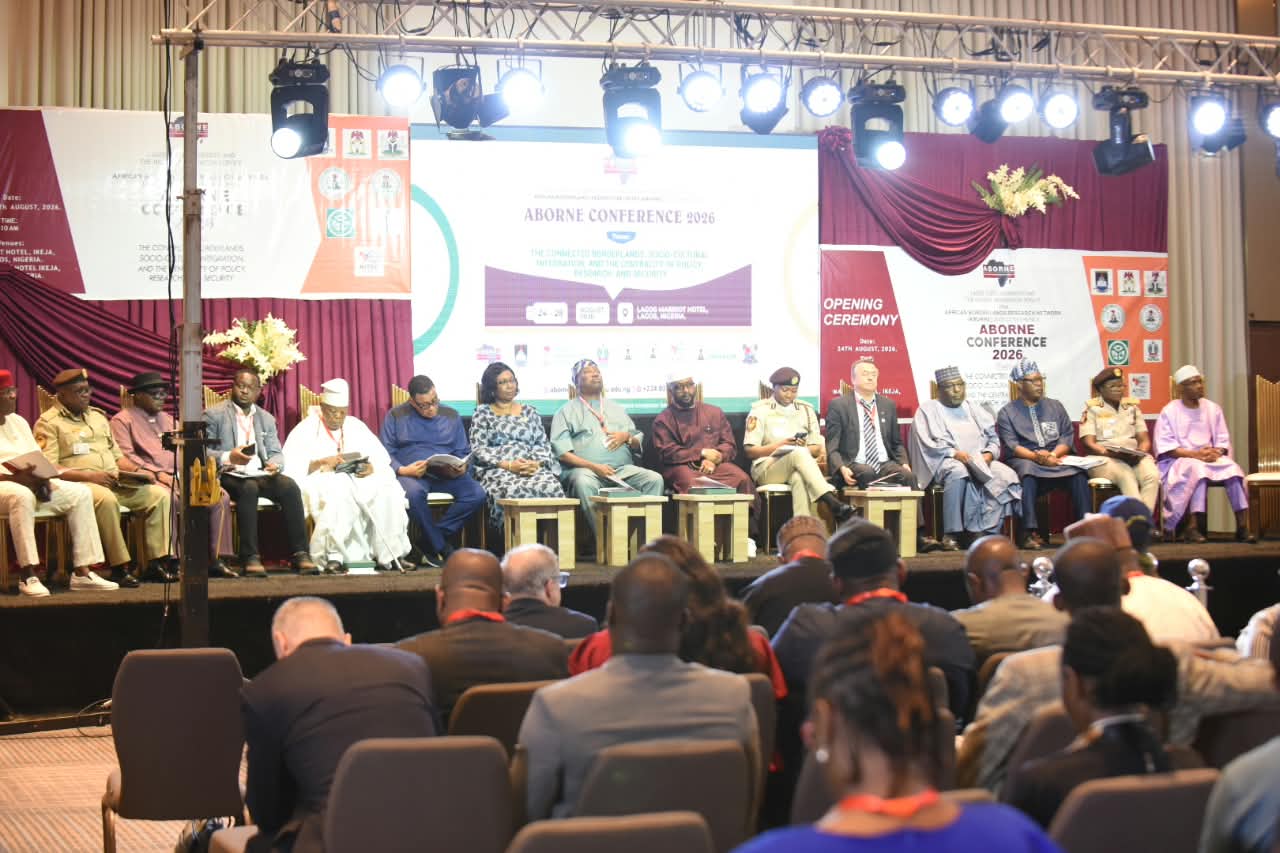
Faces at the Grand Opening of ABORNE Conference 2026 which took place at the Lagos Marriott Hotel Ikeja on August 24, 2026.
By Cyriacus Nnaji
In a collaborative efforts between town and gown to enhance land border management, the Lagos State University (LASU), in partnership with the Nigeria Immigration Service (NIS), came together to host the African Borderlands Research Network (ABORNE) Conference 2026.
The event which commenced on Monday, August 24, 2026 with the theme: “The Connected Borderlands, Socio-Cultural Integration, and the Centrality of Policy, Research, and Security”, at the Lagos Marriott Hotel, Ikeja, Lagos, would come to an end on Friday, 28th August, 2026.
The conference brought together researchers, policymakers, security professionals, academics and other stakeholders to explore contemporary issues surrounding borderlands, integration, policy, research and security.
Ideally the African Borderlands Research Network (ABORNE) is an interdisciplinary network established in 2007 to advance research on international borders, borderlands, and transboundary phenomena across Africa. Bringing together scholars from disciplines including political science, geography, anthropology, sociology, history, migration, development, and refugee studies, ABORNE examines borderlands not only as physical spaces but also as dynamic social, economic, and political environments shaped by the movement of people, goods, ideas, and institutions. Through its interdisciplinary approach, the network promotes a deeper understanding of border governance, regional integration, peace building, and cross-border cooperation in Africa.
ABORNE also serves as a vibrant platform for academic collaboration, bringing together internationally recognised scholars, early-career researchers, and doctoral students to exchange ideas through conferences, workshops, researcher exchanges, PhD seminars, and joint publications. Beyond advancing scholarship, the network actively engages policymakers and practitioners to ensure that research informs evidence-based policy and practice. Through its strategic partnership with the African Union Border Programme (AUBP), formalised by a Memorandum of Understanding, ABORNE supports the participation of Africa-based researchers and strengthens collaboration on issues of scientific and policy relevance, contributing to improved border governance and regional cooperation across the continent.
Co-Hosted by the Lagos State University, partnering agencies include the National Boundary Commission (NBC), Border Communities Development Agency (BCDA), the National Institute for Policy and Strategic Studies (NIPSS), the United Nations Development Programme (UNDP- Resilience Hub for Africa) and the ECOWAS Commission.
Speaking on the occasion, the Vice Chancellor, the Lagos State University (LASU,) Professor Ibiyemi Ibilola Olatunji-Bello stated that Policy, research, security must come together to drive borderlands as living places.
She stated that for Lagos State University, the gathering is much more than the hosting of an international academic conference, she said, “It is an affirmation of our University’s commitment to producing knowledge that responds to the realities of our country, our continent and its development. We are particularly delighted to welcome ABORNE to Nigeria. We take pride in the fact that LASU and the Nigeria Immigration Service are co-hosting this conference for the first time in Nigeria since the organisation was founded in Edinburgh, United Kingdom, in 2007.”
She added that since its foundation in 2007, ABORNE has grown into an important international interdisciplinary network connecting scholars and practitioners interested in the complex realities of African borders and borderlands, adding that its meetings across Europe and Africa have created spaces where historians, geographers, anthropologists, cultural workers, political scientists, migration scholars, policymakers and practitioners can engage across disciplinary boundaries.
She said Lagos is eminently qualified to play host to discussion on Connected borderlands. “Lagos is an appropriate setting for this conversation. Lagos has always been a city of connections — a meeting point of peoples, cultures, commerce and ideas. Its strategic position along the Lagos–Abidjan Corridor further underscores its importance within West Africa’s ecosystems of movement, trade and regional integration.”
On the significance of ABORNE to LASU she said, “For Lagos State University, therefore, borderlands are not a distant academic subject. They are part of the environment within which we live, teach, research and serve society. Our commitment is also reflected in the establishment of our Bachelor of Arts programme in Border and Migration Studies. We recognise that Africa needs a new generation of scholars and professionals who understand that borders are not merely questions of territorial sovereignty. They are also questions of people, livelihoods, identity, security, development and human mobility.
“The University must therefore do more than observe these realities. It must help to understand them, interrogate them and contribute to shaping the policies and practices that govern them. This is why our partnership with the Nigeria Immigration Service, our co-host for this conference, as well as our partnerships with the other agencies , is so important,” the VC stated.
She further said that the partnership between the University and the institution responsible for managing immigration and migration matters is both symbolic and practical. “It reminds us that the border cannot be adequately understood from the classroom alone. Equally, it cannot be effectively managed without knowledge. Research needs practice. Practice needs research. And both need policy. That is the triangle within which meaningful border governance must operate.”
She said, across Africa, borders often separate states while connecting communities. Families live on different sides of boundaries. Languages and cultures cross frontiers. Traders, farmers, pastoralists and transport workers move through networks that existed long before many modern borders were drawn.
“Therefore, policy, research and security must come together. None can function effectively in isolation.
By hosting this conference, we want our University to be a place where knowledge does not merely accumulate but travels — from the classroom to government, from research to policy, from Nigeria to Africa, and from Africa to the wider world.
“I therefore hope that this conference will produce more than papers and proceedings. Let it produce partnerships. Let it produce research that informs policy. Let it strengthen the relationship between universities and practitioners. Let it contribute to more effective and secure approaches to migration and border governance. Let it unite peoples and cultures. Let it promote prosperity in Africa,” she said.
In her own welcome address, the Comptroller-General of NIS, Mrs Kemi Nanna, said the service was honoured to co-host the conference at a time of significant transformation in border management.
Nanna said technological advances, changing migration patterns, regional integration, cross-border economic activities and emerging security threats were reshaping African borderlands.
She said that borders must facilitate legitimate movement, strengthen regional cooperation and preserve socio-cultural and economic relationships while remaining secure.
According to the NIS boss, traditional patrols and document inspections remained important but are insufficient against human trafficking, migrant smuggling, identity fraud, terrorism and cyber-enabled threats.
Nanna said NIS had continued modernising Nigeria’s border management through electronic passports, biometric systems, automated processing and electronic gates at international airports.
She said that technology was also being deployed to strengthen surveillance, communications, command-and-control systems and data platforms across Nigeria’s air, land and maritime borders.
The comptroller-general stressed that technology could not replace professionalism, experience, sound judgement and integrity among officers responsible for securing Nigeria’s borders.
She also described border communities as essential stakeholders whose knowledge and lived experiences were critical to developing secure, peaceful and prosperous borderlands.
Nanna said Nigeria remained committed to strengthening cooperation in border technology, biometric identity management, cybersecurity, surveillance, intelligence sharing, capacity building and research.
She said the border of the future would be more digital, biometric and intelligence-led, but must remain human-centred.
“Our ambition is therefore broader than securing Nigeria’s borders. We seek secure, connected and resilient borderlands where communities can prosper,” she said.
On his part, Dr Kareem Oladokun, the Senior Special Adviser on Policy to the Minister of Interior, Olubunmi Tunji-Ojo,who represented the minister, said effective border management required stronger partnerships among government institutions, universities, security agencies and development partners.
Oladokun said border communities were often the first to experience the consequences of insecurity and irregular migration, but also possessed valuable knowledge that could contribute to early warning, conflict prevention and effective border management. “Building resilient border lines therefore requires us to see border communities not merely as populations to be secured, but as partners in security and development.”
He tasked researchers to produce knowledge capable of anticipating emerging challenges rather than merely explaining past problems, stressing the need to translate research findings into practical and sustainable policy solutions.
Declaring the conference open on behalf of the Federal Government, Oladokun said the gathering provided Nigeria with an important platform to contribute to the development of secure and resilient borderlands across West Africa and Africa.
Representing the Lagos State Governor, Babajide Sanwo-Olu, the Commissioner for Tertiary Education, Tolani Sule, said the conference demonstrated the importance of universities engaging with real-world challenges.
Sule said that Border and migration studies are no longer peripheral areas of academic inquiry. They intersect with national security, economic development, international relations, cultural integration, public health, employment, trade, demography, climate change and human rights.
He added, “For Lagos state, the course has an additional importance. We are Nigeria’s economic and commercial hub and a major gateway for people, goods, capital and ideas. Our relationship with neighbouring countries is shaped every day by formal and informal, local and international movement. The realities of Lagos therefore remind us that mobility is not an abstract concept. It is part of economic life. It is part of social life. It is part of our history. And it will remain part of Africa’s future.
“This makes it imperative that we produce the knowledge and human capacity required to manage mobility intelligently. We need scholars who can investigate the realities of border communities and we need policymakers who can interpret evidence,” he said.
The Keynote, 20 Years After CIUDAD JUAREZ: ABORNE Ship Berths in Lagos was delivered by Prof. Anthony Asiwaju. While Goodwill messages also came from partners to ABORNE 2026 Conference, Director – UNDP Resilience Hub for Africa Dr. Zeynu Ummer, National Institute for Policy and Strategic Studies Prof. Ayo Omotayo, National Boundary Commission (NBC) Surveyor Adamu A. Adaji, Border Communities Development Agency Dr. George-Kelly Dax Alabo, and Nigerian Institute of International Affairs (NIIA) Prof. Eghosa Osaghae
Others include the Vice Chancellor, the University of Lagos, Prof. Folashade Tolulope Ogunsola, the Vice Chancellor, Admiralty University of Nigeria, Prof. Christopher N. Oghogbo, and President, Society for Peace Studies and Practice Prof. Benjamin A. Aluko, among others.