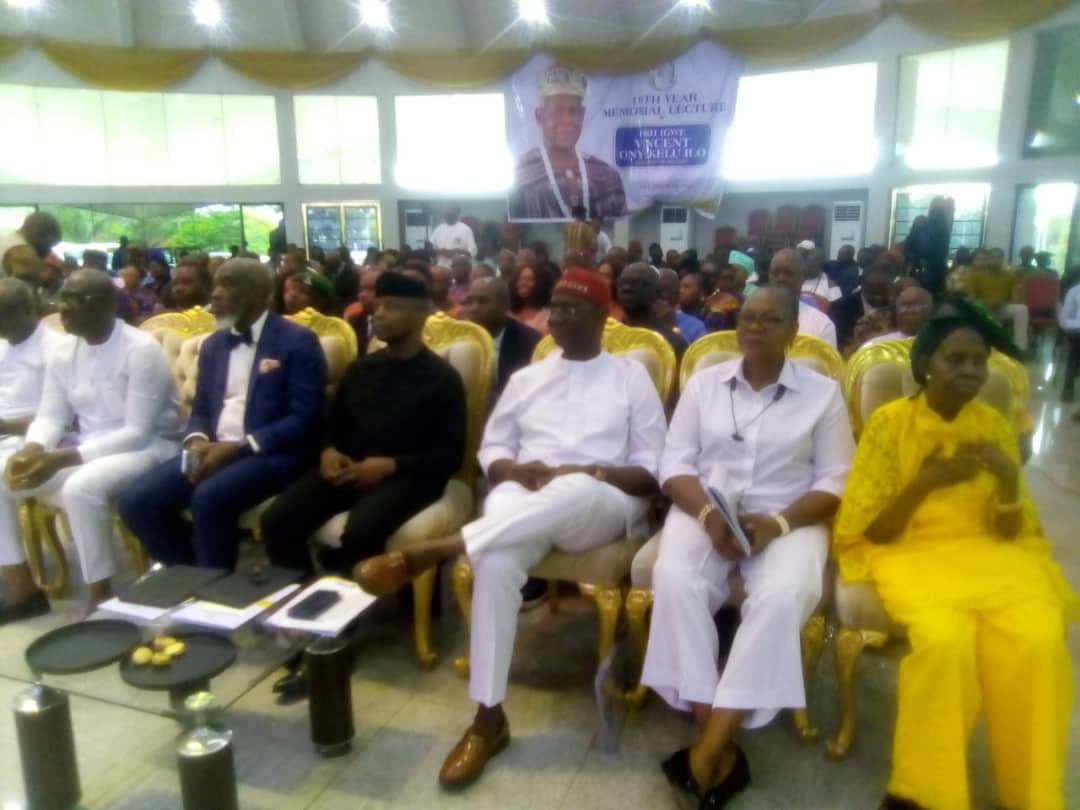
From left : Prof. Onyia, Enugu SSG; Ex-VP, Prof.Yemi Osibanjo, Chief VinMartin Iloh, and others,at late HRH Igwe Vincent Iloh,10th Memorial lecture.
From Maurice Okafor, Enugu
Former Vice President of Nigeria, Prof. Yemi Osinbajo, has advocated the strengthening and restructuring of institutions capable of creating jobs and reducing dependence on charity through sustainable empowerment initiatives.
Osinbajo stressed that investments targeted at job creation and empowerment opportunities for youths and women remain the surest path to sustainable economic growth and poverty reduction in society.
The former Vice President stated this while delivering the keynote address at the inaugural memorial lecture of late Igwe Vincent Onyekelu Ilo, OHABUENYI of Adu-Achi in Oji River Local Government Area of Enugu State.
The lecture, themed “Charity as a Catalyst for Social Change: Moving from Philanthropy to Sustainable Social Impact,” was held on Tuesday, May 19, 2026, at the Enugu International Conference Centre.
Prof. Osinbajo noted that charity and philanthropy are both noble expressions of humanity aimed at addressing people’s needs, but explained that while charity provides immediate relief, philanthropy focuses on long-term solutions capable of reducing dependence on aid.
According to him, “Charity is the provision of immediate help or relief. It responds to urgent human needs such as hunger, poverty, illness, disasters, homelessness or hardship.
“Charity is very important because human suffering cannot wait for long-term solutions.”
Osinbajo explained that philanthropy is generally geared towards long-term systemic change and seeks to tackle the root causes of societal problems rather than merely addressing their immediate effects.
His words: “Philanthropy often involves strategic investments in institutions, education, innovation, research, policy, entrepreneurship and community development.”
He listed acts of philanthropy to include funding education through schools and scholarships, investing in affordable housing initiatives, supporting healthcare research, creating job-training programmes, financing social enterprises, and advocating policy reforms.
Drawing a distinction between charity and philanthropy, he stated: “Charity gives a hungry person a meal, whereas philanthropy creates systems so fewer people will go hungry in the future.
“Charity offers a short term palliative, philanthropy seeks to give a long-term solution.”
Osinbajo further asserted that charity alone may keep people alive without empowering them to escape poverty.
“Charity comforts; justice disrupts. This is why poverty can deepen even in cultures saturated with benevolence,” he said.
He added that with charity alone, “the poor become permanent recipients instead of equal participants in economic life.”
He continued: “A mature moral society therefore cannot stop at almsgiving. Charity is necessary because suffering is immediate. But if charity becomes the endpoint rather than the beginning, it risks functioning as a tranquilizer for the conscience.
“The ultimate measure of compassion is not how efficiently a society distributes alms, but whether it steadily reduces the number of people who need them at all. So the world today does not simply need more charity. It needs more transformation.”
Lamenting the growing inequality across the world, the former Vice President said:“We are living in an era of widening inequality. Millions still lack access to quality education, healthcare, affordable housing, clean water, and economic opportunity. Climate change disproportionately affects the poorest communities.
“Youth unemployment threatens social stability. Entire populations remain excluded from systems of prosperity. In this reality, philanthropy must evolve.
“The future of social impact lies not only in helping people survive hardship, but in empowering them to overcome it permanently.
“This is the shift we must embrace: from transactional giving to transformational investment; from temporary relief to long-term resilience; from dependency to empowerment; from charity as sympathy to charity as strategy.”
Osinbajo maintained that investments should focus on creating jobs, strengthening institutions, empowering women and youths, and preparing future generations for a rapidly changing world.
“We need investments that create jobs, strengthen institutions, empower women and youth, and prepare future generations for a rapidly changing world.
“Perhaps it is time for us all – leaders, institutions, businesses, and citizens – to rethink what it means to give.
“Let us move beyond charity that only alleviates suffering. Let us build systems that eliminate the causes of suffering. Let us move from occasional acts of kindness to enduring structures of opportunity. Let us create impact that outlives us.”
The former Vice President emphasised that modern philanthropy must become catalytic and sustainable by strengthening systems instead of replacing them.
“Good philanthropy in the 21st century must become catalytic. It must ignite possibilities. To be sustainable, it must strengthen systems rather than seek to replace them. It must create ecosystems of people to become architects of their own future,” he stated.
Osinbajo cited the example of a philanthropic initiative he established in 2016 for vulnerable youths in Internally Displaced Persons (IDP) camps in Borno State through the North East Children’s Fund.
According to him, the initiative provided education for children orphaned by the Boko Haram insurgency in addition to relief materials.
“The current Vice President, then Governor HE Kashim Shettima gave me a good piece of land to build the school. The school was named the Learning Centre. Our first intake of 500 kids, boys and girls, could not speak Hausa except Kanuri. We got the best teachers and partnered with Grange School in Lagos. Five years later in 2021 at the fifth year anniversary of the school, the kids were showing off their coding, music and debate.
“Charity was able to go as far as the IDP camps but to transform the destinies of the children, philanthropy had to come in.”
He also referenced the Ford Foundation as an example of an institution that transformed modern philanthropy through long-term investment in social justice and civil rights causes rather than short-term charity.
Osinbajo disclosed that between the 1950s and 1970s in the United States, the Ford Foundation funded civil rights organisations, public-interest law, community development, education, and policy reforms aimed at addressing systemic inequality and discrimination.
He said: “Its investments strengthened institutions that expanded access to justice, housing, and economic opportunity for marginalized communities. The Foundation’s most transformative contribution was shifting philanthropy from temporary relief toward changing systems, institutions, and power structures – a model that has since influenced philanthropic and development work around the world.”
He further stressed that philanthropy should strengthen public systems and not replace government responsibilities.
“Philanthropy must be aimed at strengthening public systems not replacing them. Philanthropy cannot last forever so it must not pretend that it can. For the same reason, governments must not depend on philanthropy to run systems.
“Second, philanthropy must be collaborative. Collaboration is essential. No single government, corporation, foundation, or NGO can solve today’s complex social challenges alone. Real change happens when public institutions, private enterprise, civil society, faith organizations, and local communities work together with shared purpose.”
Concluding his lecture, Osinbajo urged wealthy individuals and organisations to go beyond occasional charity and invest in long-term transformation.
“To conclude, charity or generosity is important, but it must not stop there. Charitable givers must also see the need to understand their role in the value chain of transformation. There are those who can only give very small amounts to deal with immediate crisis, but there are those with the resources to give immediately and long term,” he emphasised.
He appealed to individuals and organisations with substantial resources to channel their wealth towards building systems that create opportunities and reduce dependence on almsgiving.
“They have the resources to build systems that unlock opportunity. We need philanthropy that supports innovation, entrepreneurship, education, healthcare, sustainable housing, and inclusive economic growth,” he said.
Osinbajo also thanked the Ilo family of Adu-Achi, Oji River Local Government Area, for inviting him to deliver the inaugural memorial lecture in honour of their late father and patriarch, His Royal Highness Igwe Vincent Onyekelu Ilo, the Ohabuenyi of Adu-Achi.
He commended the family for transforming the memorial into a platform for social reflection and national discourse.
“In doing so, they have elevated this memorial to an act of public purpose.
“So we gather not merely to remember a remarkable man, but to inaugurate a tradition – one that affirms the dignity of lives devoted to the service of others and the common good, while encouraging thoughtful public introspection on the challenges of development and human progress,” he added.
Governor Peter Mbah of Enugu State, represented by the Secretary to the State Government, Prof. Chidiebere Onyia, described the late monarch as a rare gem who positively impacted the lives of his people during his lifetime.
He assured that the state government would continue to partner with traditional rulers as critical drivers of development in their various communities.
The traditional ruler of Adu-Achi, Igwe Sunday Orah, who succeeded the late Igwe Vincent Ilo, described him as a mentor, peace builder and role model whose principles of discipline, unity and community service continue to inspire the community.
Former Nigerian High Commissioner to Australia and the Pacific, Ambassador Anderson Madubike, commended the Ilo family for sustaining the values and legacy of the late monarch.
Speaking with newsmen after the event, the Chief Executive Officer of Signature TV and first son of the late monarch, Hon. VinMartin Ilo, said the lecture was organised to project the values of humanity and service exemplified by their late father throughout his lifetime.
He described the keynote speaker, Prof. Yemi Osinbajo, as an embodiment of justice, truth, knowledge and integrity, which informed his selection as speaker for the inaugural memorial lecture.