By Livinus Nnebedum
In the past farming appeared to be the job for the illiterates or those who have failed in other activities and thus farmers are considered to occupy the lower rank in the society. In Nigeria then, there was sociological and psychological effects of being called a farmer. In fact people prefer white-collar jobs than Blue-collar jobs where they can stay in air-conditioned offices with their suits and “babanriga”. But farmers today are better off as there are many billionaire farmers. Many Nigerians are “soiling” their hands in farming and they are rich, literate and resourceful. To serve as an encouragement to our youths and others, it is worthy to know that the former Military Head of State (HOS) who handed over to Civilian president Shagari on October 1, 1979 is interested in farming as a business. He is no other person than General Olusegun Obasanjo. The Daily Times Newspaper in those days did not fail to show the photo-news of the President working in his farms. This writer Livinus Nnebedum in 1987 during the NYSC visited some of the farms located in Oyo and Ogun states. To serve as more encouragement to our people towards farming, it should be recalled that in 1980’s during the launching of Green Revolution, the former Civilian President Alhaji Shehu Shagari launched the program by tilling the ground at the State House Ribadu Road Lagos then in his attire “babanriga”.
In Developed countries they have Billionaire farmers. The 39th President of U.S (1977 to 1981) was Jimmy Carter and he is a rich peanut farmer. It is recalled that President Jimmy Carter visited Nigeria in 1978 and met the Nigeria Head of State then General Obasanjo. Revolution is going on in Agriculture where the educated, the elites or the bourgeois, the powerful and the rich are reaching for the “green gold” with the best farming technologies money can buy.
Farming should no longer be regarded as poor-man’s job. It should be given higher recognition in the society. Even in the Bible, Genesis Chapter 9 verse 20, farming is recognized as the oldest profession where Noah was mentioned as the first man on Earth to plant a vineyard. Thus let all categories of farmers be proud of their profession especially professional Agriculturists. Today high profile politicians, retired army generals, the public and civil servants, the literates, rich and resourceful are joining the business of farming. Agriculture is now a business, noble, lucrative and prestigious profession. Nigeria is blessed with abundant natural resources – land, water etc. Even the human resources are in abundance.
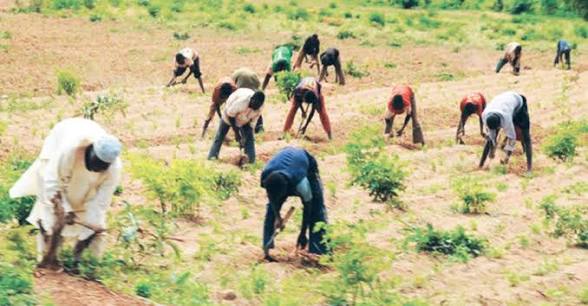
The population of Nigeria is now over 200 million, but how many of them are interested in farming as a business. Youths loathed to take-up farming as a business and farming is left in the hands of old men and women in the villages with their crude farm implements. In Nigeria Agriculture is still dependent on human muscle as its primary source of motive power and the result is low production. Farming as a business and farming in general should continue to receive subsidy in all Agricultural inputs from the government.
Government should encourage all categories of farmers by providing enough incentives to them, such as mechanization of Agriculture, provision of credit facilities, storage facilities, improved seeds and seedlings, improved livestock (fingerlings, sheep, goats, pigs, cattle, cane-rats/grass cutters, poultry birds etc), Agrochemicals (Herbicides, insecticides, fungicides, fertilizers etc).
This writer Livinus Nnebedum recalled big farming experience when I worked closely with Former Military Governor of then Bendel State and Kwara State Major-General George A. Innih in his company farms namely Niger Valley Agro-industries Ltd at Benin (Hqs of the farms) and Agenebode (farm site) in 1986/87. In 1986/87 NYSC service year, we were 12 Youth Corpers that were posted to serve in that company.
We were involved in using combine Harvester machine in harvesting maize in the farms. I had opportunity of travelling by Air when I visited the Liaison office of the farms in Lagos from Benin Airport and also visited Obasanjo’s farms variously located in Abeokuta, Ota, Lanlate etc in 1987. I was also in Samuel Ogbemudia farms in Benin and at National Institute for Oilpalm Research (NIFOR) Benin in 1987. There was Leventis Maize farms near Agenebode in Bendel state then, now Edo State where they used helicopters in planting of maize and application of fertilizers in 1986. The 12 Youth Corpers used to visit the Leventis Farms canteens during break periods.
Livinus Nnebedum, (livynnebedumadp@yahoo.com, 07069723819) writes from Federal College of Education (Technical) Umunze, Anambra State.
END
QUOTE: “Government should encourage all categories of farmers by providing enough incentives to them, such as mechanization of Agriculture, provision of credit facilities, storage facilities, improved seeds and seedlings, improved livestock (fingerlings, sheep, goats, pigs, cattle, cane-rats/grass cutters, poultry birds etc), “
XXXXXXXXXXXX
The Abacha paradox: Reassessing Nigeria’s most misunderstood strongman
By Jerome Aduojo Agi
Twenty-eight years after his sudden demise on June 8, 1998, the mere mention of General Sani Abacha still triggers a visceral reaction in the Nigerian psyche. For decades, the dominant narrative surrounding his five-year tenure as Head of State has been cast in stark, unforgiving monochrome: an era defined by iron-fisted authoritarianism, international isolation, and severe political repression.
Yet, history is rarely a story of simple villains and heroes. As the dust of the late 1990s settles into the distance, a more complex, nuanced picture demands to be examined. Was Abacha merely the caricature of military dictatorship his critics claim, or was he a deeply disciplined, hyper-focused strategist whose governance laid the actual foundations of modern Nigeria?
The reality, as it turns out, is a fascinating paradox.
While the democratic deficits and human rights concerns of his regime remain an undeniable stain on his legacy, a cold look at Nigeria’s current structural architecture reveals Abacha’s ghost everywhere. The very map of the country—from the balance of the 36 states down to the ubiquitous six geopolitical zones used for every political and economic calculation today—was codified under his watch. Economically, his era achieved a level of single-digit inflation and currency stability that modern administrations can only dream of. From the sprawling concrete reality of Abuja’s Gwarinpa Estate to the strategic long-term planning of Vision 2010, his “round pegs in round holes” approach yielded undeniable material landmarks.
This reassessment does not seek to sanitize the past, nor does it ignore the heavy toll of military rule. Instead, it dares to ask a more uncomfortable question: Did General Abacha’s uncompromising, no-nonsense methodology provide Nigeria with a blueprint for stability and development that his civilian successors failed to preserve?
As we look back nearly three decades later, it is time to move past emotional rhetoric. By weighing his undeniable institutional legacies against his controversial excesses, we may find that General Sani Abacha remains not just one of the most consequential leaders in modern African history, but arguably its most profoundly misunderstood.
QUOTE: “Did General Abacha’s uncompromising, no-nonsense methodology provide Nigeria with a blueprint for stability and development that his civilian successors failed to preserve?”
Aduojo Agi, PhD is a commentator on Public Affairs