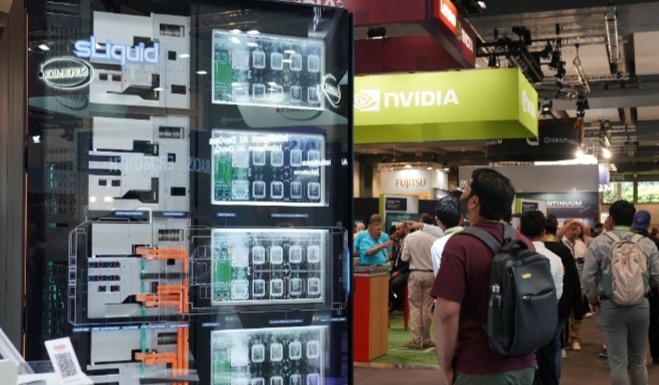
A ScaleX supernode product is displayed at the Sugon booth during the International Supercomputing Conference 2026 in Hamburg, Germany, June 23, 2026. /VCG
China’s domestically developed LineShine supercomputer has become the world’s fastest supercomputer, returning the country to the top spot in global supercomputing for the first time in nine years.
Announced at the ISC 2026 conference in Hamburg, Germany, LineShine achieved a sustained performance of 2.198 exaflops, becoming the first supercomputer to surpass two exaflops of sustained computing power.
Developed at the National Supercomputing Center in Shenzhen, LineShine is designed to combine scientific computing and artificial intelligence on a single platform. As AI becomes increasingly important in scientific research, supercomputers are evolving from tools for running simulations into infrastructure for data-intensive discovery.
At the heart of the system are China’s self-developed LX2 processors, which support both traditional computing and AI workloads. The chips incorporate China’s first domestically developed high-bandwidth memory, enabling data to move about 10 times faster than in conventional CPUs.
Moving data efficiently is just as important as raw computing power. LineShine uses a proprietary high-speed interconnect network capable of linking up to two million ports and 100,000 nodes, while its storage system is designed to support both large-scale simulations and the massive datasets used in AI applications.
Developers also built a software platform that integrates supercomputing and AI capabilities, allowing researchers to make more efficient use of the underlying hardware. The system is supported by a fully liquid-cooled design that helps improve energy efficiency while maintaining record-breaking performance.
Since entering operation, LineShine has supported research in atmospheric and ocean science, engineering simulation, materials research, drug discovery, brain science and scientific AI.
Supercomputers are increasingly used to tackle challenges ranging from climate modeling and advanced manufacturing to AI development. LineShine’s debut marks China’s return to the forefront of high-performance computing and highlights the growing convergence of supercomputing and artificial intelligence.