By Mercy Aikoye
Nigeria’s Social Cohesion Index has risen to 48.8 per cent, the highest since the survey began in 2019, according to the 2026 Nigeria Social Cohesion Survey released by the Africa Polling Institute (API).
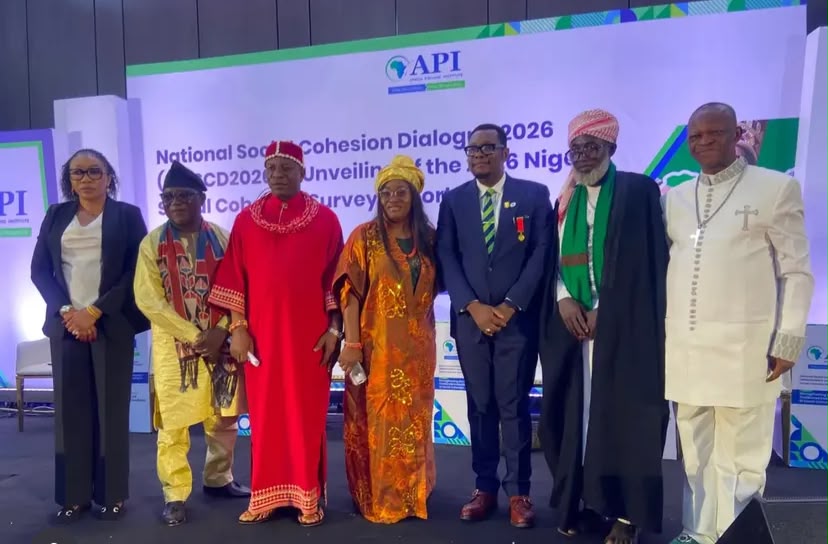
The report was unveiled at the National Social Cohesion Dialogue 2026 (NSCD2026) in Abuja on Thursday, where policymakers, development partners, civil society organisations and academics examined the country’s progress in strengthening national unity and social inclusion.
Despite the improvement from 46 per cent recorded in 2025, the report noted that the index remains below the 50 per cent threshold, indicating that significant work is still needed to build a more cohesive society.
A key finding of the survey is that, for the first time since the assessment commenced, a majority of Nigerians identified first as Nigerians rather than by ethnicity, religion or region. API described the shift as a positive indication of growing national identity.
The survey also revealed that Nigerians continue to place greater trust in religious and traditional leaders than in public institutions. It further found that while many citizens remain hopeful about the country’s future and are willing to interact across ethnic divides, concerns over governance, insecurity and economic hardship continue to affect public confidence.
Presenting the report, API Executive Director, Professor Bell Ihua, said the emergence of a stronger national identity provides an opportunity for government and other stakeholders to deepen social cohesion through inclusive governance, accountability and equitable development.
He called for the establishment of a National Social Cohesion Commission to coordinate policies and programmes aimed at promoting national unity, preventing conflicts and strengthening citizens’ trust in institutions.
The survey, supported by the Ford Foundation, assessed Nigerians’ perceptions across key indicators, including identity, trust, security, governance, corruption, civic participation and migration.
Stakeholders at the dialogue urged governments at all levels to implement the report’s recommendations, stressing that sustainable peace and development depend on stronger social cohesion and greater public trust in national institutions.