By Chuks Oyema-Aziken
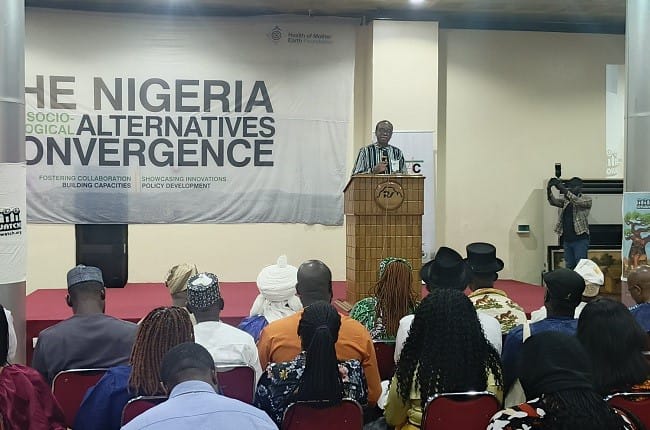
The 3rd Nigeria Socio-Ecological Alternatives Convergence (NSAC) opened in Abuja on Tuesday with strong calls for urgent action to address the growing threats posed by deforestation, mining activities and environmental degradation across the country.
The convergence, organised by the Health of Mother Earth Foundation (HOMEF), brought together traditional rulers, civil society groups, environmental activists, academics, policymakers and community leaders to deliberate on the theme: “Deforestation, Mining and the Crisis of Human Security in Nigeria.”
In his welcome address, environmental rights activist and Executive Director of HOMEF, Nnimmo Bassey, described the gathering as a platform for communities and stakeholders to examine the socio-ecological challenges confronting Nigeria and to chart pathways toward ecological justice, sustainability and human security.
Bassey said the conference was taking place at a critical period when Nigeria was witnessing increasing investments in solid minerals, particularly lithium and other critical minerals, following recent announcements of major mineral discoveries in parts of the country.
While acknowledging the economic opportunities associated with the mining sector, he cautioned that Nigeria must not repeat the mistakes of the oil industry, particularly in the Niger Delta, where decades of extraction have left behind severe environmental degradation and social dislocation.
According to him, the country must have honest conversations about the type of development it seeks, stressing that communities should not continue to bear the environmental and social costs of extractive activities while others reap the benefits. He questioned whether host communities have a genuine right to reject mining and timber extraction projects in their territories.
Bassey also expressed concern over the alarming rate of deforestation in Nigeria, noting that between 250,000 and 300,000 hectares of forests are lost annually. He warned that if the current trend continues, Nigeria could lose most of its forests within the next few decades, with grave consequences for biodiversity, climate resilience and rural livelihoods.
The environmental advocate further criticised what he described as the growing trend of “carbon colonialism,” where large expanses of forests and communal lands are being enclosed for carbon credit projects. He cited examples in Delta and Niger states, warning that such initiatives often displace local communities and deprive them of traditional means of livelihood.
On mining, Bassey observed that promises of development frequently translate into polluted water sources, degraded farmlands, abandoned mine pits and displaced populations. He maintained that the global demand for critical minerals needed for the energy transition should not become an excuse for a new wave of destructive extractivism in developing countries.
He argued that genuine human security goes beyond military deployments and requires the protection of ecological systems that provide clean water, fertile land, healthy forests and sustainable livelihoods. According to him, environmental degradation often fuels conflicts, displacement and social instability.
Bassey further noted that many forests have increasingly become havens for criminal elements, including bandits and terrorists, who exploit weak governance structures to establish what he described as “criminal fiefdoms,” thereby cutting communities off from their traditional forest resources.
Chairman of the occasion, the Emir of Nasarawa, Alhaji Ibrahim Usman Jibril, represented by former Director-General of the National Council on Climate Change, Dr. Salisu Dahiru, echoed similar concerns about the link between environmental degradation and insecurity in Nigeria.
The royal father noted that while states such as Nasarawa are richly endowed with mineral resources capable of driving economic growth, exploitation of such resources must be guided by transparency, accountability and environmental responsibility. He stressed that development should never come at the expense of human lives, environmental integrity or the future of coming generations.
The Emir highlighted the growing nexus between illegal mining, forest exploitation and insecurity, arguing that armed groups often displace communities to gain control of resource-rich territories. He explained that proceeds from illegal mining and timber extraction have become important sources of funding for criminal networks operating in different parts of the country.
He called for stronger environmental governance, greater community participation, effective regulation and collaborative action involving traditional institutions, government agencies, civil society organisations and local communities. He urged participants to use the convergence to develop practical and people-centred solutions capable of addressing Nigeria’s environmental challenges while promoting peace, ecological justice and sustainable development.