By Jonathan Lois
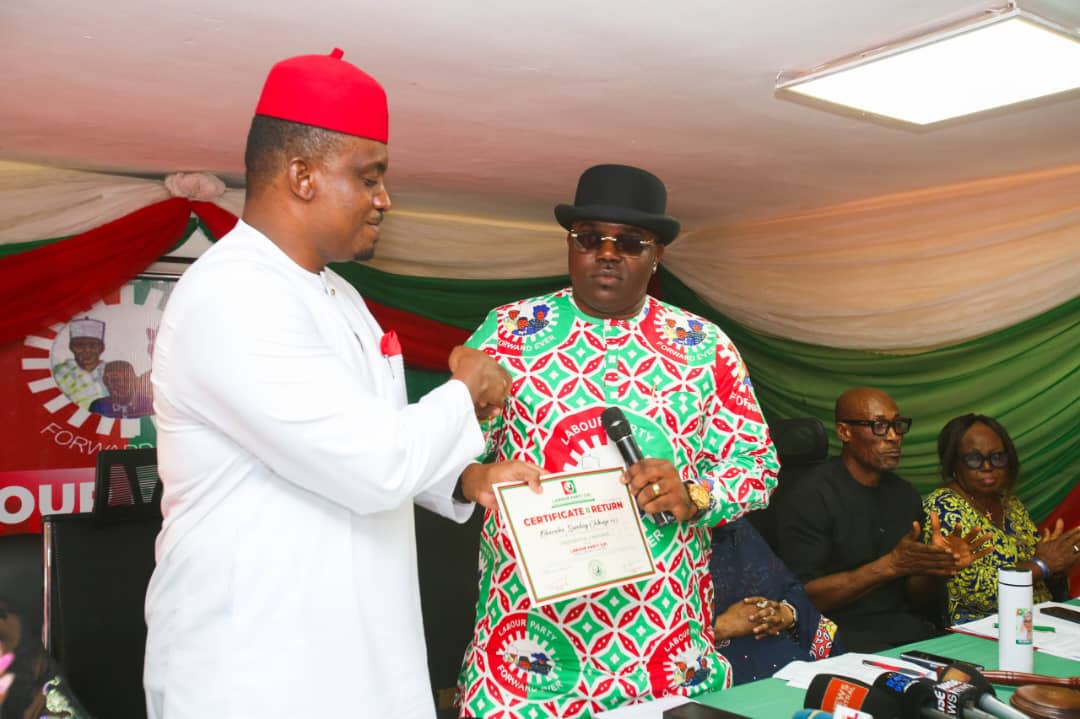
The Labour Party on Thursday ratified the nomination of Dr. Chibuzo Okereke as its presidential candidate for the 2027 general elections, with the candidate using his acceptance speech to unveil an ambitious governance blueprint anchored on a “Nigerians First! Believe Again” vision.
Speaking at a hybrid meeting of the party’s National Executive Committee (NEC) held at the Labour Party National Headquarters in Utako, Abuja, Okereke formally accepted the nomination and pledged to provide what he described as visionary leadership capable of resetting Nigeria’s political, economic and social trajectory.
“Let me begin with two important words that rise from the depth of my heart at this historic moment: THANK YOU!” he declared.
The Labour Party candidate thanked the leadership of the party for the confidence reposed in him and paid special tribute to the party’s National Leader, Governor Alex Otti of Abia State.
“I thank our dear National Leader, His Excellency, Dr. Alex Chioma Otti, OFR, for mentoring, inspiring, and preparing me for this responsibility. In His Excellency, Dr. Otti, we have a people-centric leadership template, a guide and model ready to be extrapolated to the national stage to drive sustainable development for Nigeria,” he said.
He also expressed gratitude to National Chairman Senator Nenadi Usman, members of the National Working Committee, members of the NEC, party members at home and abroad, as well as the leadership of the Nigeria Labour Congress and the Trade Union Congress.
“I therefore, with gratitude, readiness to provide visionary leadership, and a full understanding of the weight of this responsibility, ACCEPT MY NOMINATION AS THE PRESIDENTIAL CANDIDATE OF THE LABOUR PARTY FOR THE 2027 GENERAL ELECTIONS,” he stated.
Okereke described the Labour Party as “the Party of First Choice,” arguing that it remains the only political party in Nigeria with institutional membership and constitutional provisions granting automatic membership to Nigerian workers and allied groups.
“The implication is that in Nigeria, ‘WE ARE ALL LABOUR,’” he said.
The presidential candidate used the occasion to restate the party’s ideological commitment to democratic socialism, social justice and equal opportunity, saying the Labour Party was founded on principles that place human dignity at the centre of governance.
According to him, the vision of his proposed administration would be built around a philosophy that prioritises citizens over political structures.
“The Vision of My Presidency is Nigerians First! Not Nigeria First!” he declared.
“I am on a mission to Make Nigerians Believe Again in the limitless possibilities and shared prosperity of our great country, Nigeria. It is going to be the greatest positive reset ever witnessed in the history of the Nigerian State.”
Explaining the concept, Okereke said Nigeria’s future depends on investing in its people and restoring public confidence in governance.
“Our Nigerians First! Believe Again Vision is premised on the fact that Nigeria exists because Nigerians exist. The purpose of the state is to serve its people. Globally, nations are built by citizens. Strong and patriotic citizens build strong institutions. Strong institutions build strong nations.”
He argued that successive governments had focused excessively on protecting the state and managing political interests while neglecting citizens.
“However, our Nigerians First Vision offers a fundamental philosophical shift in our theory of nationhood and focuses on developing Nigerians, securing Nigerians, expanding socio-economic opportunities, restoring the dignity of our people, building trust among citizens, and investing in the Sustainable Development Goals. We are convinced that when Nigerians prosper, Nigeria prospers.”
The Labour Party flagbearer said his administration would place governance ahead of politics.
“Our Presidency will put People and Governance First before Politics. We understand that politics is not the purpose of government; governance is the real purpose of government. Nigerian citizens will become partners in nation-building rather than spectators. No Nigerian citizen under our watch will ever again live as though there is no government.”
Speaking on the challenges facing the country, Okereke said Nigeria was experiencing one of its most difficult periods since the return to democratic rule in 1999.
“Across the federation today, millions of citizens are burdened by rising costs of living, insecurity, high infant and maternal mortality, unemployment, declining purchasing power, infrastructure financing gaps, power and energy deficiencies, growing numbers of out-of-school children, struggling businesses and families, and declining public trust in government institutions.”
He, however, insisted that the challenges presented opportunities for innovative leadership and national renewal.
“This is why we have chosen not to lament but to rise to leadership. Where we are as a country calls for collective patriotism that must be led by the government, and the people will follow. Not blame games!”
Okereke unveiled what he called a “Nigerians First Great Reset National Recovery Blueprint” built around five major pillars: national security and unity; economic stabilisation, food security and productive growth; education, human capital development and healthcare; institutional reforms and good governance; and national unity and social cohesion.
On security, he promised a comprehensive strategy aimed at rebuilding public confidence in the ability of the state to protect lives and property.
“Our goal is clear: restore public confidence that the Nigerian State is capable of protecting lives and property across every part of the federation. We will adopt a practical and sincere whole-of-society approach. We will rebuild our military and restore the pride and glory of our land.”
On economic reforms, he advocated decentralisation of the power sector and a regional development approach driven by comparative advantages.
“We will pursue a variable mix that confronts the structural challenges limiting investment and sustainable enterprise growth, including power and energy bankruptcy, regulatory uncertainty, infrastructure deficits, and policy inconsistency. The national power grid will be completely democratised and decentralised.”
The candidate pointed to the development model in Abia State as an example that could be expanded nationally.
Addressing education and healthcare, he stressed that sustainable prosperity would depend on investments in human capital.
“Our administration will prioritise foundational education, technical skills, digital literacy, research capacity, and curriculum reforms aligned with modern economic realities. We must prepare Nigerian youths not merely to seek jobs, but to create value within a globally competitive economy.”
Okereke also proposed sweeping institutional reforms, including greater transparency, digitisation of public services, merit-based recruitment and a review of several federal agencies and laws.
“We will repeal and re-enact the Procurement Act, strengthen the Fiscal Responsibility Act, and carry out a complete reset of our budget process. Zero-Based Budgeting will be introduced.”
He further announced plans to establish Nigeria Government Accountability Offices across ministries, departments and agencies and to transfer certain responsibilities currently managed by federal agencies to local governments.
Among the proposals outlined were repealing the Universal Basic Education Commission Act, transferring its assets and resources to local governments, repealing the National Primary Health Care Development Agency Act, and restructuring policy and research institutions.
The Labour Party candidate also proposed making the National Youth Service Corps optional for most graduates.
“The NYSC Scheme will be made optional, except for graduates of STEM disciplines and a few others. All other graduates will undertake a three-month National Community Development Project and, upon completion, receive their NYSC discharge certificate.”
On national unity, Okereke called for a renewed effort to rebuild trust among Nigerians across ethnic, religious and regional divides.
“Our diversity should be a strategic advantage, not a source of perpetual political tension. We must consciously rebuild trust across regions, ethnicities, religions, and generations.”
He also proposed the enactment of a National Day of Peace and Forgiveness Law as part of efforts to promote healing, reconciliation and national cohesion.
In the closing section of his speech, the Labour Party candidate repeatedly urged various segments of Nigerian society to “Believe Again,” directing the message to security personnel, young Nigerians considering emigration, farmers, artisans, industrialists, pensioners, women, academics, entrepreneurs and voters.
“To our dear soldiers and all members of the defence, security, and intelligence community who still feel abandoned in the forests of Sambisa, wondering why you are still fighting for a country that appears not to care, I ask you to BELIEVE AGAIN!”
“Young Nigerians leaving the country in droves under the Japa syndrome, which has caused tremendous brain drain in the health and education sectors, you may have concluded that there is no hope or opportunity for you in Nigeria; But I ask you to BELIEVE AGAIN in the promise of this land.”
“Our pensioners, retired servicemen, and servicewomen who struggle to receive retirement benefits and sometimes pay the ultimate price in the process, I ask you to BELIEVE AGAIN in a Nigeria that cares.”
“Our women who have been grossly underrepresented in parliaments and key policy institutions for decades, I ask you to BELIEVE AGAIN!”
“Our citizens who still wonder whether there is any need to perform their civic duty of voting because they have lost confidence in the electoral process, I ask you to BELIEVE AGAIN!”
Concluding his acceptance speech, Okereke said: “BELIEVE AGAIN! In the promise of Nigeria and in the limitless possibilities of our greatness.”
The ratification of Okereke’s nomination by the NEC formally positions him as the Labour Party’s standard bearer for the 2027 presidential election as the party begins preparations for the next electoral cycle.
END